One entry only, please. Giveaway is US and Canada only, due to publisher constraints.
Thank you and good luck!

 I'm delighted to welcome Ben Kane back, on his virtual blog tour to promote his new novel, SPARTACUS THE GLADIATOR (St Martin's Press, hardcover, $26.99). Steven Pressfield calls Ben's latest book "Gritty, passionate and a damn good read. Brings Spartacus -and ancient Rome - to vivid, colorful life." I couldn't agree more. I'm currently reading it and am enthralled by Ben's keen sense of the violence and splendor of the era, as well as his sensitive, unique approach to this legendary man. Today, Ben offers us a guest post on the history behind his work. Please join me in giving a warm welcome to Ben Kane!
 How
is it, then, that for thirteen hundred years after the fall of Rome, he was
forgotten? It wasn’t until the 1760s that Spartacus’ memory was resurrected ―
in France. This was due to the movement for political freedom that was sweeping
Europe, and the frequent slave uprisings that were taking place in the European
powers’ overseas colonies. Spartacus’ renown spread far and wide once more. His
name was taken up by revolutionaries all over the world. Karl Marx thought of
him as a hero. Lenin, and later Stalin, used Spartacus as the ultimate icon of
the class struggle, as the model whom the proletariat should emulate. Howard
Fast, American author of the bestselling novel, was a Communist who used
Spartacus’ struggle in a similar manner. But his appeal was not just to
left-wingers. Spartacus crossed the political divide in the 1980s, when Ronald
Reagan mentioned him as a symbol of the fight for freedom.
How
is it, then, that for thirteen hundred years after the fall of Rome, he was
forgotten? It wasn’t until the 1760s that Spartacus’ memory was resurrected ―
in France. This was due to the movement for political freedom that was sweeping
Europe, and the frequent slave uprisings that were taking place in the European
powers’ overseas colonies. Spartacus’ renown spread far and wide once more. His
name was taken up by revolutionaries all over the world. Karl Marx thought of
him as a hero. Lenin, and later Stalin, used Spartacus as the ultimate icon of
the class struggle, as the model whom the proletariat should emulate. Howard
Fast, American author of the bestselling novel, was a Communist who used
Spartacus’ struggle in a similar manner. But his appeal was not just to
left-wingers. Spartacus crossed the political divide in the 1980s, when Ronald
Reagan mentioned him as a symbol of the fight for freedom. |
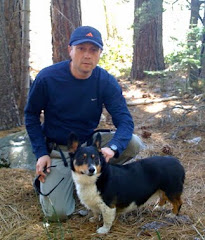
| David Blixt, performing |
 It
was going to be a short book, romantic and sad, just to get the idea out of my
system. So I started to do a little research, mostly about Verona – the
history, the culture. I discovered some facts. At the time the tale of the
star-cross’d lovers supposedly took place, a few interesting people were in
Verona. Dante, the father of Renaissance literature. Giotto, the father of
Renaissance painting. Petrarch, the poet who technically started the
Renaissance by finding Cicero’s letters. So in a very real sense, the
Renaissance began in Verona at the start of the fourteenth century.
It
was going to be a short book, romantic and sad, just to get the idea out of my
system. So I started to do a little research, mostly about Verona – the
history, the culture. I discovered some facts. At the time the tale of the
star-cross’d lovers supposedly took place, a few interesting people were in
Verona. Dante, the father of Renaissance literature. Giotto, the father of
Renaissance painting. Petrarch, the poet who technically started the
Renaissance by finding Cicero’s letters. So in a very real sense, the
Renaissance began in Verona at the start of the fourteenth century. Suddenly
the feud became a mere backdrop to a larger tale, revolving around this
incredible man. Because he reminded me of someone, a rogue I’d fallen in love
with the first time I played him. A character I’ve been asked to perform more
times than any other. In the play, it’s said that Mercutio is both a cousin to
the Prince, and ‘the Prince’s near ally.’ The Prince in the play is named
Escaulus, the Latin version of della Scala.Cangrande
was related to Mercutio.
Suddenly
the feud became a mere backdrop to a larger tale, revolving around this
incredible man. Because he reminded me of someone, a rogue I’d fallen in love
with the first time I played him. A character I’ve been asked to perform more
times than any other. In the play, it’s said that Mercutio is both a cousin to
the Prince, and ‘the Prince’s near ally.’ The Prince in the play is named
Escaulus, the Latin version of della Scala.Cangrande
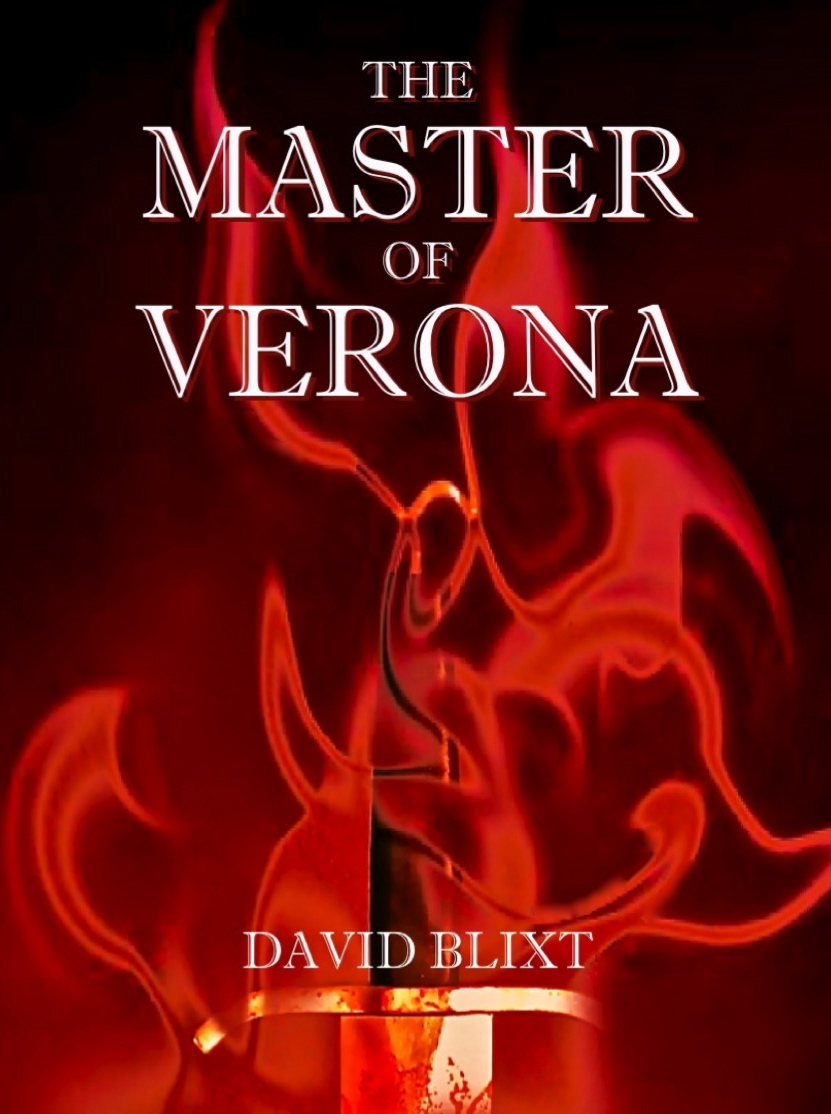
was related to Mercutio. I'm delighted to welcome back my friend and historical novelist extraordinaire, David Blixt. A few years ago, David published the gorgeously inventive MASTER OF VERONA, set in Renaissance Verona and exploring the historical origins of the Romeo and Juliet legend. Master of Verona captured many readers' hearts and had us all salivating for the next book in the series. At long last, David has released the sequels, VOICE OF THE FALCONER and FORTUNE'S FOOL, as well as the first novel in his new series set in ancient Rome - COLOSSUS - and a delightfully witty and suspenseful Elizabethan thriller, HER MAJESTY'S WILL. I'll be hosting David here for a few days, so please help me give him a warm welcome!
 In THE MASTER OF VERONA, the title ‘Count’ is reserved for
my villain, the historical Count of San Bonifacio. But if I were to mention the
Count to my wife, she would respond with a smile and a joke about pouring
coffee. She tells this story so much better than I do. So, without further ado,
Jan Blixt telling the story of ‘Coffee With The Count.’
In THE MASTER OF VERONA, the title ‘Count’ is reserved for
my villain, the historical Count of San Bonifacio. But if I were to mention the
Count to my wife, she would respond with a smile and a joke about pouring
coffee. She tells this story so much better than I do. So, without further ado,
Jan Blixt telling the story of ‘Coffee With The Count.’ The next morning we took a cab from our hotel to the address
we had been given, many miles outside of the city, down winding country
roads. The cabbie stopped the car next
to a rather nondescript 15 foot high stone wall. In garbled Itanglish, we asked “Is this
it?” He nodded and pointed at the wall. As
the cab drove away, David noticed that there were some buzzer buttons placed
high on the wall – the kind you find at the front door of many Chicago 3-flats,
little white buttons with little white nametags made on a labeling machine next
to them. They said things like ‘Vineyard
Business Office’ and ‘First Floor Office’ – in Italian, of course. One said
‘Count Serego-Alighieri.’ Giggling like five-year-olds, we pressed that button.
After a moment, a low voice came over a small speaker, "Si?"
The next morning we took a cab from our hotel to the address
we had been given, many miles outside of the city, down winding country
roads. The cabbie stopped the car next
to a rather nondescript 15 foot high stone wall. In garbled Itanglish, we asked “Is this
it?” He nodded and pointed at the wall. As
the cab drove away, David noticed that there were some buzzer buttons placed
high on the wall – the kind you find at the front door of many Chicago 3-flats,
little white buttons with little white nametags made on a labeling machine next
to them. They said things like ‘Vineyard
Business Office’ and ‘First Floor Office’ – in Italian, of course. One said
‘Count Serego-Alighieri.’ Giggling like five-year-olds, we pressed that button.
After a moment, a low voice came over a small speaker, "Si?" The Count lead us into a large paved in stones courtyard
framed by the vineyard building we had just left, a large square barn-like building,
a long, two-storied stone building, and the house.The house! A lovely Italian
stone house that looked both fresh and inviting and also as if it had been
there forever, carved out of the countryside. It had large double doors in the
center of the first floor that led us into a two-storied entryway. The marble
floor was polished to an almost mirror-like sheen, the center of the floor
containing an inlaid heraldic crest. David and I skirted the crest, trying to
study it and the rest of the room surreptitiously while following the Count. He
noticed our appraisal of the floor and said, “That was updated in the 1470s
when the Serego family married the Alighieri.
It was originally just the Alighieri symbol – now it is much more.”
The Count lead us into a large paved in stones courtyard
framed by the vineyard building we had just left, a large square barn-like building,
a long, two-storied stone building, and the house.The house! A lovely Italian
stone house that looked both fresh and inviting and also as if it had been
there forever, carved out of the countryside. It had large double doors in the
center of the first floor that led us into a two-storied entryway. The marble
floor was polished to an almost mirror-like sheen, the center of the floor
containing an inlaid heraldic crest. David and I skirted the crest, trying to
study it and the rest of the room surreptitiously while following the Count. He
noticed our appraisal of the floor and said, “That was updated in the 1470s
when the Serego family married the Alighieri.
It was originally just the Alighieri symbol – now it is much more.”
 I, Iago has two
parts: the first is a prequel to Othello;
the second is a retelling of the play. The prequel was tremendous fun. The play
is loaded with references to things that happened before the curtain goes up,
and reconstructing them into a coherent story line felt almost like losing
myself in a mystery novel.
I, Iago has two
parts: the first is a prequel to Othello;
the second is a retelling of the play. The prequel was tremendous fun. The play
is loaded with references to things that happened before the curtain goes up,
and reconstructing them into a coherent story line felt almost like losing
myself in a mystery novel.  Othello is both a
deeply psychological story (which makes it easy material for a novel
adaptation) and a highly theatrical one (which makes it difficult).The story is set in the 1500s in Venice and Cyprus. General
Othello, leader of the Venetian army, is duped by his ensign Iago into
believing that Othello’s bride, Desdemona, has slept with his lieutenant,
Cassio. Iago does this to punish Othello; he is furious at Othello for passing
him over for promotion. The position went instead to Cassio, which is why
Cassio becomes his pawn. (Why is Desdemona made a pawn as well? Different
actors have different interpretations.) Delighting in his ability to manipulate
others, Iago keeps up his deceit even after Cassio is demoted and he himself is
elevated. He gratuitously continues his mischief until (spoiler alert) everyone
is either dead or wounded.
Othello is both a
deeply psychological story (which makes it easy material for a novel
adaptation) and a highly theatrical one (which makes it difficult).The story is set in the 1500s in Venice and Cyprus. General
Othello, leader of the Venetian army, is duped by his ensign Iago into
believing that Othello’s bride, Desdemona, has slept with his lieutenant,
Cassio. Iago does this to punish Othello; he is furious at Othello for passing
him over for promotion. The position went instead to Cassio, which is why
Cassio becomes his pawn. (Why is Desdemona made a pawn as well? Different
actors have different interpretations.) Delighting in his ability to manipulate
others, Iago keeps up his deceit even after Cassio is demoted and he himself is
elevated. He gratuitously continues his mischief until (spoiler alert) everyone
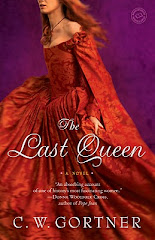
is either dead or wounded.Kate Quinn: I have Catherine de' Medici to thank for introducing me to C.W. Gortner. I w as reading his novel Confessions of Catherine de'Medici and by the time a certain scene came along (I won't spoil it for you by saying which one) I was reading through gapped fingers, clapped against my face. Even as I was squealing, “Oh, no!” I was thinking: Here is an author with real imagination. I was delighted later to be a guest blogger here on Historical Boys, where Christopher and I discussed a fascination for women in power – and I was even more delighted to meet him in person at the Historical Novel Society Conference. He's since become a friend.
C.W. Gortner: I've always loved historical fiction set in ancient times and discovered Kate when her publicist sent me a copy of Daughters of Rome. I was hooked from page one and immediately bought Mistress of Rome, which I also promptly devoured. I loved the wit and modernity of the language; she made ancient Rome feel sexy and contemporary. Plus, I laughed out loud a couple times - always a good sign for me. Kate has a way of combining the travertine glamor of the age with a stiletto-heel imagination and I was delighted when we finally met at the HNS Conference in San Diego. Lo and behold, she was wearing . . . yes, red leather stiletto heels. How's that for serendipity?
KQ: We'd already arranged for me to come do an author Q&A on Historical Boys when my latest book “Empress of the Seven Hills” came out. But it occurred to me that we should just post one of our conversations instead – one of the conversations where we zing questions back and forth. Shall we say three questions each?
CWG: Sure, go ahead.
KQ: Okay, off to the races – I know how I got into this racket: Sally Watson's early YA historical fiction novels had me vowing to be a Royalist spy for King Charles, and Pauline Gedge's The Eagle and the Raven had me swearing bloody vengeance on the Romans who defeated Boudicca. Throw in a precocious viewing of “I, Claudius” and that old Elizabeth R series with Glenda Jackson as young Princess Elizabeth sitting down on the steps of the Tower of London and telling her jailers she wouldn't go one step further – after that I was pretty well sunk, obsessed with history and writing short stories about the murder of King Edward II, among other completely age-inappropriate topics. How about you? What books, movies, or other influences drew you into historical fiction?
CWG: Growing up in Spain. There was history all around me: ruined castles and cathedrals and statues. Oh, and repeat viewings of "Henry VIII and His Six Wives" and the aforementioned "Elizabeth R" certainly helped. When I was growing up, there were only 3 television channels in Spain, so I saw those a lot. I also had this very prim schoolteacher who caught me one day outside in the blazing sunshine during lunch break, huddled in a corner while children played all around me, my nose deep inside a battered copy of Murder Most Royal by Jean Plaidy, a birthday gift from my mom. She asked me if I liked history. Well, it was like me asking if I like tapas! She then introduced me to more Plaidy, plus tons of non-fiction. It became my obsession. I especially found myself drawn to the Renaissance; it felt so familiar to me. If I believed in reincarnation, I'd say I had a life in the 16th century (I was probably some miserable carter who collected night soil or something equally unappetizing!) I also fell in love with ancient Egypt and Rome. I'd like to write a book set in ancient times one day. Are there eras you find yourself particularly drawn to? Any you wouldn't touch with a ten-foot pole?
KQ: I love the Tudors, but I'm not sure I have anything new and different to contribute to their saga – not unless I can find a really original angle and narrator, as you did with The Tudor Secret. I've always been drawn to ancient Rome, ever since watching the original Spartacus and getting an enormous crush on Kirk Douglas. The lesser-known emperors are especially fascinating to me; there isn't nearly as much written about the Flavian and Antonine dynasties as opposed to the early Claudian emperors or the end of the Republic, and yet it's a period just packed with larger-than-life personalities. I'm also infatuated with the Italian Renaissance; everything is so wonderfully picturesque with the booming art and cultural advances juxtaposed against the violent politics, and all of it splashed against those beautiful Italian landscapes as a backdrop. And someday I'd love to do a series set in the Hundred Years War, though it might get depressing hanging out there for three or four books in a row. That's a lot of dirt, plague, and civil war, and most HF writers these days tend to stick with an era they love for at least a few books. Now, you have an interesting platform: Bad Girls Throughout History. How did that come about, and how's it working for you?
CWG: It first came about when I started asking my school teacher questions like: "Did Anne Boleyn really have six fingers?" or "Did Isabella of Spain really burn people?" or my favorite, "Why does everyone think Juana of Castile went crazy for love?" That's my  favorite because we'd just taken a school trip to Granada and visited her tomb. When I saw her effigy beside that of her allegedly I'll-love-you-to-death Philip, she looked decidedly upset that she had to share a tomb with him. That set me to wondering, What if history lies? I mean, these women aren't around to tell us their sides of the story. What if it didn't happen exactly the way history tell us? The bad girls of history got a raw deal, especially as history became popularized under the Victorians. As I studied history in my high school and college years, I realized that overt sexuality, the seizing and exercising of power, and generalized acting out: these made a bad girl in history. But these were also the very qualities I most admired in the women of my family, all of whom have strong personalities. I love the idea that behind each historical bad girl lies an untold story. As for how it's working for me, great so far. I love being able to do what I always dreamed of, write historical fiction. One drawback I do see is that the current focus on popular marquee names, like Elizabeth I, constrains the exploration of less familiar characters. History is full of bad girls, but not all are necessarily known to readers. Do you agree? What is about flawed characters that makes them more interesting than conventional ones?
KQ: That was a problem I wrestled with in writing Empress of the Seven Hills. A major character is Emperor Trajan's adopted son Hadrian, a historical figure who is now counted a great man: a world traveler, an intellectual, an artist, a visionary. But the more I read about him, the more I drew the conclusion that this great man was, in person, a spiteful snobbish drone with a habit of cutting his friends loose once they were no longer useful to him. I scratched my head over that conundrum, but ended up putting him into the book warts and all – and I think I got a more interesting story out of it. Real people aren't black and white, after all; they're many different shades of gray. And no matter how legendary or famous the historical figures we put into our books, they were still very much real people. You've certainly had to deal with some controversial ladies in Catherine de Medici and Isabella of Castile.
CWG: Indeed, but I think controversy is not a bad thing. It makes for a more interesting character and can highlight the complexities we all carry within.
KQ: Not to mention the fact that complex characters are so much more cinematic! Speaking of cinematic, I sometimes get asked if any of my books will ever be made into movies, and I have to say probably not – it doesn't cost me anything as a writer to plop my bejeweled heroine down in a Dacian rebellion complete with three armored legions assaulting a walled city, but that scene (from Empress of the Seven Hills) would be prohibitively expensive for any Hollywood production. And that's before the triumphal parade with the chariots, the temples, and the 200,000 screaming costumed extras. Still, I indulge myself in the occasional idle daydream: “HBO announces star-studded miniseries `Empress of the Seven Hills,' directed by Ridley Scott and starring Emma Watson (she'd be perfect for my heroine Sabina; poised and intelligent and a bit mysterious) and Wentworth Miller (who would be terrific as the charming but morally ambiguous Hadrian.)” So if the dream came true for you, Christopher, and HBO picked up one of your books and gave it the George R.R. Martin “Game of Thrones” treatment, which book would you pick? Who would play your Catherine or Juana or Isabella?
CWG: I'd love any of my books to be optioned, of course, but I think Catherine de Medici's story in particular has the requisite mix of sex, violence, intrigue, betrayal, not to mention killer costumes, that just screams for Showtime or HBO. I don't often indulge in this particular fantasy, but if I did get offered an adaptation and if they did let me cast it (the former is already a long-shot, the latter an impossibility), I'd cast Minnie Driver to play Catherine de Medici. I think she'd knock the role  out of the park, and I see either Michelle Pfieffer or Kristen Scott-Thomas as Diane de Poitiers. Sometimes, I get e-mails from readers who tell me they see so-and-so actress playing Catherine or Juana, and their choices surprise me. I like that, though; I like it that each reader has her or his own visual interpretation of the character. It probably explains why historical fiction covers often feature eye-less or brow-less women in fancy dress. To see a face can destroy the illusion. Speaking of readers, do you ever find yourself being influenced by the reactions of your readers to a book, or a character?
KQ: I love subverting reader expectations! “Can I create a very violent hero, a man who at one point beats up his young son and at another point is forced to kill women to survive, and still have the reader root for him?” (That hero turned up in Mistress of Rome.) “Can I make readers sympathize with a doting grandpa even though he keeps marrying his granddaughter off to some very unsavory people?” (That character had a role in Daughters of Rome.) “Can I have a heroine who ruthlessly manipulates the people around her, even the man she loves, to get the life she wants – and still have the readers root for her?” (My Empress of the Seven Hills heroine.) If I can subvert the literary conventions of good behavior in my characters and yet still have my readers root for them, then I feel I've won. Harder sometimes is when I find myself tackling themes or issues in my books that are still sensitive today. In Empress of the Seven Hills, for example, I have an unashamedly homosexual Roman military leader; a violent ethnic cleanse of the Jewish population; and a great many imperialists who see no problem razing a rebellious next-door neighbor into total submission for the glory of Rome. Gays in the military; antisemitism; arrogant foreign policy on the world stage – these are all hot-button topics today, and I imagine I will offend some people.
CWG: If a reader feels the need to write to me, good or bad, I guess that means my book touched something in them. Based on the few initial reactions I've gotten from outside readers so far, evidently my portrayal of Isabella of Castile in The Queen's Vow will elicit strong reactions and that's great. The whole point of historical fiction is to put flesh and bone on these characters, to develop them emotionally, without distorting the known facts. Isabella was a complex woman, extraordinary for her time as well as a product of her time; it's quite interesting that she's often reduced to a stereotype, as, for example, 'religious fanatic', when in reality she was, as we all are, subject to complicated and even contradictory variances in her personality, depending on the issue she was confronting. Again, it all goes back to the inconsistency of human nature. In addition, I find it quite difficult to judge and interpret people who lived hundreds of years ago by today's standards. We tend to forget that even the most lauded heroes and heroines of the past had their dark sides, and that cruelty toward animals and human beings, rigid religious doctrine, intolerance, violence and abuse, etc. were pervasive. We think that life in, say, the 16th century, is all velvet and silver chalices and sexy people in fitted hose, because that's what we are fed by modern-day depictions of it, but in reality the past was violent and frightening. Most of those who survived its vicissitudes to make a name for themselves so that we remember them today all did things that are, by our standards, appalling. Even the much-glorified Elizabeth I acted with utter ruthlessness when it came to those she considered her foes. The black and white of history, as I call it, helps us relate to the past, but it's not entirely accurate.
KQ: I think there's a tendency to whitewash our historical figures when they make us feel uncomfortable. Heroes must be noble figures on white steeds, all their sins swept up under the rug; villains must wear black hats and cackle evilly, their good deeds forgotten in favor of their bad. But the feet of clay make a heroic figure so much more interesting and three-dimensional, and a villain's virtues give him layers of sympathy. Stripping off the whitewash or black paint on a hunt to find the real person underneath – to me, that's one of the best parts of writing historical fiction. What's the best part for you? And what do you think is the hardest or most challenging?
CWG: The best part by far, for me, is being able to slip into another time and discover both the unique differences and similarities to our own era. In the end, people of the past are still human beings; it's the thread that unites past with present, and makes historical fiction so exciting. I always find it amazing that despite how much the world has changed, so much remains the same. The most challenging part for me, however, is to accurately portray my characters without judgment. They are not me. They did not see the world as I do. I can never assume that Isabella of Castile, Catherine de Medici, or Juana saw their lives and circumstances in the same context as I see mine. These women were shaped, for better and for worse, by their particular era and the realities they faced. Whether I approve of them or not is besides the point; what I must do as a writer is understand them. Because if I don't know what makes them tick, neither will my reader.
KQ: I think you've put your finger on the eternal dilemma of any historical fiction novelist: how to portray a person who is true to the morals and standards of their time, not ours – yet also bring home the fact that these people are still people, and thus subject to the same desires and hopes that drive us all, no matter where or when we are born. Love, friendship, ambition, revenge, hope – some human emotions are so universal that they drive us all, from Isabella of Castile and Emperor Trajan of the Roman Empire, to the readers devouring books about them in the 21st century. And isn't that why modern readers remain fascinated with historical fiction? To get a glimpse of such different worlds, which are still so very relatable.
Christopher, thanks for having me as always. Best of success with THE QUEEN'S VOW.
CW: Likewise, Kate. Best of success with EMPRESS OF THE SEVEN HILLS!
 Readers can visit Kate at her website. To visit me, go here.
THE LADY OF THE RIVERS. Philippa Gregory
Philippa Gregory’s third entry in her Cousins’ Wars series features an unusual character: Jacquetta Woodville, mother of Elizabeth, who in turn gave birth to the princes who disappeared mysteriously in the Tower. In THE LADY OF THE RIVERS, Ms Gregory travels further back in time, bringing us a glimpse of the seeds of the epic conflict that will be known as the War of the Roses. French-born Jacquetta first weds an older duke more interested in her supernatural gifts than her physical ones; upon his death, she defies convention to find love with his squire, whose loyalty to the crown  brings them heavy responsibilities. Through Jacquetta’s eyes, we’re given a wide-angle view of the lethal intrigues that plague the English court, where a young, weakling king is manipulated by his nobles, and accusations of witchcraft are wielded to destroy opponents. The end of the Hundred Years’ War, when England lost its territories in France, offers a compelling backdrop to Jacquetta’s personal trials as she endures repeated separations from her husband and witnesses the depredations of power-hungry courtiers. When her fortunes increase with the arrival of Margaret of Anjou, a princess brought to wed the king, the novel becomes more intimate, as well. Margaret is a compelling character who steals the show— not yet the Lancastrian virago of legend, Gregory depicts her as a brash, beautiful girl tethered to a man better suited to prayer than bed play; Margaret’s vulnerability and fallible relationship with Jacquetta bring humanity to the crowded historical events. Jacquetta’s magical gifts are underplayed except for one crucial episode; and her astounding fertility and perennial passion for her husband, as well as her keen insight, center her as a voice of reason in a complex, treacherous era.
ALL THE KING’S COOKS: THE TUDOR KITCHENS OF HENRY VIII AT HAMPTON COURT. Peter Brears
From the storage of game without modern refrigeration to the extraordinary size of the staff required to cater a banquet, Peter Brears’ All The King’s Cooks offers a fascinating, detailed account  of how the massive kitchens built at Hampton Court were operated. This deceptively slim book goes beyond a mere accounting of pots and pans. Interspersing recipes from the era with commentary on social mores and table etiquette, along with a thorough examination of how the system contended with the daily demands placed on it, Mr. Brears has created an intelligent yet accessible look into a rarely explored part of the Tudor world. The kitchens at Hampton Court are marvelous to visit; the book fleshes out the displays for tourists with the grease and grit of the machinery that propelled these kitchens to become one of the most efficient in the realm. Numerous illustrations help visualize a part of the palace that remained hidden from most courtiers’ eyes. Mr. Brears has himself re-enacted cooking at Hampton Court and his hands-on knowledge makes his book a must-have for Tudor aficionados.