Pages

Showing posts with label new books. Show all posts

Monday, June 16, 2014

Random Reviews: SAVAGE GIRL


Jean Zimmerman. SAVAGE GIRL.

The premise of Jean Zimmerman's Savage Girl is gripping: What would happen if a wealthy couple with everything they could possibly imagine came across a so-called "feral child" in a tawdry Nevada sideshow and decides to bring her back to New York and convert her into a society belle? With shades of Pygmalion crossed with the darker hue of Edith Wharton, Savage Girl posits this theory and adds another layer: What if all the men who show an erotic interest in the girl start to turn up dead and the disturbed son of the wealthy couple begins to suspect she may be a brutal killer, even as he sees disturbing signs within himself that he might be to blame?

There is no question that Ms Zimmerman is a masterful writer; her prose is beautiful and she brilliantly captures the unreliable voice of the couple's son, Hugo Delegate, who narrates the story. Hugo is both repelled and fascinated by Bronwyn, the "savage girl," whose past is slowly revealed as Hugo's suspicions and attraction to her deepen. The world of Gilded Age New York also comes to vivid, detailed life; we feel the hypocrisy and emphasis on lineage and social position as the curiosity-obsessed Delegates seek to put one over on their peers by turning Bronwyn into something she is not. Bronwyn fascinates in her contradictions - alluring yet remote, with a tendency to slip out after-hours to roam the streets, wearing a glove fitted with claws. However, her distance from the narrative voice and Hugo's preoccupation with a variety of other concerns dampen the plot's thrust, as he's distracted both by his own torment and his family's foibles. At times, there simply is too much story in this heady brew, diluting the lethal mystery at its heart.

Nevertheless, the experience of reading it turns compulsive, as the underside of the Gilded Age is torn asunder by the introduction of the wild within us all - a metaphor for how we seek to curb our baser instincts, forcing our repressions to find other, more unsavory ways to erupt. Hugo's confession turns chilling as we realize how far his family has gone and the terrible price exacted of them, while Bronwyn's own secrets lead to an excellent denouement. In the end, we find ourselves questioning: Who is truly the savage here?

Saturday, August 10, 2013

Guest post and Giveaway from Elizabeth Fremantle, author of QUEEN'S GAMBIT

I'm delighted to welcome Elizabeth Fremantle, author of QUEEN'S GAMBIT, a sumptuous account of the life of Katherine Parr, sixth wife of Henry VIII who survived the murderous king and went on to endure an ill-fated marriage to Thomas Seymour.

In Queen's Gambit, Kate Parr's story is entwined with that of Dorothy, or Dot, her maidservant, as well as several supporting characters, all of whom are complex and depicted as people whose very existence within the treacherous politics of court dictate both their behavior and their survival. Kate's voice is compelling; a widow with a secret, she attracts the unwanted affections of the ailing king and must sacrifice her magnetic attraction to gorgeous Seymour in order to be queen, only to find herself plunged into an increasingly desperate gambit that requires all her courage and perseverance. Her transformation into a crusader for the Reformed Faith at a time when Henry himself frowns upon it, having retreated into the solace of his Catholicism despite his break with Rome, pits the queen against enemies eager to see her fall. Witnessing her mistress's struggles while contending with her own, is Dot, who emerges as the novel's most engaging character, her wit and keen perspective on her role in the scheme of life at court lending her a unique voice that makes us truly care about what happens to her. Dot, in fact, ends up carrying the story, as Kate Parr becomes mired in her battles and unmitigated desire for Seymour. An adolescent Princess Elizabeth also makes several appearances, stealing the show, as usual, with her self-absorbed antics. I especially liked a scene when Dot overhears Elizabeth conversing rather carelessly with a bewildered Jane Grey.

Tudor aficionados and those who love historical fiction will thoroughly enjoy Queen's Gambit; the inevitable comparisons to Hilary Mantel's work aside, this is by far a more accessible account of the Tudor court, written by an author who's mastered her craft and has deep respect for her subject matter.

GIVEAWAY: Simon & Schuster is kindly offering one free copy of Queen's Gambit. To enter the giveaway contest, please add your comment below this post. Thanks and good luck!

Now, please join me in welcoming Elizabeth Fremantle.

Why Katherine Parr?
I am often asked why I chose to write about Katherine Parr and it is true she seems one of the less interesting when compared to her more glamorous predecessors. But scratch the surface of her story and a dynamic, charismatic woman emerges. She may not have been born a princess to make a great alliance, nor did her life come to a truly dramatic climax with execution, but she was a highly intelligent well-loved woman and an astute political operator who understood how to play the game of power in a dissembling court, using her position to support religious reform at great personal cost. This is a woman who managed to out-fox her powerful adversaries and survive a plot on her life. She was an author too, publishing two books at a time when to publish at best risked ridicule and at worst might seriously compromise a woman’s virtue. She was clever enough to wait until after Henry’s death to publish her second book, a highly political and unashamedly reformist tome. She might not have become known as the wife who ‘survived’ had she not had the sense to wait.

There is much to admire about Katherine Parr’s dynamism, intellect and ability to survive as well as the fact that she was married no less than four times.  But one of the things that most appealed to me about her story was that she was also flawed. She made a disastrous decision in the name of misguided romance with devastating consequences, and it is this picture of a truly accomplished woman becoming a fool for love that fascinated me. The contradiction in her character makes her, for me, so very human and relatable to us today. Who doesn’t know of a clever woman who has fallen foul of romance?

Author photo: Paola Pieroni
But my story is not just one of a remarkable queen. I was determined to explore another view of the Tudor court through the character of Dot. Dot, who serves as Katherine’s maid, is largely of my imagination. We know almost nothing about the woman Dorothy Fountain who served as maid to Katherine Parr’s stepdaughter Margaret Neville during her second marriage. We know she remained with the family serving Katherine Parr when she was Queen, that she was left four pounds a year in Margaret’s will and that she married a man named William Savage who might have been a musician.

It is not much to go on and for the purposes of QUEEN’S GAMBIT I have made Dot lower born than she was likely to have been in reality, as I wanted to offer a different perspective on the court – a 'below stairs' view. I was keen to explore the kind of life an ordinary women like Dot might have had in the period. In the novel, she is visited by exceptional circumstances and comes to move in an elevated world, her experience of it is different to those born into the nobility.

Dot gave me the chance to look at loyalty and true friendship between women, allowing me to show Katherine as a woman who was both loyal herself and inspired great loyalty, even in an uneducated young woman well beneath her in the social scale. Literacy and education was something entirely beyond such a woman’s reach and in Dot I wanted to imagine her as having an intellectual curiosity, striving to educate herself against the expectations of her age. As an adjunct to this I touch on the possibilities for social mobility that were beginning to open up (it must be said mostly for men) in the renaissance period.

Through the eyes of these two women whose lives intersect and yet are so different, I hoped to convey something of what it was like to live in the court of history’s most notorious tyrant, Henry VIII.

Thank you, Elizabeth. To find out more about Elizabeth Fremantle and her work, please visit her website.http://www.elizabethfremantle.com/

Wednesday, July 17, 2013

THE TUDOR CONSPIRACY is available!

THE TUDOR CONSPIRACY, the second novel in the Elizabeth I Spymaster Chronicles is out in paperback! Taking place a few months after the events of The Tudor Secret, Brendan Prescott, a spy in Princess Elizabeth's service, returns to court during the reign of Bloody Mary and plunges into London’s treacherous underworld to unravel a dark conspiracy that could make Elizabeth queen—or send her to her death.

I'll be on both a physical and virtual tour, and hope to see you at one of my events. Click on the banner below for all my blog tour stops, which run from July 16 to August 27.

To purchase the book, you can find links to online stores here or better yet, visit your local indie. If they don't have it, they can always order it for you. I'm happy to send signed bookplates, as well. Just write to me via my Contact page on my website with your address.

Thanks for all your support! I hope you enjoy the book.

APPEARANCES:

* July 18. 7 PM. Books, Inc. Berkeley. 
* July 23. 7 PM. Bookshop West Portal, San Francisco. Launch Party for The Tudor Conspiracy. Wine, cheese and cake will be served. Open to everyone! 
* July 25 - 28. Guest Faculty at Book Passage's MysteryWriters Conference, Corte Madera. 
* August 1. 6 PM Mechanic's Institute Library, San Francisco. Season finale event. Flamenco music and dancing; tapas and Spanish wine will be served. 
* August 7. 7 PM. A Great Good Place for Books. Oakland
 * September 21. 1 PM. Orinda Books


Wednesday, July 3, 2013

Guest post by Nicole Galland, author of GODIVA


I'm delighted to welcome back Nicole Galland (author of I, Iago and The Fool's Tale; among others), whose latest novel GODIVA offers us a fascinating, unique look at the infamous nude rider. According to legend, Lady Godiva lifted the unfair taxation of her people by her husband, Leofric, Earl of Mercia, by riding through the streets of Coventry wearing only a smile. It's a story that has endured for nearly a thousand years. But what would drive a lady of the court to take off everything and risk her reputation, her wardrobe, even her life—all for a few peasants' pennies? In this daringly original, charmingly twisted take on an oft-imagined tale, Nicole exposes a provocative view of Countess Godiva and her ride into infamy, turning the legend into an unexpected adventure of romance, deceit, and intrigue.

Please join me in welcoming Nicole Galland.

Godiva: The Naked Truth

 When I first encountered Godiva, the countess of Mercia, I thought she should merely play a cameo in a novel I was already working on. But I diligently research even my minor characters, and when I submerged myself in Godivation, I realized she deserved her own novel.
Nicole Galland

I was captivated by the discrepancy between real history and the “Godiva legend.” Briefly, the latter goes like this: Earl Leofric of Mercia mercilessly taxed the people of Coventry, ignoring his wife’s pleas to give them tax relief – until he declared if she rode naked through the streets of Coventry, he would lighten the tax. Astonished, she did it, and Leofric, indeed, lowered the tax.

Besides the obvious dozen question this anecdote raises (why would an earl encourage his wife to do something so random? and so humiliating? and then reward her for it? to his own detriment?)… this story, upon examination, falls apart for a simple fact in British history: Godiva owned Coventry, and under Anglo-Saxon law, she was the only person who could tax it. Under Norman rule, when the story was first written down nearly 200 years later, then yes, the Coventrians would have been taxed by Leofric. But before the Norman Invasion, things didn’t work like that.

Maybe this means Godiva never made the ride at all. But why would such a specific, well-developed (and bizarre) story – filled with everything from domestic sarcasm to Christian piety –  spontaneously pop into being so many decades after the fact? As with most legends, it may have been based on something that really happened, but which over time was skewed and misinterpreted so that it became a tale tailored to a particular audience.

So I decided to do the same. With history to bolster my own take on the legend – namely the existence of the heregeld, a detested national tax that was used solely to fund the king’s private military – I decided to tell the story so that it would speak to a modern audience, in an age of military strife, tax dissension and arguments about the role of government… but also an age of strong, liberated women who are celebrated, not punished, for demonstrating they are forces to be reckoned with. I’ve enjoyed the double challenging of bringing Godiva into the 21st century while rooting her accurately (at last) in the 11th. She’s leapt the millennium surprisingly well – without even using a saddle.

Friday, May 24, 2013

Exclusive Excerpt from THE CORPSE READER by Antonio Garrido

I’m delighted to offer an exclusive excerpt from an upcoming historical novel out May 28. THE CORPSE READER by Antonio Garrido is inspired by Song Cí, who was considered to be the founding father of CSI-style forensic science in thirteenth-century China. This historical thriller is drawing comparisons to The Hangman's Daughter for its absorbing details of another time and received the Zaragoza International Prize for best historical novel published in Spain in 2012.


In ancient China during the Song Dynasty only a select few ever reach the coveted title of "corpse reader," a forensic elite force which, even at the risk of their own lives, has a mandate that no death go unsolved and no crime go unpunished.  Cí Song is the first of those elite few.  Envied for his pioneering methods, and persecuted by his peers, he arouses the curiosity of the emperor himself, who assigns Ci to track a series of heinous crimes that threaten to destroy the imperial court.  But as Ci delves deeper into the mysterious deaths, there are those who will do anything to silence him—forever.

Excerpted from THE CORPSE READER by Antonio Garrido
Copyright 2013. Published By AmazonCrossing.
*************************************************************************
Cí got up early that morning to avoid running into his brother Lu. He could barely pry his eyes open, but he knew that, like every morning, the paddy field would be awake and waiting.
He got up and began putting away his bedding, smelling the tea his mother was brewing in the main room. He entered the room and greeted her with a nod. She replied with a half-hidden smile that he noticed nonetheless, and he smiled in return.
He adored his mother almost as much as he did his little sister, whose name was Third. His other sisters, First and Second, had died very young from a genetic disease. Third was the only one who had managed to survive, though she remained sickly.
Before breakfast, he went over to the small altar the family had erected in memory of his grandfather. He opened the wooden shutters and inhaled deeply. Outside, the first rays of sun were filtering delicately through the fog. The breeze moved through the chrysanthemums in the offering jar and stirred the spirals of incense rising in the room. Cí closed his eyes to recite a prayer, but the only thought that came into his mind was this: Heavenly spirits, allow us to return to Lin’an.

He cast his mind back to when his grandparents were still alive. This backwater had been paradise to him then, and to his brother Lu, who was four years his elder, his hero. Any child would have worshipped Lu. Lu was like the great soldier in their father’s stories, always coming to Cí’s rescue when other children tried to steal his fruit rations, always there to deal with shameless men who tried to flirt with his sisters. Lu had even shown him how to win a fight using certain kicks and punches. He’d taken him down to the river to splash around among the boats and to fish for carp and trout, which they’d then carry home in jubilation. He had also shown Cí the best hiding places from which to spy on their neighbors.
As Lu got older, though, he became vain. At fifteen, he was stronger than ever, as well as boastful, and was unimpressed with anything other than a good right hook. Lu began organizing cat hunts so he could show off in front of the girls. He’d get drunk on stolen rice liquor and crow about how he was the strongest in the gang. He became so arrogant that even when girls were making fun of him he thought they just wanted his attention. Eventually, all the girls began avoiding Lu, and Cí gradually became indifferent to his former idol, too.

In spite of everything, Lu had generally managed to steer clear of any serious trouble, apart from the occasional black eye from fighting or from riding the community buffalo in the water races. But when their father announced his intention to move to the capital city of Lin’an, Lu, who was sixteen at the time, refused to go. Lu didn’t want to move to any city; he was happy in the countryside. In his eyes, the small village had everything: the paddy field, his braggart group of friends, even a few local prostitutes for his amusement. Although his father threatened to disown him, Lu refused to back down. So that year the family split up: Lu stayed in the village and the rest of them moved to the capital, in search of a better future.
Cí had found it difficult adjusting to Lin’an life, though he had a routine. He was up every morning with the sun to check on his sister. He’d make her breakfast and look after her until their mother came back from the market. Having wolfed down his bowl of rice, he’d go to classes until midday, and after that he would run all the way to the slaughterhouse to help his father in his job clearing away carcasses. In the evening, after cleaning the kitchen and praying to his ancestors, he studied the Confucian treatises for recitation in class the next morning. Month after month this was his life. But one day, everything changed. His father left the slaughterhouse and got a job as an accountant for the prefecture of Lin’an under Judge Feng, one of the wisest magistrates in the capital.

Antonio Garrido
Life improved rapidly. The salary his father was now earning meant that Cí, too, could give up the slaughterhouse and dedicate himself to his studies. Thanks to excellent grades, after four years in school Cí was given a junior position in Judge Feng’s department. To begin with, he was given straightforward administrative tasks, but his dedication and attention to detail set him apart, and the judge himself decided to take the now seventeen-year-old under his wing.

Cí showed himself worthy of Judge Feng’s confidence. After just a few months he began assisting in taking statements, interviewing suspects, and preparing and cleaning the corpses of anybody who died under suspicious circumstances. It wasn’t long before his meticulousness, combined with his obvious talents, made him a key employee, and the judge gave him more responsibility. Cí ended up helping with criminal investigations and legal disputes, and thus learned both the fundamentals of law and the basics of anatomy.
Cí also attended university part time, and in his second year Judge Feng encouraged him to take a preparatory course in medicine. According to the judge, the clues to a great many crimes lay hidden in wounds. To solve them you had to develop not a magistrate’s but rather a surgeon’s understanding of trauma. Everything was going well until, one night, Cí’s grandfather suddenly fell ill and died. After the funeral, as was dictated by Chinese custom, his father was obliged to give up his job as well as the house they had been living in, since the owner, Cí’s grandfather, was dead. Without a home or work, the family had to return to the village, the last thing Cí wanted to do.


They came back to a very different Lu. He had built a house on a plot of land he’d acquired, and he was the boss of a small crew of laborers. When his father came knocking at his door, the first thing Lu did, before he would allow him to cross the threshold, was make him get down on his knees and apologize. He made their father sleep in one of the tiny bedrooms, rather than give up his own, and treated Cí with the same disinterest. Soon after, when Lu realized his younger brother no longer worshipped him and cared only for books, Cí became the target of all Lu’s anger. A man showed his true value out in the fields, Lu maintained. That was where your daily rice came from, not from books, not from studying. In Lu’s eyes, his younger brother was a twenty-year-old good-for-nothing, just one more mouth to feed. Cí’s life became little more than a series of criticisms, and he quickly came to hate the village…

A gust of wind brought Cí back to the present.
Going back into the main room, he ran into Lu, who was at the table beside their mother, slurping his tea. Seeing Cí, he spat on the floor and banged his cup down on the table. Without waiting for their father to wake up, he grabbed his bundle of work things and headed out.
“No manners,” muttered Cí, taking a cloth and wiping up the tea his brother had just spilled.
“And you should learn some respect,” said his mother. “We’re living in his home, after all. The strong home—”
“I know, I know. ‘The strong home supports a brave father, prudent mother, obedient son, and obliging brother.’” He didn’t need to be reminded of the saying. Lu was quite fond of it.
Cí laid the table with the bamboo place mats and bowls; this was supposed to be Third’s job, but recently her chest illness had been getting worse. Cí didn’t mind filling in for her. According to ritual, he lined up the bowls, making sure there was an even number of them, and he turned the teapot so that its spout pointed toward the window. He placed the rice wine, porridge, and carp meatballs in the center of the table. He cast his eyes over the kitchen and the cracked sink all black with carbon. It looked more like a dilapidated forge than a home.
Soon, his father hobbled in. Cí felt a stab of sadness.
How he’s aged.
Cí frowned and tensed his jaw. His father’s health was deteriorating: He moved shakily; his gaze was lowered and his sparse beard looked like some unpicked tapestry. There was barely a shred left of the meticulous official he had been, the man who had bred in Cí such a love of method and perseverance. Cí noticed that his father’s hands, which he used to take such care of, were anemic looking, rough and callused. He imagined his father must miss the time when his hands had to be immaculate—the days he’d spent examining judicial dossiers, doing proper work.
Cí’s father sat at the head of the table, motioning for Cí and his mother to sit as well. Cí went to his place, and his mother took her seat on the side closest to the kitchen. She served the rice wine. Third didn’t join them because of her fever.
“Will you be eating with us this evening, Cí?” his mother asked.
“After all this time, Judge Feng will be delighted to see you again.”
Cí wouldn’t have missed it for anything. He didn’t know why exactly, but his father had decided to curtail the mourning period and return to Lin’an. Cí was hoping Judge Feng would agree to take him back into the department.
“Lu said I have to take the buffalo up to the new plot, and after that I was thinking of stopping in on Cherry, but I’ll be back in time for dinner.”
“Twenty years old and still so naive,” said his father. “That girl has you wrapped around her finger. You’ll get bored of her if you carry on seeing so much of each other.”
“Cherry’s the only good thing about this village,” said Cí, eating his last mouthful of food. “Anyway, you were the ones who arranged the marriage.”
“Take the sweets I made with you,” said his mother.
Cí got up and put the sweets in his bag. Before leaving the house, he went into Third’s quarters, kissed her feverish cheeks, and tucked her hair back. She blinked. Cí took out the sweets and hid them under her blanket.
“Not a word!” he whispered.
She smiled, too weak to say anything.
**************************************************************************
Excerpted from THE CORPSE READER by Antonio Garrido, Copyright 2013. Published By AmazonCrossing.

Wednesday, May 15, 2013

Guest Post and Giveaway from Ben Kane, author of SPARTACUS: REBELLION


It's an honor to welcome back my friend and fellow author Ben Kane, as he celebrates the release of the second book in his dramatic account of Spartacus, the slave who led a massive rebellion and changed history. In SPARTACUS: REBELLION, Spartacus has already done the impossible—escaped from slavery, created a mighty army that has challenged Rome and defeated the armies of three praetors, two consuls, and one proconsul. Now the road home lies before them but danger gathers on the horizon. One of Spartacus's most powerful generals has defected, taking his men with him, and in Rome, an immense force is being gathered against him. Spartacus wants to lead his men over the Alps but others have a different plan. They want to march on Rome and bring the Republic to its knees. Rebellion has become a war to the death.
As with his first installment Spartacus: The Gladiator, Ben has created a pulse-pounding adventure that is rich with detail and characterization. The Daily Express says, "Burly prose highlights the pain, brutality and chaos of ancient combat" and the Historical Novel Reviews says, "Kane succeeds in drawing a convincing picture of how it might have been, which is what a good historical novel should do."

Please join me in welcoming Ben Kane, who offers us this guest post about how he came to write about this iconic figure as well as a giveaway of ONE copy of each of his Spartacus books. This giveaway is open to US and Canada only. To enter, please comment below. A winner will be drawn at random on May 30.


How I Came To Write About Spartacus
Ben Kane

 It’s a funny thing, but the idea for writing about Spartacus came about by chance. In March 2009, I was talking with my agent about ideas for books. I had already set my mind upon a series set during the second (Punic) war between Carthage and Rome, but we were talking about other possibilities as well. I won’t mention them, because I haven’t written the books yet, but Spartacus came up. It sounds naive but in that moment it was as if someone had switched a light bulb on in my head. I had watched the famous Kubrick movie once as a boy, and it had made a great impression on me. (I should add that we didn't have a TV when I was growing up, or I am sure that I would have seen it more than once!) I had had cause to read about Spartacus in the previous few years. As many of you know, Marcus Licinius Crassus was the man who put down Spartacus’ rebellion in 71 BC. He is also a character in my first novel, The Forgotten Legion. That day, the plan for a set of novels about Carthage and Rome won out, but the idea didn't go away.


In early 2010, I started hearing a lot of news about an upcoming TV miniseries called Spartacus: Blood and Sand, starring a then little-known Australian actor called Andy Whitfield*.This set me to thinking about Spartacus’ story all over again. I did some more research on the man, and became even more enamored of his achievements, and amazed by how close he had come to getting away. He was someone who was subjected to a great injustice, and he didn't take it lying down. Instead, he fought back ― in the process shaking the mighty Roman Republic to its core. Although the reasons for Spartacus’ fame have quite modern roots (he was resurrected as a symbol of the small man’s fight against oppression in the 18th and 19th centuries), his name is one of the most well-known from ancient times. Thrilled, I went as far as writing the plotline for a novel and submitting it to my UK publishers. Sadly, but perhaps sensibly, they were keen that I concentrate on my other novels.
 
I went back to work, finishing the novel Hannibal: Enemy of Rome. The itch to write Spartacus became a lot worse over the subsequent months, however, and I kept badgering my publishers. I am pleased to say that eventually, they gave in! I started writing Spartacus’ story in mid-December 2010, and I had it finished by mid-June 2011. The story just burst out of me. At about 100,000 words (the normal length of my novels is about 145,000 words) I knew there was no way this amazing man’s story would fit into one volume. Cap in hand, I went back to my publisher. This time, they were quick to agree to a second book. The first volume immediately became Spartacus: The Gladiator, while I named the second Spartacus: Rebellion. That book also took me little more than 6 months to write. In all, I lived, breathed and dreamed Spartacus for more than a year. It was the most amazing experience, and I was very sad to end the story. I actually dreaded writing the final battle (most everyone knows what happens, but I won’t mention it just in case), but when the time came, the writing flowed so well. Working up to 16 hours a day, I wrote more than 15,000 words in 8 days. By the end, I was totally drained, but it had been a fantastic experience. It is my sincere hope that readers will get as much enjoyment out of reading the books as I did in writing them.

*Andy was a mesmeric actor, who totally made the role of Spartacus his. Tragically, he died before the rest of the series could be made. His role was taken over by the actor Liam McIntyre.

Thank you, Ben! Best of success with the book. To follow Ben on his virtual tour, please go here. To find out more about Ben and his work, visit his website. And don't forget to comment below to enter the giveaway.

Friday, May 10, 2013

Q&A with James Forrester, author of ROOTS OF BETRAYAL

I'm delighted to welcome back James Forrester, whose second novel ROOTS OF BETRAYAL was published this week. Following the harrowing adventures detailed in Sacred Treason, Forrester's first installment of this exciting series set in the reign of Elizabeth I, Catholic herald William Clarenceaux is now the custodian of a highly dangerous document. When it is stolen, Clarenceaux suspects a group of Catholic sympathizers and soon enters a nightmare of suspicion, deception and conspiracy. Conflict and fear, compounded by the religious doubts of the time, conceal a persistent mystery. Where has the document gone? Who has it and who really took it? And why? The roots of betrayal are deep and shocking: and Clarenceaux's journey towards the truth entails not just the discovery of clues and signs, but also the discovery of himself.

Please join me in welcoming James Forrester.

You are well known for your non-fiction work. What inspired you to turn to historical fiction? What can you tell us about your reasons for writing THE ROOTS OF BETRAYAL?
At the most fundamental level, it has to do with the messages we send out when writing history, and the limitations of non-fiction. I play around with non-fiction more than most people. I devise new ways of analysing historical evidence, and I find new ways of disproving myths. I also come up with new theories and forms of how to write history – from treating the past as a ‘foreign country’ that we can visit to writing an objective diary of a year, day by day. BUT – but, but, but – no historical form or theory allows you to say what you want to say about humanity as you see it through your own eyes. Non-fiction history is always primarily about someone else, someone in the past. If you want to write history that expresses something in your heart, you have to turn to fiction, plays or poetry. And plays and poetry don’t sell.

The first book in the trilogy, Sacred Treason, was partly inspired by some documents I came across in the course of doing some historical research for the Royal Commission on Historical Manuscripts in the nineties. More important, however, was a woman who… How shall I put this? Well, to be honest, she encouraged me to think of her in romantic ways. I am a happily married man, so it created problems. However, the problems that arose for me in the modern world weren’t half as bad as those I’d have had to deal with in Elizabethan or Puritan times.

This is what got me thinking about the whole historical fiction thing. Using the past as a magnifying glass, we can expose aspects of our daily lives in different ways. Adultery in the modern world is today unworthy of a newspaper column inch (unless you’re royal) but in the 1650s you could be hanged for it. Treason today is almost laughable – but you could be tortured to death for it in the 1580s. And heresy, which today no one blinks an eye about, could result in your being burnt at the stake in the sixteenth century. The backdrop of the past can be used to say things about humanity in a bigger and more vibrant way – and historical fiction can be used to say things about your own life that are true. Put those two things together, and there you have it. There were truths that that I was keen to explore that could never have been fitted into a non-fiction history book, and they were important and dramatic enough to warrant them being set in dramatic times.

As for The Roots of Betrayal in particular,I wanted to create an atheistic character to set as a foil against my religious hero, known as Clarenceux. One night I went round the corner to my local pub and there was a good friend of mine in the bar. The way he was standing, legs slightly apart, reminded me of a pirate standing on the deck of a ship – and as I looked at him and he smiled back, the character of Raw Carew was born. Just as Clarenceux is loosely based on me, then Raw Carew is loosely based on my friend. And plenty of other people from this village are to be found behind the masks of the faces of his pirate crew.

Tell us about the time period in which your book is set. What drew you to this particular era? What are some of the challenges and/or delights about writing about this time?
The Roots of Betrayal is set in 1564. The doubts about the religious change in England – from Catholicism to Protestantism (but not as far as Puritanism) allow the historian to talk about a wide spectrum of things that really mattered to people, about the challenges of the world and how people understood their place in existence. At the same time people were just about becoming able to think that there is no god, and so atheism is something we can stir into the mix.

There were some great historical characters too. I loved writing the dialogue between Sir William Cecil and Francis Walsingham, in which each is trying to outwit the other.
In my day job as a historian I research and write about England in many time periods, over the last thousand years. The attractions of the 16th century are that it is sufficiently familiar that people can visualize the period easily (portraits, TV shows), and they can pretty well understand the English of the time when you want to quote it (it’s much harder for the medieval period - Latin and French). There are many more things that can be safely taken for granted about life in the sixteenth century (for example, widespread ability to read (25% men in 1600, 10% women), or to communicate with someone by letter). These things are very difficult to keep out of a medieval novel because you have to explain to the reader, who automatically assumes that literate people could and would write a letter, that they normally would not even think of doing it (because they could read but not write, or they did not have vellum or ink, or did not have the means to send the letter, etc). It’s also a period in which I did a PhD, so I’m very happy writing about anything to do with medicine, nursing and ill-health for the period.

What process did you use to transport yourself and your readers to another era? How do you go about your research and incorporating it into fiction?
I don’t do any research. With four history degrees, years working in archives, and a lifetime engaged in historical enquiry, it’s more important for me to LOSE facts rather than gain them. I need to get rid of the bits of the past that are unnecessary to my storytelling. This is the main thing: the books are not about the past; they are about us now. They are set in the past but they are about me and the people I know, and the things I feel, and the ambitions and desires I have (for myself and for others). If I wanted to write about the 1560s, I would write a history book (and I have – The Time Traveller’s Guide to Elizabethan England). My novels, in contrast, are rather are about me expressing myself, not about the past, or recreating the past. You know yourself: the passions we write about are our passions and (in the broadest sense), what turns us on. We don’t try to recreate the enormous fun and amusement had by the masses of people who flocked to see people hanged or to bet on the cockfights, or rushed to see the dogs and bulls killed at a bull baiting. What matters in historical fiction is what matters to us in the here and now. When I am writing fiction, I don’t want to be a slave to a period in which cruelty, hierarchy, misogyny and racism were all seen as justified in the eyes of man and god. I have to deal with that quite enough in my non-fiction!

Does your historical fiction convey a message or theme relevant to our world today? If so, what do you think it is? If not, how do you think readers can find common ground with the characters in your story?
Oh, this is a good question, especially now that I’ve expressed where I’m coming from in my fiction. Yes, there are moral, sexual and relig

ious dilemmas through the book – throughout all three books. I suppose the big story in my historical fiction is this: there is only one true virtue and that is loyalty - but everything in life conspires to make people stray from the path of loyalty. In this book, enmity does, love does, desire does, fear does, sadness and loss do, the state does, vengeance does, protective instincts towards a child do, a refusal to accept responsibility does. Loyalty to one person/thing forces you to be disloyal to another. And yet any disloyalty is to alienate yourself from part of your earlier world. In my opinion, making these difficult decisions is what makes us human. That is what my fiction is about.
I could set my stories in any period and say much the same things. But because of the public reactions to disloyalty in an age which saw loyalties tested to the extreme, the second half of the 16th century is the best.

Can you tell us about your next project?
The Clarenceux Trilogy is finished. The third and final volume, entitled The Final Sacrament, came out in the UK last year and will be published by Sourcebooks in the USA in Fall 2013. My current project is a 3-part TV series based on my second Time Traveller's Guide (Elizabethan England), which will be aired in the UK in April, and then I hope will be shown elsewhere in the world. My next non-fiction book is entitled ‘Centuries of Change. Basically it asks which century of the last ten saw the most change, in the Western World. My next novel is going to be completely off-the-wall, utterly different from anything I’ve ever written  - or ever read , for that matter. It covers one man's life - but over 600 years. More than that I can’t say at the moment. It’s a secret. But I’ll tell you over a pint when next you visit England!

Thank you, James! We wish you the best success with The Roots of Betrayal. To find out more about James Forrester and his work, please visit his website.

Monday, April 8, 2013

Q&A with Lauren Willing, author of THE ASHFORD AFFAIR

I'm delighted to welcome Lauren Willig, bestselling author of The Pink Carnation series, whose novel THE ASHFORD AFFAIR debuts today. Set in the 1920s and modern-day Manhattan, this enthralling tale of two women and the family secrets that bind them moves from the inner circles of WWI-era British society to the broad expanses of Kenya. Lauren has been highly praised for her novels and The Ashford Affair is no exception, with Library Journal starring its review, saying: "[A] nuanced story teeming with ambiance and detail that unfolds like African cloth, with its dips and furls and textures, woven by a master storyteller."

Please join me in welcoming Lauren Willig.

Please you tell us about your inspiration for writing THE ASHFORD AFFAIR.

THE ASHFORD AFFAIR was one of those books that popped up out of the blue.  I wasn’t meant to be writing about 1920s Kenya; I was scheduled to write another novel set during the Napoleonic Wars.  But one rainy afternoon in the fall of 2010, a friend sent me a copy of Frances Osbornes’s The Bolter as a gift.  It wasn’t just that I was fascinated by the rackety life of British expats in Kenya; I was deeply struck by the author’s comment, in the preface, that she hadn’t known that the Bolter (aka Idina Sackville) was her great-grandmother until she was in her teens.  The family had kept the relationship under wraps.
At the time, my own grandmother was very ill, and it struck me, forcibly, how much we assume and how little we know of our own family members and their pasts.  What if a modern woman were to discover that nothing about her family was as it seemed? Once the idea struck, it wouldn’t go away.  I put the next Napoleonic book on hold, read up on Edwardian England, World War I, and 1920s Kenya, and launched into the story that would eventually become THE ASHFORD AFFAIR.

What drew you to the particular era that your book depicts? What are some of the challenges and/or delights about writing about this time?
If you had told me two years ago that I was going to write a book set entirely in the twentieth century, I would have made rude noises of incredulity.  After nine novels all set during the Napoleonic Wars, I had always assumed that if I were to jump century, as it were, I would go back in time to the seventeenth century, the era of my abandoned doctoral thesis, or perhaps even earlier than that.  The twentieth century was just so… modern.  In particular, I’ve always avoided World War I, with its gas masks and trenches and mechanized warfare.

I had no idea what I was missing. 

Periods of flux and change make for larger than life characters and great fiction—and the World War I era doesn’t lack for either.  One of the delights of writing about World War I England and 1920s Kenya was that I came to the topic knowing so little (despite a brief stint in grad school TA-ing a class on colonial Kenya—but that’s a whole other story!).  My research was a journey of discovery, fresh and exciting, and I hope that fascination with the time period, with the quirks and characters I was discovering, came across in the book itself.

What process did you use to transport yourself (and readers) to another time period? How do you go about research and incorporating it into fiction?
I’ve always found that the best way to get a sense of the time is to read the firsthand accounts of those who lived it: letters, diaries, novels, memoirs.  (Allowing, of course, for the tendency of memoirs to shift the truth about to exculpate the author!)  Fortunately for me, the denizens of the early twentieth century were not chary with their prose.  I found a wealth of material that I was able to draw on to understand how my characters would have perceived and reacted to various places and events.  Rupert Graves’s World War I memoir, Goodbye to All That, left a deep impression on me (and my characters), as did Beryl Markham’s account of her days as an aviatrix in Kenya.  Many of their experiences, as well as those of others, found their way into the lives of my characters.
For those wanting to read more on the topic, I have a truncated bibliography up on my website.

Does your historical fiction convey a message or theme relevant to our world today? If so, what do you think it is? If not, how do you think readers can find common ground with the characters in your story?
THE ASHFORD AFFAIR zigzags back and forth between a modern woman in 1999 and the life of her grandmother in the 1910s and 20s.  When we meet my modern heroine, Clemmie, she’s running late to her grandmother’s ninety-ninth birthday party, harried and coffee-stained, on track for a partnership at a prestigious law firm—but at the cost of lost friendships and a broken engagement.
I know many women like Clemmie, women who have been told, by teachers and mothers, that they’re meant to go out and grasp with both hands all that the previous generations of women have been denied, who achieve and achieve and achieve, and wake up one day—usually at one a.m. in the office with half-filled coffee cups scattered around them—to ask, “How did I go wrong? Why is this making me so miserable?”  With all of the discussion these days of leaning in, leaning out and work/life balance, I think there are many who will find Clemmie’s experience particularly relevant.

Can you tell us about your next project?
I’ve been hopping time periods.  In August, the tenth book in my madcap Napoleonic-set spy series, THE PASSION OF THE PURPLE PLUMERIA, hits the shelves. Set in Bath in 1805, a chaperone turned spy and a former Colonel in the East India Company’s army join forces to find a pair of missing school girls and a legendary cache of missing jewels—unless someone else finds them first….

I am also very excited about my next major stand- alone novel (still untitled) which will be coming out in the spring of 2014. This new stand-alone goes back and forth between 2009 and 1849, as a modern woman, raised in New York, is drawn back to the suburbs of London when she unexpectedly inherits a house from an unknown great-aunt.  In the old house on Herne Hill, she discovers a lost Preraphaelite painting hidden away in the back of a wardrobe.  As our modern heroine hunts down the provenance of the painting—and the fate of the man who painted it—she discovers a tale of forbidden love and a hushed up family scandal with reverberations through the generations.I had such fun researching the early days of the Preraphaelite movement—and, of course, coopting Dante Gabriel Rossetti as a side character!

Thanks so Lauren and best of luck with The Ashford Affair. To find out more about Lauren and her work, please visit her website,


Tuesday, October 16, 2012

Guest Post from Jeri Westerson, author of BLOOD LANCE

I'm delighted to welcome back Jeri Westerson, author of the Crispin Guest historical noir series. Jeri has received resounding acclaim for her novels; set in 14th century London, her hero, Crispin, is a disgraced knight turned detective, trying to eke out a living while seeking to restore his fortunes. Jeri's stories are full of hard-hitting action and characters with secrets. And there’s the added twist of murder and a relic with mystical powers that always seem to stir things up. In celebration of the release of BLOOD LANCE, the fifth installment in the series, Jeri offers us this guest post about that most iconic of London's attractions: The Bridge.


London Bridge
By Jeri Westerson

What do you think of when you hear the words “London Bridge”? Do you hear the nursery rhyme? You know the one:
London Bridge is falling down,
Falling down, falling down.
London Bridge is falling down,
My fair lady.

The origins of nursery rhymes are hard to trace and this one is no different. It is likely from a seventeenth century rhyme incorporated with an arch game people played in the Middle Ages, where participants join hands to form an arch with folks dancing under it. At an appropriate part of the rhyme or song, someone is trapped, like musical chairs without the chairs.

No matter the origins, London Bridge itself has been an important part of London’s landscape for almost 2,000 years. The Romans built a bridge across the river Thames where the embankments on both sides of the river were high, and where the indigenous people probably forded the river when the tide was low far before a bridge was ever built.

But a bridge was eventually constructed many times over that same spot for many hundreds of years, well after the Romans left. In Roman times, it probably started off life as a simple wooden bridge. But as Britannia became more important to the empire and as more commerce came through Londinium, a grander wooden bridge was probably erected. Empires fell and England began its many fights for power of the realm. The bridge fell into disrepair and only built up again in order to move troops when the Saxons wanted to assert power. When William the Conqueror arrived in 1066, he rebuilt the bridge yet again, but in 1091, a freak tornado destroyed it. It was once again rebuilt by his son William II but it was again destroyed in 1136, this time by fire, and rebuilt in the mid-twelfth century. Under King Henry II in the latter part of the twelfth century, a monastic guild, the "Brethren of the Bridge", was created to oversee all work on the bridge, and in 1163 the last timber bridge was built. It was in stone ever after that and that made all the difference to commerce for the city.

London was always an important center and capital, and it now had a bridge to match it. London Bridge joined the north bank (where anyone who is anyone lived and worked) with the south bank, or Southwark (where brothels and some of the poorer neighborhoods dwelt. Eventually, in Shakespeare’s day, it was also the side where the theatres were erected, since actors were thought of little better than whores.)
Meanwhile, London’s Bridge—and incidentally, its only bridge—became more and more grand. And you had to pay a toll to cross. Either you paid the Bridge’s toll or you paid a ferryman to ferry you across in a boat. It might be more convenient and more covert to hire a ferryman in the dead of night, particularly if you were up to no good, but the Bridge was mostly the way to go.
Because London was so bustling, space was at a premium. It was tough to expand outward as much of the land surrounding the formerly walled city was pasture and belonged to others, and so they built upward, medieval skyscrapers, if you will, reaching two and sometimes three storeys high situated in crowded canyon-like streets and alleys. And the bridge was not immune to this building. Houses, shops, and even a chapel were erected on the bridge itself, cantilevering its structures over the churning Thames, going two and three storeys high.

When I set out to write my latest Crispin Guest Medieval Noir novel, BLOOD LANCE, I wanted to focus on London Bridge. It was its own city within a city, and in fact, was its own parish. Much of the action takes place on the bridge, including a climactic joust, which was based on real jousts that were held there. London Bridge, with its closed-knit community, suspicious of outsiders, seemed the perfect setting for a murder, and what better murder than a man hurtling into the chilling Thames below? Consequently, the Bridge becomes another character in the story, a stoic parade of stone arches with buildings huddled on its shoulders, fearful of interlopers, and a silent witness to murder.

Thank you, Jeri. Best of luck with the new novel.You can read more about BLOOD LANCE and the other books in Jeri’s series, see discussion guides and read Crispin’s blog at Jeri's website.

Tuesday, September 18, 2012

Guest post from Robin Maxwell, author of JANE

I'm thrilled to welcome Robin Maxwell, whose new novel JANE: The Woman Who Loved Tarzan is out today. JANE is a thrilling and evocative telling of the Tarzan legend from Jane's point of view;  officially authorized by the Edgar Rice Burroughs Estate, JANE will transport you into the wilds of Africa on a fantastic journey of self-discovery, danger, love, and adventure. When I was growing up in Spain, I used to go to Saturday matinees to watch old Tarzan movies; I was always entranced by the story. I loved this book because it offers a fresh take on a timeless fable while staying true to the spirit of the original work. Jane Goddall has praised it as "an honest portrayal of the only woman of whom I have been really, really jealous" and Margaret George calls it "a triumph."

 Please join me in welcoming Robin, who offers us this guest post about Jane.

JANE: Queen of the Jungle


When I was growing up in the 60s, of all the characters I watched breathlessly on late night TV, I was most envious of Tarzan’s beloved Jane (from the 1930s feature films starring Johnny Weissmuller and Maureen O’Sullivan). I was also intrigued by Sheena: Queen of the Jungle, starring the leggy blonde Irish McCalla who had her own TV series and ruled her domain without a man.But while Sheena had a better outfit—a seductive little leopard skin number, gold upper-arm bracelet, spear, and that curved horn she’d blow in times of danger, Jane had a full-blown romance in paradise with the hunky (if dumb) Tarzan. So what if she stood—as actresses did in those days—in a sophisticated slouch with hands on hips and was somehow a cosmopolitan lady underneath it all? And who cared that after a scintillating start with her revealing two-piece outfit and a four-minute-long fully nude swimming sequence with Tarzan her tog became a high-necked, brown leather house-dress?
It was all right. The movie-Jane still lived a wild, unfettered life, cavorting with wild animal friends, chasing through one hair-raising adventure after another, and (gasp!) living in sin with a half-naked Adonis.
This was the extent of my girlish jungle fantasy. As I grew into adulthood no other Tarzan movies were remotely satisfying. The one I waited for breathlessly in 1984 (Greystoke: The Legend of Tarzan, Lord of the Apes) was the greatest disappointment of them all. This Jane, a delicate, corseted Victorian lady, made her entrance fully halfway through the movie and never put a single toe in Tarzan’s jungle. Sacrilege! All the others were forgettable (or like John and Bo Derek’s Tarzan the Ape Man, downright awful). By the time of Disney’s animated version and its live action Tarzan spoof, George of the Jungle, were released, I was too old too care. Or so I thought.

When the idea of a Tarzan story from Jane’s point of view popped unbidden into my head three years ago, I hadn’t had a single thought about the wild couple in three decades. But the concept hit me hard, then haunted me unceasingly until I took action.I began by reading the Edgar Rice Burroughs books in which Jane appeared (eight of the twenty-four, sometimes as only a minor character). I had decided to base my novel primarily on the first in his series, Tarzan of the Apes, as it dealt with the series’ most iconic issues: the feral boy’s back-story; how his lordly English parents came to be marooned on a West African beach; the tribe of talking apes that raised him; his first meeting with Jane, and the foundation of their love affair.
I admit to being shocked and dismayed by ERB’s characterization of Jane Porter in that first book. She was quite the “Baltimore Belle,” as Alan Hanson wrote in an extensive and erudite essay about Jane’s evolution throughout the novels in which she appeared. She had come to Africa with a treasure hunting party, accompanying her father and attended by her maid, Esmeralda. Here Jane was a wide-eyed, swooning girl, and though she did have one flash of courage in the book—shooting at a lion about to attack—it was followed immediately by Miss Porter fainting dead away.

Her meetings with Tarzan were all too brief, with few words spoken, and the wild man falling instantly in love with her. This young man brought up from the age of one by “anthropoid apes” somehow knew how to kiss Jane on her upturned lips and even wrote her a love note. Eventually, through misunderstandings and twists of fate worthy of Shakespeare, Jane sailed out of Tarzan’s life, leaving him love-struck and forlorn. The ending of Tarzan of the Apes was, to my mind, wholly unsatisfying. It had Tarzan driving an automobile around the American Midwest and saving Jane from a forest fire, then leaving for Africa after giving her up to marry another man for some unfathomable reason, ostensibly “nobility of spirit.”

I learned that Burroughs had been more than a little ambivalent about the female character he had created. While he’d used Jane as the linchpin of the first book, and as a civilizing influence on Tarzan in a couple more (eventually having them marry, making her “Lady Greystoke”) the author actually killed her off in Tarzan the Untamed. Says ERB in a letter to a friend: “…I left Jane dead up to the last gasp and then my publisher and the magazine editor rose up on their hind legs and roared. They said the public would not stand for it…so I had to resurrect the dear lady.” He all but ignored her for eight more novels before returning Jane to the series, finally painting her as a strong, courageous woman adept at “woodcraft” and weapon-making, and capable of surviving alone in the jungle. By Tarzan the Terrible (1921) she thinks as she walk alone and abandoned in the forest, “The parade of cities, the comforts and luxuries of civilization, held forth no allure half as insistent as the glorious freedom of the jungle.”

I was determined that Jane reach this elevated state by the end of my stand-alone novel. And since this was meant to be story from her perspective, I needed to spend sufficient time illuminating her upbringing, circumstances and character before letting her embark on her African adventure. Considering she was an Edwardian girl brought up in an English society stultifying for most females, I gave her a head start—a father who moved mountains to provide his daughter with not just an education, but a vocation: paleoanthropology.
I established Jane as a tomboy and outspoken, rule-breaking, free-thinking “New Woman.” She was an equestrian, proficient archer and skeet shooter, a young lady with big dreams based on the exploits of her personal heroines—outrageous women explorers and adventurers like Mary Kingsley, Annie Smith Peck and Lady Jane Digby. Though a spinster at twenty, my Jane was not immune to lustful daydreams and even experimentation. I felt these traits would allow for modern readers, particularly intelligent female fiction readers, to relate to a protagonist who lived a hundred years ago; make believable the extraordinarily radical shift in her character that was about to occur.

I wanted more than anything a story that bespoke of equality between the sexes. It was vital to me that if Tarzan saved Jane, then Jane would in a different but equally important way, save Tarzan. They would serve as each other’s teachers. The ape man’s character arc would be as sweeping and dramatic as Jane’s. The pair, by the end of my book, would be “fit mates” for one another. To be fair, I had an advantage over both Sheena and Maureen O’Sullivan’s portrayals of Jane. I had a brilliantly detailed, exotic world into which I could set my protagonist down and a boyfriend for her like no other, whose own unique history had been crafted by a master storyteller, and generous permission and authorization to change it at my discretion.

 It was a posthumous gift given me by the late, great Edgar Rice Burroughs. I can only hope that he would approve.

Thank you, Robin! To find out more about Robin, her books, and join in lots of fun activities surrounding the publication of Jane, please visit her website.

Monday, September 3, 2012

Guest post from C.C.Humphreys, author of A PLACE CALLED ARMAGEDDON

I'm delighted to welcome back my friend C.C. Humphreys, who is currently touring for the US release of his new novel A PLACE CALLED ARMAGEDDON. Set in Constantinople in the earth-shattering year of 1453, this is a riveting account of the city's catastrophic fall to the Sultan Mehmet, as seen though the eyes of four lead characters whose lives and fates are entwined with that of the beautiful, doomed city. C.C. has such an eye for detail and voice; he captures the tragedy and drama of this pivotal event in history while never forgetting the human impetus behind it. I'm reading this novel now and am thoroughly entranced.

Please join me in welcoming C.C. Humphreys as he recounts an event that happened while researching this book.

In the cause of research, an Author is assaulted


What is travel without a little danger? I have always been a lucky traveller, rarely had  any problems. Humans are nearly always delightful, kind and generous. I have been given beds when I could not find hotels, food when I was hungry, heard great tales from people whose language I barely understood. 

And yet? The usually great experiences have to be contrasted with something darker to achieve their full brightness, surely? So there was that time in the hill tribe village near the Cambodian border. Another on the streets of Lima. A third beneath the pyramids at Giza…and then there was Istanbul.

It happened like this. I had rendezvoused with my good friend Allan Eastman – film director, history nut, fabulous indulger in life and its pleasures – to explore the city and especially the tale of the great siege of 1453. We both knew the battle well by this stage, and our plan was to walk over the sites, trying to see down the centuries to the men and women who’d fought there, attackers and defenders. We’d get distracted by speculation, possibilities.

So we’d come up from the Golden Gate to a rundown section of the Theodosian walls. To a turret, knocked down by Turkish cannon in 1453, never repaired. There was waste ground behind the ruin we explored, some ramshackle dwellings beyond it. Realizing that we couldn’t walk further along the walls, we were about to retrace our steps when a pack of boys came running across from the houses. Ten of them, they ranged in age from about nine to fourteen.
‘Heh, Mister! Cigarettes! You give!’
We both put up our hands in a pacifying gesture. ‘No, no,’ we said. ‘We don’t have any. Excuse us.’
We tried to move through them. They blocked our path. ‘Money. You give money now.’
‘Don’t think so.’
Hands still raised, smiles fixed, we managed to push through. The boys glowered but didn’t touch us. I thought we were in the clear… until I felt a shove in my back. I turned. A boy was a couple of paces away, glaring at me. I gave him a stare, turned slowly, moved away.
No one followed. We made the road, hailed a cab, went to more populated sections.

That night, back at my pension, I was emptying my bag when I found something unusual in it: a jagged piece of rock that had definitely not been there before. And I realized - it hadn’t been a shove - that boy had shied a stone at me! It had hit my daypack, dropped in… I studied it more closely – and found it wasn’t a rock at all but baked clay over brick. A chunk of the turret that had almost certainly been shattered by a cannon blast, fired by the boy’s ancestors.

Next moment, I was laughing. I had taken shot from a Turk upon the Theodosian Walls! And unlike many a Christian in 1453, I had survived. The rock sits on my desk – and makes me smile every time I look at it.

Thank you, C.C.! To learn more about C.C. Humphreys and his work (he's also a master swordsman and accomplished actor) please visit his website.

Sunday, August 19, 2012

Isabella of Castile and Her Myth

Note: This is a revised version of an essay published during my blog tour for THE QUEEN'S VOW.

Isabella of Castile is one of those historical characters who generate strong reactions. When I told my friends that I was writing about her, I heard everything from, “Oh, are you sure you want to tackle her?” to “Didn’t she burn everyone?” to flat-out: “I'd never read a book about her. She was a monster.”

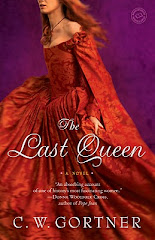
Now, it may seem odd but those reactions excited me. I’ve always been fascinated by famous women with controversial reputations, as evidenced by my previous novels about Catherine de Medici and Juana la Loca, who is Isabella’s daughter. But I must admit that while growing up in Spain all I heard about Isabella (in Spain, she’s properly known as Isabel) was that she was this near-saintly queen who united Aragón and Castile through her marriage to King Ferdinand, conquered Granada, sent Columbus to find the New World, and . . . Well, that was about it. I’d also visited her tomb in Granada as a child, but I was more taken by the lurid fate of her willful daughter, Juana, the queen who went mad out of love— an interest that eventually resulted in my first novel, The Last Queen.

It was while writing my first book that I began my research into Isabella’s life. I focused mainly on her later years and found myself affected by her struggles, even as I deplored her religiously motivated actions. She outlived two of her beloved children only to die at the age of fifty-three, leaving behind a bereaved nation and uncertain future. No one could argue she was both stoic and indefatigable in her commitment to her country. But, I found myself asking, who was she before she became queen? How did this young and inexperienced princess sent to live far from court become the first female ruler of a united Spain? How did her experiences in her youth define and shape her later years? These questions obsessed me, and so I came to realize I had to write more about Isabella.

Nevertheless, when my editor accepted my proposal, I understood that I’d set myself a formidable task. For though Isabella has all the hallmarks of a formidable heroine, she's also shrouded by dark condemnation, often seen as a narrow-minded fanatic who gave rise to the Inquisition and callously evicted the Moors and Jews from Spain. Infamy clings to her name; as history has been revised by more enlightened times, she’s borne the brunt of it. I’d confronted historical calumny before with my characters, however, and my task as a writer is never to judge what happened but rather to try and reveal why. I also try my utmost to not view the past through the prism of the present. The world which Isabella of Castile knew was vastly different from our own, and its contradictions must have shaped her in unexpected ways.

First and foremost, no one can argue that Isabella was exceptional for her era. She's also, like so many of us, a bundle of contradictions.  Publicly and privately, she fought the dictates of society and its prohibitive limitations on women, intent on forging her own path. Nevertheless, she was rather traditional in her outlook on her duty as a wife, yet paradoxically she was a mother who insisted on raising her own children in a time when queens rarely did. She also faced a unique set of circumstances as a ruler that had proven the bane of her predecessors—a fractured kingdom weakened by centuries of strife, overlaid by an uneasy religious amalgam that made Spain both tolerant, and conversely, rife with divisiveness. Isabella inherited a land that was crumbling and in desperate need of unity if it was to survive the hostile encroachments of neighboring powers. Destined to become Spain’s architect, who would guide her new-born country into the Renaissance age, she achieved the impossible. Yet, like many rulers before and after her, she also made tragic mistakes - and those mistakes blackened her reputation irreparably.

The Queen’s Vow portrays the complex, fallible woman behind Isabella’s legend. From her forgotten youth when no one believed she was destined for greatness, to her plunge into the cesspool of her half-brother’s court and the unexpected loss that propelled her into a dramatic fight for her throne, as well as her passion for a prince she was forbidden to wed and courage as a neophyte ruler, which molded her into the queen who changed the world, her story is one of grandeur and passion, triumph, tragedy and sacrifice. It is a story of a princess who defied the odds, of a devoted wife and mother who endured heartbreaking betrayal, and of a devout woman torn between duty to her subjects, her faith and her country. It is a story that I believe the majority of us have never heard.

Was Isabella of Castile everything that has been said about her? Or, has history only given us part of the truth?  I leave you to find out. I sincerely hope you enjoy The Queen’s Vow.

Friday, June 22, 2012

Guest post from Alma Katsu, author of THE RECKONING


I'm delighted to welcome Alma Katsu, author THE RECKONING, the next book in her thrilling trilogy that began with The Taker, a haunting tale of eternal love, betrayal and atonement as a young woman uses magic to bind her faithless lover to her, with tragic consequences. The Taker was chosen by Booklist as one of the top ten debut novels of 2011; The Reckoning has been called “brilliant” by RT Magazine and “beautiful, mesmerizing” by Library Journal. In celebration of The Reckoning's publication, Alma has offered us this fascinating guest post. Please join me in welcoming Alma Katsu!

Historical Polygamist
First, let me thank C.W. for having me on Historical Boys today. It’s a great privilege to get to address his readers. And while I am a great fan of historical novels, I come here feeling like a bit of an impostor because I don’t consider myself a historical novelist. I know I’m not because my publisher told me so. When it came time to suggest artwork for the cover of The Taker, I forwarded jpeg after jpeg of lovely paintings of moody young women in gorgeous gowns until my editor was forced to write back saying something along the lines of, “Your book isn’t a historical and it’s not going to have an oil painting for the cover. Stop sending these to me.”

There’s history to be sure in both my books, The Taker and The Reckoning, but they don’t behave like proper historical novels. C.W., who kindly provided a very nice blurb for The Taker when it came out, put it kindly when he wrote, “The Taker is unlike any novel I have read,” (which delighted me, btw). It’s a very nice way of saying that the book has elements of many genres, not unlike Diana Gabaldon’s Outlander or Anne Rice’s Interview With The Vampire (but not too much like them, either).

The trilogy follows the story of Lanore McIlvrae, a young woman born in the early 1800s in a remote corner of the Maine territory. She has the misfortune to fall in love with Jonathan St. Andrew, eldest son of the family that owns the logging business that everyone in town depends on. Lanore—or Lanny, as she’s called—comes from a poor family and faces limited prospects, but she’s an intelligent girl and wants more out of life, and this attitude (plus her natural stubbornness) get her expelled from town and sent away to Boston. It’s there that she meets Adair, a mysterious man with otherworldly powers, including the ability to grant eternal life. To become immortal, all you have to do is drink a magical elixir—but there’s a catch: you’ll be bound forever to the one who gave you the potion. Lanny sees this opportunity to get back her faithless lover Jonathan, and gives him the elixir—with tragic results.

The Reckoning and the final book in the trilogy, The Descent, tell the rest of Lanny’s story, following her adventures through history as she tries to atone for the terrible thing she did to the man she loved and come to terms with the terrible, yet terribly compelling, Adair. The secret to his powers isn’t revealed until the very end of the series, when readers will learn if these are gifts from god, a true manifestation of magic, a manipulation of scientific principles or something else entirely. 

If you’re still with me, I’ll get to the historical bits now. The Taker is mostly set in northern Maine and Boston from 1810-1822. The story isn’t tied to a particular real-life person or event, and so I’m often asked why I chose that specific time and place. And the answer is: it just sort of happened. Lanny’s home town in Maine doesn’t even exist, but for the story to work, I needed a place that was cut off from the rest of the world, a miniature kingdom for Jonathan’s family to rule. That area of Maine was perfect, with the endless woods and the great Allagash River invoking the idea of a barrier. I picked years when America was still wild in places but civilized in others. But mostly, I picked New England because at the time the story formed in my brain, I had spent most of my life there, in the area I call “Colonial Ground Zero” near Concord, Massachusetts. I find something very romantic about the area: romantic not in the Valentine’s Day sense but in the sense that it was a time of great promise and potential for America and its settlers. Living around these old houses, you develop affection for the people who toughed it out and created a life for themselves in the wilderness.

As much warmth as I feel for New England, for The Reckoning I left Boston and have the reader travel the rest of the world as we follow Lanny’s life. It’s more like a novel of time travel in that respect, though I think the most direct influence is Orlando, the Virginia Woolf novel (and here I’ll be completely heretical and admit that Sally Potter’s outstanding film adaption was more of a direct influence than the book). We get to spend a few weeks with Lord Byron in Pisa and we get to run guns in the Hindu Kush during Rudyard Kipling’s time. We go back to St. Petersburg not once but twice to commune with Russian mystics. We even return briefly to Maine.

I admire the way some novelists are completely faithful to one time period, or one place, settling in as they would a good, long marriage. As a writer, I find it hard to restrict myself like that: I seem to love nearly all times and places. I love to turn over history they way a gardener turns over earth, amazed at the richness I find. I’ll continue this technique in the last book, The Descent, which comes out in 2013, when I’ll take another turn as a historical polygamist. I have a few ideas for bona fide historical novels and if I can get a contract for them, we’ll if I can behave myself and act like a proper historical monogamist.

Thank you, Alma. To find out more about Alma and her books, please visit her website.