Pages

Showing posts with label novels. Show all posts

Monday, June 16, 2014

Random Reviews: SAVAGE GIRL


Jean Zimmerman. SAVAGE GIRL.

The premise of Jean Zimmerman's Savage Girl is gripping: What would happen if a wealthy couple with everything they could possibly imagine came across a so-called "feral child" in a tawdry Nevada sideshow and decides to bring her back to New York and convert her into a society belle? With shades of Pygmalion crossed with the darker hue of Edith Wharton, Savage Girl posits this theory and adds another layer: What if all the men who show an erotic interest in the girl start to turn up dead and the disturbed son of the wealthy couple begins to suspect she may be a brutal killer, even as he sees disturbing signs within himself that he might be to blame?

There is no question that Ms Zimmerman is a masterful writer; her prose is beautiful and she brilliantly captures the unreliable voice of the couple's son, Hugo Delegate, who narrates the story. Hugo is both repelled and fascinated by Bronwyn, the "savage girl," whose past is slowly revealed as Hugo's suspicions and attraction to her deepen. The world of Gilded Age New York also comes to vivid, detailed life; we feel the hypocrisy and emphasis on lineage and social position as the curiosity-obsessed Delegates seek to put one over on their peers by turning Bronwyn into something she is not. Bronwyn fascinates in her contradictions - alluring yet remote, with a tendency to slip out after-hours to roam the streets, wearing a glove fitted with claws. However, her distance from the narrative voice and Hugo's preoccupation with a variety of other concerns dampen the plot's thrust, as he's distracted both by his own torment and his family's foibles. At times, there simply is too much story in this heady brew, diluting the lethal mystery at its heart.

Nevertheless, the experience of reading it turns compulsive, as the underside of the Gilded Age is torn asunder by the introduction of the wild within us all - a metaphor for how we seek to curb our baser instincts, forcing our repressions to find other, more unsavory ways to erupt. Hugo's confession turns chilling as we realize how far his family has gone and the terrible price exacted of them, while Bronwyn's own secrets lead to an excellent denouement. In the end, we find ourselves questioning: Who is truly the savage here?

Saturday, August 10, 2013

Guest post and Giveaway from Elizabeth Fremantle, author of QUEEN'S GAMBIT

I'm delighted to welcome Elizabeth Fremantle, author of QUEEN'S GAMBIT, a sumptuous account of the life of Katherine Parr, sixth wife of Henry VIII who survived the murderous king and went on to endure an ill-fated marriage to Thomas Seymour.

In Queen's Gambit, Kate Parr's story is entwined with that of Dorothy, or Dot, her maidservant, as well as several supporting characters, all of whom are complex and depicted as people whose very existence within the treacherous politics of court dictate both their behavior and their survival. Kate's voice is compelling; a widow with a secret, she attracts the unwanted affections of the ailing king and must sacrifice her magnetic attraction to gorgeous Seymour in order to be queen, only to find herself plunged into an increasingly desperate gambit that requires all her courage and perseverance. Her transformation into a crusader for the Reformed Faith at a time when Henry himself frowns upon it, having retreated into the solace of his Catholicism despite his break with Rome, pits the queen against enemies eager to see her fall. Witnessing her mistress's struggles while contending with her own, is Dot, who emerges as the novel's most engaging character, her wit and keen perspective on her role in the scheme of life at court lending her a unique voice that makes us truly care about what happens to her. Dot, in fact, ends up carrying the story, as Kate Parr becomes mired in her battles and unmitigated desire for Seymour. An adolescent Princess Elizabeth also makes several appearances, stealing the show, as usual, with her self-absorbed antics. I especially liked a scene when Dot overhears Elizabeth conversing rather carelessly with a bewildered Jane Grey.

Tudor aficionados and those who love historical fiction will thoroughly enjoy Queen's Gambit; the inevitable comparisons to Hilary Mantel's work aside, this is by far a more accessible account of the Tudor court, written by an author who's mastered her craft and has deep respect for her subject matter.

GIVEAWAY: Simon & Schuster is kindly offering one free copy of Queen's Gambit. To enter the giveaway contest, please add your comment below this post. Thanks and good luck!

Now, please join me in welcoming Elizabeth Fremantle.

Why Katherine Parr?
I am often asked why I chose to write about Katherine Parr and it is true she seems one of the less interesting when compared to her more glamorous predecessors. But scratch the surface of her story and a dynamic, charismatic woman emerges. She may not have been born a princess to make a great alliance, nor did her life come to a truly dramatic climax with execution, but she was a highly intelligent well-loved woman and an astute political operator who understood how to play the game of power in a dissembling court, using her position to support religious reform at great personal cost. This is a woman who managed to out-fox her powerful adversaries and survive a plot on her life. She was an author too, publishing two books at a time when to publish at best risked ridicule and at worst might seriously compromise a woman’s virtue. She was clever enough to wait until after Henry’s death to publish her second book, a highly political and unashamedly reformist tome. She might not have become known as the wife who ‘survived’ had she not had the sense to wait.

There is much to admire about Katherine Parr’s dynamism, intellect and ability to survive as well as the fact that she was married no less than four times.  But one of the things that most appealed to me about her story was that she was also flawed. She made a disastrous decision in the name of misguided romance with devastating consequences, and it is this picture of a truly accomplished woman becoming a fool for love that fascinated me. The contradiction in her character makes her, for me, so very human and relatable to us today. Who doesn’t know of a clever woman who has fallen foul of romance?

Author photo: Paola Pieroni
But my story is not just one of a remarkable queen. I was determined to explore another view of the Tudor court through the character of Dot. Dot, who serves as Katherine’s maid, is largely of my imagination. We know almost nothing about the woman Dorothy Fountain who served as maid to Katherine Parr’s stepdaughter Margaret Neville during her second marriage. We know she remained with the family serving Katherine Parr when she was Queen, that she was left four pounds a year in Margaret’s will and that she married a man named William Savage who might have been a musician.

It is not much to go on and for the purposes of QUEEN’S GAMBIT I have made Dot lower born than she was likely to have been in reality, as I wanted to offer a different perspective on the court – a 'below stairs' view. I was keen to explore the kind of life an ordinary women like Dot might have had in the period. In the novel, she is visited by exceptional circumstances and comes to move in an elevated world, her experience of it is different to those born into the nobility.

Dot gave me the chance to look at loyalty and true friendship between women, allowing me to show Katherine as a woman who was both loyal herself and inspired great loyalty, even in an uneducated young woman well beneath her in the social scale. Literacy and education was something entirely beyond such a woman’s reach and in Dot I wanted to imagine her as having an intellectual curiosity, striving to educate herself against the expectations of her age. As an adjunct to this I touch on the possibilities for social mobility that were beginning to open up (it must be said mostly for men) in the renaissance period.

Through the eyes of these two women whose lives intersect and yet are so different, I hoped to convey something of what it was like to live in the court of history’s most notorious tyrant, Henry VIII.

Thank you, Elizabeth. To find out more about Elizabeth Fremantle and her work, please visit her website.http://www.elizabethfremantle.com/

Thursday, May 31, 2012

Guest post from Ben Kane, author of SPARTACUS THE GLADIATOR


I'm delighted to welcome Ben Kane back, on his virtual blog tour to promote his new novel, SPARTACUS THE GLADIATOR (St Martin's Press, hardcover, $26.99). Steven Pressfield calls Ben's latest book "Gritty, passionate and a damn good read. Brings Spartacus -and ancient Rome - to vivid, colorful life." I couldn't agree more. I'm currently reading it and am enthralled by Ben's keen sense of the violence and splendor of the era, as well as his sensitive, unique approach to this legendary man.  Today, Ben offers us a guest post on the history behind his work. Please join me in giving a warm welcome to Ben Kane!

Spartacus ― the man, and the history behind the fiction

There are few names in history as recognizable as that of Spartacus. At first glance, this may seem unsurprising. Spartacus’ achievements were truly remarkable. Having been sold into slavery ― we are told by one ancient writer that he deserted from the Roman auxiliaries, but by another that he was innocent of any crime ― he escaped with some seventy others from a gladiator school in Capua, Italy. Through a combination of ingenuity and pure luck, the motley group put to flight not only the first Roman force sent against them, but also the second. Neither set of soldiers were not the Republic’s crack troops, but the second unit outnumbered the gladiators by more than forty to one. Unassailable odds, one would have thought, yet the gladiators prevailed.

Word spread fast. Slaves began running away from their masters to join Spartacus’ band. Soon he had a force of over ten thousand men; within a year, it was quadruple that number, or if some of the sources are to be believed, more than ten times. The gladiators’ breakout had become a full-scale rebellion that saw much of southern Italy laid waste. It sent shockwaves through the corridors of power, and in the two years that followed, Spartacus and his army won at least nine major victories over Roman legions. Ultimately, however, he was defeated.

How is it, then, that for thirteen hundred years after the fall of Rome, he was forgotten? It wasn’t until the 1760s that Spartacus’ memory was resurrected ― in France. This was due to the movement for political freedom that was sweeping Europe, and the frequent slave uprisings that were taking place in the European powers’ overseas colonies. Spartacus’ renown spread far and wide once more. His name was taken up by revolutionaries all over the world. Karl Marx thought of him as a hero. Lenin, and later Stalin, used Spartacus as the ultimate icon of the class struggle, as the model whom the proletariat should emulate. Howard Fast, American author of the bestselling novel, was a Communist who used Spartacus’ struggle in a similar manner. But his appeal was not just to left-wingers. Spartacus crossed the political divide in the 1980s, when Ronald Reagan mentioned him as a symbol of the fight for freedom.

So what were the causes of Spartacus’ slide into obscurity after his death? The fact that not a single written word survives from the man himself, or from any of his followers, has to be a major reason. Another is that little over four thousand words survive that mention him – that’s about ten pages of a typical novel. More was written about Spartacus, but sadly it did not survive. Thirdly, Roman scholars chose not to comment too much on this dark chapter in their history. It’s a common feature for great powers to brush the details of their military defeats under the carpet. Human beings prefer to dwell on the glories, the heyday and the wars won. As the saying goes, the victor takes the spoils ― and they also get to write the history.

Was Spartacus really the man we think of today? First, let’s take a look at the world in which he lived. By the first century BC, Rome had conquered all of its potential enemies in the Mediterranean. Its conquests provided a huge influx of wealth into the Republic. At the same time, agriculture was changing, becoming larger-scale. The result was an enormous demand for labour, a need that was satisfied by the import of hundreds of thousands of slaves to Italy. They provided the workforces for the latifundia, or estates that covered much of the countryside.

The human tide of slaves that came from the eastern Mediterranean, from north of the Rhine and Danube rivers, and from the areas beyond the Black Sea. Thrace (roughly, modern-day Bulgaria) was one of the crossroads for this trade, and its people were also subject to enslavement. Other slaves came from northern Europe, from the regions east of the Rhine, and from Gaul. The influx of a huge number of free-born slaves into Italy over a short time had a dramatic effect. One of the least welcome was slave rebellions. Spartacus’ uprising was not the first, but the third, slave war to rock Rome in a turbulent period of only sixty years. The first two took place on Sicily, the first from 135-132 BC, and the second from 104-100 BC. It is ironic that these rebellions, both of which lasted longer than that of Spartacus, have all but been forgotten ― despite being better documented. What’s clear about the first two uprisings is that they were not about ending slavery. Nor was that of Spartacus. What they were about was men and woman, many of whom had been freeborn, seeking to escape their enslavement.

Today, there are few better symbols of the small man’s fight against overwhelming tyranny or brutal oppression than Spartacus. Much of what we think about the man comes from films, TV shows, or novels. Many modern-day portrayals depict Spartacus as a warrior in the fight against evil, even someone who wanted to free all slaves. As I’ve mentioned, the real situation was very different to these depictions. It is all too easy ― yet erroneous ― to place modern sensibilities on people who lived two thousand years ago. Yet life and morals then were totally different. Slaves were part of everyday life. Like washing machines or automobiles, everyone who could afford one, had one. Wealthy slaves had their own slaves. Freeing a favoured slave was common enough, but the idea of ending the practice of slavery would have seemed bizarre to the vast majority. Spartacus was a talented and courageous man, a charismatic and canny general. He worked to his strengths and was adept at exploiting Rome’s weaknesses.

But he was not a man whose burning desire was to free all slaves.

Thank you, Ben! To find out more about Ben and his work, please visit his website.

Sunday, March 4, 2012

Guest post from Donna Russo Morin, author of THE KING'S AGENT

I'm delighted to welcome Donna Russo Morin, author of THE KING'S AGENT. Set in 16th century, Italy, this is a stunning adventure featuring a woman agent and art collector for Francois I of France, whose work for the king leads her into a deadly mission to find a mysterious sculpture and a dark secret that could change the course of history. Publisher's Weekly's starred review says The King's Agent "skillfully blends historical fiction and fantasy in surprising ways . . . a wonderfully action-packed ride through the lush landscape of Renaissance Italy."

Please join me in welcoming Donna Russo Morin!


Michelangelo: A Short History of a Long, Magnificent Life
To sum up a life such as Michelangelo Buonarotti’s in the length of a blog post seems not only an impossible challenge but the epitome of an understatement, yet if there was ever a life worthy of such an endeavor, it is his.

Michelangelo is perhaps one of the most well-known artist’s throughout the history of the world, the man who struggled for years to complete one of the ultimate pieces of art ever created. But in truth, Michelangelo’s struggles began almost at the beginning of his life and they were to mold that life as distinctly as he himself would carve his great statues. When I uncovered his connection to my main historical character in The King’s Agent, I felt it a blessing to be able to research this gifted man’s life and a privilege to include him in one of my books.

Born on March 6, 1475 in Casentino, Italy, outside the walls of the grand city of Florence, his father was Lodivico di Lionardo Buonarroti-Simoni, the Podesta of Caprese and Chiusi. His mother, Francesca di Neri di Miniato del Sera, gave birth to five sons in all, all within an eight year span. It killed her, and it was a loss that would shape the entirety of Michelangelo’s life.
Because of his mother’s ill health, Michelangelo was suckled by a wet nurse. The loving woman, nurturing in even sense of the word, was one Signora Topolino, a stone-cutter’s wife living in the rocky hills of Pontasseive. Michelangelo found such encompassing affection from this woman and her family that he would return to them, for days and months at a time, throughout the entire course of his life. It is a great myth—one that might have started from Michelangelo’s own lips—that he ingested stone dust along with the woman’s milk, binding him and his life to worship of the stone.

Michelangelo was six when his mother passed and, from that moment on, he lived a life of solitude; his father was consumed by his grief and incapable of caring for the children Francesca left behind. Lodivico’s sister, Michelangelo’s Aunt Cassandra, took over the care of the household, but she was a cold if efficient woman, seeing to the boys’ needs but with little love in the act. Nonna Alessandra, Michelangelo’s grandmother, offered some affection, but it was not enough to fill the emptiness created by the loss of his mother. None of the adults cared much to keep track of the young boy’s comings and goings and Michelangelo became a child of the streets, an urchin as prone to mischief as he was to curiosity.

At the age of 13, his father sent Michelangelo to school in the city proper, under the auspices of Francesco da Urbino, but he neglected all of his studies save for drawing. And though his father and uncle tried, literally, to beat the predilection for art out of the child, they were vastly unsuccessful, eventually capitulating to Michelangelo’s truth and fostering his artistic achievements. In 1488, he entered the studio of Domenico and Davide Ghirlandaio, elite members of the large Florentine artistic community. There he learned the cutting edge techniques of the age and studied the works of such masters as Giotto, Donatello, Ghiberti, and others, those considered the founding fathers of the Renaissance. In 1489, he became a pupil at the School of Sculpture headed by the great Bertoldi, who was himself a student of the master Donatello. Here his obsession with sculpture would be secured and here he would come to the attention of one Lorenzo de’ Medici, Il Magnifico.

His life would be forever changed for it. From this moment on, Michelangelo’s life would be one of learning, not only artistically, but philosophically and of self-enlightenment, present in the studio of Lorenzo during the deep discussions of Paganism and Humanism. He studied the human anatomy by sneaking into the morgue of a church and dissected the bodies awaiting burial (it is why he was able to recreate them with such precision). He learned too the harshness of life, the confusing truth of his sexual orientation, and the vagaries of living in Italian states that went to war with the same frequency and glee with which they sat down to a vast meal. Michelangelo was an ardent patriot to his Tuscan lands, and took part in the many revolutions that plagued the city, pulling on his loyalties to the Medici and the city in a gut wrenching struggle. He became both adored and vilified by the popes of the Catholic Church, heartbroken by both men and women, and though he was forever surrounded by great friends, talented colleagues, and lovers, he remained a solitary man, rarely speaking of what he felt most deeply.

And yet, in all that I learned of him, as he became for me not the subject of my work, but a living, breathing being with whom I spent many hours of many days, it was his intellect and his vulnerability that touched me the most deeply. It has been one of the great delights of my life to ‘spend that time’ with him while crafting The King’s Agent. And I am thrilled to be including him in my current work in progress, but there he is a younger man, in the throes of artistic and personal awakening, feisty in his arrogant youth.

Michelangelo’s list of works is breathtaking, astounding, too vast to be accounted for here, and he is considered to be one of the greatest artists of all time. He was a sculptor, painter, architect, engineer and poet. His best known work, that of the paintings on the ceiling and the altar wall of the Sistine Chapel, catapulted him into the realm of the immortal icon, and yet it was his other work, that with the stone, creations like the great David (original called the Giant), with which he cared the most, with which he identified. Were one to encounter the painter of the Sistine Chapel and ask him what he did, he would answer forthrightly, “I am a sculptor.”

The relationship between the lead male character in The King's Agent, Battista della Palla—a true historical character—and Michelangelo is as I’ve drawn it within The King’s Agent, one of emotional succor of the most innocent kind, a bond between an older and younger man of a father and son nature, each yearning to fulfill the emptiness and lack of the one, each more than willing to fulfill that emptiness for the other. It was, perhaps, the most long lasting and satisfying bond of the magnificent Michelangelo’s life. The love they bear for each other is just one of the many reasons for the love I bear them both.

Thank you, Donna! We wish you much success with this fantastic novel. To learn more about Donna and her work, please visit her website.

Saturday, October 15, 2011

Guest post from Stephanie Dray, author of THE SONG OF THE NILE


I'm delighted to welcome Stephanie Dray, author of Lily of the Nile and its recently published sequel, SONG OF THE NILE (Berkeley Trade paperback, October 2011) charting the middle part of the fascinating, dramatic, and always intrigue-laden story of Cleopatra's surviving daughter, Cleopatra-Selene. Filled with vivid details of the ancient world, as well as its depravity and mysticism, in SONG OF THE NILE, Selene has survived her perilous childhood only to be forced to marry a man chosen for her by the emperor; with the magic of Isis, she rules her realm and wins the love of her new subjects, beguiling her way to the very precipice of power. She has never forgotten her birthright but will the price of her mother’s throne be more than she’s willing to pay?

Please join me in welcoming Stephanie Dray!

Livia: Wicked or Wonderful? by Stephanie Dray


I’m delighted to be here because I’m a C.W. Gortner fan and I share his love of history’s bad girls. In my case, I love the bad girls of the ancient world. Let’s face it. Powerful women got a bad rap. This was especially the case for Rome’s first empress, Livia Drusilla, the wife of Augustus Caesar. She comes down to us as a sort of wicked step-monster of the Julio-Claudian family-one who murders, manipulates and maligns everyone who gets in her way. The ancient writers didn’t much like her. Modern writers don’t like her either.

Played to perfection by Siân Phillips in the mini-series of Robert Graves’ famous I, Claudius, Livia emerges as a delicious villainess. She makes Cruella de Vil rather civilized for merely wanting to turn spotted puppies into fur coats. Personally, I found the lure of such extravagant evil too hard to resist. When writing about my heroine, the orphaned daughter of Cleopatra, who was taken as a prisoner of war at the age of nine and marched through the streets in chains, there were plenty of villains for me to choose from. But my novels aren’t about the the tragedies this real life princess lived through; my novels are ultimately about Cleopatra Selene’s triumphs. So I wanted an antagonist who could show the darker sides of my heroine’s ambitions.

Livia fit the bill.

It’s true that in my novels, Cleopatra Selene plays a dangerous and twisted game with the ruthless Emperor Augustus, who was obsessed with her mother and is now obsessed with her, too. But I wanted to show the other side of the coin--a woman who was nothing whatsoever like Cleopatra of Egypt, but almost as powerful. That’s where Livia came in.

Unlike the seductive Queen of the Nile, Livia was known for chaste and modest public behavior. (At least, after she married Augustus.) She always dressed in voluminous garments that practically covered her from neck to ankle, and of course, her husband would brag that she spun the wool and wove the cloth to make those baggy clothes as well. She was a veritable goddess of domesticity, our Livia. And one who supposedly eschewed expensive jewelry, claiming that her children were the only jewels she needed. In spite of all this puritanical posturing, Livia was, nonetheless, associated with sexual scandal. Suetonius reports that she was rumored to procure young virgin girls for her husband’s bed. That made me wonder if such girls came from within the emperor’s own household and included vulnerable orphans like Cleopatra Selene.

Livia was also rumored to be a poisoner. She’s known to have concocted tonics and elixirs that she said accounted for her extraordinarily good health and long life, but if you were supping at the imperial palace, you might be better off not drinking the wine. At various points, she’s been accused of murdering Marcellus, Drusus, Germanicus, Postumus and even Augustus himself. In my novel, she offers Cleopatra Selene a poisoned cup.

But was Livia really such a she-devil?

Her biographer, Anthony Barrett, paints a picture of a much maligned mother of the empire. She had a documented record of altruism against which her detractors could only conjure up rumor and innuendo. She went to the emperor on behalf of the citizens of the Isle of Samos to return them to independence. She is known to have intervened on behalf of one woman accused of witchcraft; she also saved the life of a man who accidentally appeared naked before her, saying that to chaste women, to look at a naked man was like looking at a statue. Known to advise her husband on political matters, Livia enjoyed a marriage with him of more than fifty years. Especially tricky, considering that she never gave him a child and he rather desperately needed an heir.

I can’t point to a single documented event in which Livia did an evil deed. Her worst crime, it seems, was to have lived for so long and exerted such power over the empire as the wife or ancestress of every Julio-Claudian emperor, that the only way to explain her political success was to make her a monster. In the end, Livia was deified, and worshiped, as a goddess, so maybe she’ll have the last laugh. Certainly, the one regret about my own novels is that I so enjoyed exploiting her bad reputation.

Expect lots of wickedness and depravity in Song of the Nile, but in the third and final book of the trilogy, I hope to redeem myself by giving Livia a little bit of empathy. So, what about you? Are there women in history that you love to hate?

Thank you, Stephanie! We wish you much success and I, for one, am really looking forward to the third part of this amazing story! To find out more about Stephanie and her work, please visit her at her website.

Tuesday, March 29, 2011

Guest Post from Christy English, author of TO BE QUEEN

I'm honored to welcome Christy English, author of THE QUEEN'S PAWN and her new novel TO BE QUEEN (Pub date: April 5, 2011; NAL Trade, 400 pages, $15.00) about the tumultuous early years of that most fascinating of medieval queens, Eleanor of Aquitaine. It seems we never tire of this original independent lady, whose feisty attitude and zest for life, as well as enormous celebrity quotient, blazed a trail of scandal across her world; in other words, in today's world, she would have had paparazzi chasing her on motorcycles! Though she's most famous for her tempestuous marriage to Henry II, with whom she loved, battled and ended up imprisoned by, for a time, her early life is my favorite - full of the dramatic tumult that shaped her into the queen she became. Christy's novel promises a riveting, fresh account of how Eleanor grew into her crown.

Please join me in welcoming Christy English.

Eleanor of Aquitaine and The Search for Charlemagne by Christy English

Charlemagne, also known as Charles the Great, King of the Franks, united all the lands of modern day France and Germany under his rule. His empire only lasted one generation after his death, but it lived on in the minds of the people he left behind. Eleanor’s Ancestor Charlemagne founded the Duchy of Aquitaine, which was passed down through the centuries in Eleanor’s family, finally coming through her father’s hands to her in 1137. Charlemagne and all he achieved loomed large in Eleanor’s imagination, and with her marriage to Louis VII of France, she saw how she might regain some of Charlemagne’s former glory by uniting France and the Aquitaine, as well as Gascony, Poitou and all of her other holdings.

Eleanor hoped to put her son on the throne after Louis and make him a second Charlemagne. Her unborn son would rule fairly under the law, would render justice, and all importantly, keep the power of the Church in check. Eleanor discovered only one problem with this plan. She and Louis did not have a son. Louis VII was perfectly happy to accept what he considered to be “God’s will” in his youth, to accept the fact that he and Eleanor did not have a son and would not until God sent the boy. Louis constantly prayed for such a son to come to them, but neglected Eleanor’s bed, the only way a son would ever be born to France. After the Crusade in 1148, Eleanor knew with all certainty that her dreams for a united France under her son’s rule were in vain. She worked for an annulment for her marriage in Rome, and once Abbot Suger, Louis’ spiritual father, the largest obstacle to their annulment, died in 1151, Louis began to work with her. Rome granted their annulment, and in March, 1152, Eleanor rode home to her capital at Poitiers.

Eleanor did not retire to her lands and marry one of her own barons. Instead, she united in alliance and in marriage to Henry, Duke of Normandy. Henry was a young man when she married him, nineteen years old, eleven years younger than herself. Eleanor and Henry were married for less than two years when Henry won the throne of England, and she and her new husband were crowned King and Queen of England. Eleanor and Henry’s first son, William, had already been born and she was pregnant with their second son, Henry the Younger, when they were crowned.

Their empire stretched from Scotland and Ireland to Wales and England, and in France they controlled the territories of Normandy, Brittany, Anjou, Aquitaine, Poitou and Gascony. Between Henry and Eleanor, both with their inheritances and with what Henry had re-conquered at the point of the sword, they ruled a larger empire than had been seen in France since the time of Charlemagne. Though time would divide Henry and Eleanor from each other, and their sons from their father in countless rebellions and struggles for power, at the time of her marriage to Henry, Eleanor had realized her dream of a large empire that she might one day pass on to her son. After Henry II’s death, her favorite son, Richard the Lionhearted, ruled all the lands of his father.

Thank you so much for joining us today, Christy. We wish you all the best of success! TO BE QUEEN: A Novel of The Early Years of Eleanor of Aquitaine is available for pre-order and will be in bookstores on April 5. If you want to learn more about Christy and Eleanor’s adventures, please find visit her at her website.

Saturday, November 27, 2010

Mini-review of HERESY by S.J. Parris

Giordano Bruno was one of the 16th century's most erudite visionaries, a Dominican monk who fled the Church after being accused of heresy. His cosmological theories went beyond Copernicus's heliocentric visions; Bruno was the first European to conceptualize the universe as a vast continuum populated by many galaxies. He was also a visionary writer on the concept of memory and avid scholar of mysticism.

Naturally, his curious mind made him very unpopular with Catholic authorities, struggling as they were with the catastrophic repercussions of the Reformation. In S.J. Parris's debut novel, aptly titled HERESY, we first meet Bruno as he is caught in the privy with a forbidden book. When the Inquisition is called in, Bruno flees the scene and ends up in Elizabeth I's London, where, as an associate of Philip Sidney's, he's invited to debate at Oxford. Bruno seeks a lost Heremetical manuscript; he's also been secretly hired by Francis Walsingham, the queen's ruthless spymaster, to investigate a possible Catholic cell operating at the famed university.

Bruno soon finds himself the target of xenophobic comments and suspicion, even as he is drawn to the university rector's lively daughter. A series of grisly murders reveal evidence that Oxford indeed harbors a hotbed of Catholic conspirators, drawing Bruno out of his intellectual comfort zone into a shadowy world where faith and persecution are inextricably entwined and killing in the name of God is a hallowed act. While Bruno’s much-vaunted accomplishments take a back seat to his skills as an amateur sleuth, the story offers some eerily discomfiting moments, depicting a far less tolerant Elizabethan era than we may imagine, as seen through the eyes of a man for whom science and reason are paramount. Secondary characters are skillfully drawn, including a sinister bookseller and the haunted son of an exiled Catholic fellow. HERESY offers an engrossing mystery, an unusual look at the ever-popular Tudor world, and a promising initiation into a new series featuring Giordano Bruno.

Monday, November 8, 2010

Publisher's Weekly reviews THE TUDOR SECRET

The first review for THE TUDOR SECRET is in!

The Tudor Secret. C.W. Gortner, St. Martin's Griffin, $14.99 trade paper (336p) ISBN 978-0-312-65850-2

In Gortner's latest riveting historical, the influential Dudley family sends orphan servant Brendan Prescott to serve their cruel son, Lord Robert, at King Edward's court, and the young man is soon caught up in intrigue, suspicion, and shifting loyalties. Young King Edward is under the thumb of the Dudleys, but illness is greatly affecting his influence. Then the lion-eyed Princess Elizabeth, whom the Dudleys view as a threat, arrives and Prescott becomes a spy for her protector, William Cecil. Deeper involvement in the conspiracies surrounding the throne makes Prescott increasingly uncertain of loyalties, including his own, and he begins to question his fate and identity. In Gortner's capable hands, Prescott is a believable and enjoyable hero, a man of strong loyalties but naïve enough to be exploited. And while the Dudleys are mostly broadly drawn villains, Robert has depth, and though readers familiar with the Tudor era will know the key players, they may be surprised by their depiction here. Gortner handles action with aplomb, adding a riveting, fast-paced thriller to the crowded genre of Tudor fiction. (Feb.)

Friday, November 5, 2010

THE QUEEN'S SORROW Mini Review

Mary I of England - known as 'Bloody Mary' - has never evoked much sympathy, despite her fractured adolescence and horrible young adulthood, when she first suffered much of the deprivation and pain she later inflicted during her reign.

Nevertheless, her story is a fascinating one, and author Suzannah Dunn captures a fragment of it in her haunting novel, THE QUEEN'S SORROW. Focusing on the months after Mary's marriage to Philip II and her illusory pregnancy, Dunn has crafted an introspective account of longing and the price we can pay when we believe we know someone else's heart.

Dunn tells her beautifully etched story through the eyes of a Spaniard in Philip II's entourage, Rafael de Prado, who arrives in storm-drenched England bewildered and viewed with suspicion by the English, even as he is charged with the task of building a sundial for the queen. Only, no one really knows how Rafael will be paid or exactly where he is supposed to lodge; in the upheaval caused by the Spanish arrival, there is no room at court, and so Rafael and his apprentice are sent to a London manor. Here, Rafael - homesick, sensitive, and trapped in a shadowy world between two opposing faiths - meets Cecily, the manor's housekeeper, and her young son. A father himself, separated from his beloved boy, Rafael finds himself drawn to the enigmatic Englishwoman; as their attraction deepens, we learn more about Rafael and Cecily’s pasts, even as they each find themselves plunged into the tumult and terror of Bloody Mary’s persecution, their fates ultimately forever altered by the queen’s sorrow.

Saturday, October 23, 2010

THE ASTRONOMER and EMPIRE: Mini-reviews

THE ASTRONOMER by Lawrence Goldstone

This cerebral thriller plunges the reader into a treacherous world of strife in France on the eve of the brutal Wars of Religion. Amaury de Faverges, illegitimate son of the duke of Savoy, secretly yearns to learn more about scientific theories forbidden by the Church; when a beloved classmate of his is murdered, Amaury takes the dead boy's place to foil a heretical plot that could challenge the foundation of the Church. A taut, suspenseful and erudite look at the 16th century's struggle to reconcile science with faith, The Astronomer is a refreshing departure into the turmoil of an era at odds with itself. (I purchased this book. For my longer review, see here).

EMPIRE by Steven Saylor

In his sequel to the NYT bestseller Roma, Steven Saylor returns to depicting the fortunes and tragedies of his fictional Pinarius family, this time during the notorious reigns of the emperors. Mr. Saylor’s keen sense of detail and breadth of knowledge are on ample display, as is his ability to weave centuries of history into entertaining narrative. Because Saylor mines such a richly documented time in Rome’s history, Empire has some intense set-pieces, such as the horrific mass execution of Christians under Nero. Yet precisely because so much of interest occurs, at times Saylor’s fictional characters do not engage as much as their historical counterparts. Nevertheless, Empire is a magnificent feat of storytelling. (The publisher sent this book to me for review.)

Monday, September 13, 2010

Guest post from Elizabeth Chadwick, author of FOR THE KING'S FAVOR. Win TWO free copies!

Acclaimed historical fiction author Elizabeth Chadwick has carved a unique place for herself in the genre; not only does she command an intensely loyal following and an impressive list of books to her name, but she is distinguished by meticulous research and keen ability to convey the drama of the past with poignant immediacy, never resorting to anarchronisms. The London Times describes her as "an author who makes historical fiction come gloriously alive;" personally, I'm both a huge fan of her work and in awe of how effortless she makes it all seem.

In her new novel, FOR THE KING'S FAVOR , Ms Chadwick brings to compelling, bittersweet life the little-known story of Ida de Rosney, mistress to Henry II, whose passionate love for a young lord plunges her and her lover into a tumultous struggle. A captivating story, and testament to the power of sacrifice and the strength of love, this is Elizabeth Chadwick at her best. In celebration of the book's release, Elizabeth has kindly offered this guest post; in addition, her US publisher Sourcebooks is offering readers of this blog TWO free copies. Entries are available for US and Canada addresses only. Please see the bottom of this post for details to enter. Please join me in welcoming my friend, Elizabeth Chadwick, to Historical Boys.

Finding a Forgotten Royal Mistress
by Elizabeth Chadwick

What was it like to be the mistress of a king? To have the royal favour, bear the sovereign’s child and be at the hub of court life? What was it like to have power and yet be powerless when it came to the sovereign’s whim? And what happened to a mistress when she ceased to be the royal darling? For the King’s Favor tells the story of one such mistress. Her identity has only come to light in the last decade. Her name was Ida de Tosney or Toeni, and she was about fifteen years old when she caught the eye of King Henry II of England around the year 1176.

Initially I wanted to write about Ida because the firstborn son of her marriage with Roger Bigod, future Earl of Norfolk, went on to marry the eldest daughter of the great English knight, magnate and hero William Marshal whom I had written about in The Greatest Knight and The Scarlet Lion.. Roger himself had a long and distinguished career and I was keen to follow up his family story to the point where it linked into the Marshal one. Before I began writing, I knew vaguely that he had married a former mistress of King Henry II, but once I made Ida my heroine, I had to hit the research trail and try to discover more about her.

She is elusive in the historical record. We only know her name from a few charters belonging to the time when she was married to Roger where she is referred to as “Comitisse Ida, uxoris mee,” or “Countess Ida, my wife.” We only know that she was a royal mistress before her marriage to Roger because of a French list of prisoners drawn up after the battle of Bouvines in 1214, where William Longespee, Earl of Salisbury, bastard son of King Henry II, refers to Ralph Bigod who was on the prison list, as his brother. In another charter of Bradenstoke Priory, Longespee mentions his mother, Countess Ida, but since there was more than one Countess Ida around at the time, the discovered prison list was vital in identifying the right one.

Ida was the daughter of Ralph de Tosney, lord of Flamstead, and his wife, Margaret Beaumont who was close kin to the earls of Leicester. Through various family marriages, Ida had kinship with the royal house of Scotland. When her father died, Ida became the King’s ward, with her marriage to be disposed of as he chose. Henry had a certain reputation with women and already had several bastard children by various unknown women. His long term affair with Rosamund de Clifford is notorious and has passed into legend. It would have begun when Rosamund was still very young – in her teens, and ended with her death at Godstow nunnery in 1176. By this date, Ida de Tosney would have been a nubile adolescent and she plainly caught Henry’s eye in the aftermath of his losing Rosamund. Sometime between 1177 and early 1181, she bore Henry a son who became William Longespée, Earl of Salisbury, an adventurous soul and hero of the great sea victory at Damme against the French in 1213.

If Rosamund and Ida are any indication, Henry II seems to have harboured a preference for innocent young girls as his mistresses. Perhaps he found them refreshing after doing battle with his formidable queen Eleanor of Acquitaine. As an author I am led to speculate about what this attention was like for such young women who would have had little choice but to submit to the royal will. Mistresses of kings are often portrayed as sexy women with power to wield via their ability to reach the King’s ear (and other parts!), but for young, inexperienced girls, can there really have been any pleasure and real power in their role?

They were pawns to the royal lust. When a king had had his fill, they could be retired to a nunnery or sold off in marriage. We do not know if the latter is what happened to Ida, but certainly she wed Roger Bigod, future Earl of Norfolk in December 1181 about 5 years after Henry took up with her. Ida’s and Roger’s first son was born before the end of the following year and they went on to have another 3 boys and 2 girls at least, so it was certainly a fruitful match in the bedchamber. But what of Ida’s first child, William FitzRoy who became Longespée? His childhood is unknown, but by the early 1190’s as an adolescent, he was being given lands and duties to bring in an income and it seems that he was raised either at court, or in a household closely attached to the court. Certainly his mother did not bring him with her to her marriage. What she felt about this and what effect it had on her, I can only imagine – with a little help from my delvings. Ida’s reactions are a theme I explore in detail in For the King’s Favor. The same with her husband, Roger. What were his thoughts and feelings when he married a still very young woman who had shared the King’s bed and had borne a son of that liaison? How did it affect him, especially when he desperately needed to keep the king’s favor? There must have been some very tricky shoals to negotiate, both the diplomatic and the emotional, and for all concerned.

Authors of historical fiction know that the past is another country and that attitudes were often different, and very alien to the way society functions now, but I also take the view that it is us as we were then, and like clothes, while fashions and appearances change, people don’t. I hope that Ida de Tosney and Roger Bigod are people of their time, but I also hope that a modern audience will recognise their dilemmas and empathise.
Many thanks to C.W. for inviting me to post on his excellent blog!

Elizabeth Chadwick lives near Nottingham with her husband and two sons. She is the author of 18 historical novels, including The Greatest Knight, The Scarlet Lion, A Place Beyond Courage, Lords of the White Castle, Shadows and Strongholds, the Winter Mantle, and The Falcons of Montabard, four of which have been shortlisted for the Romantic Novelists’ Awards. Much of her research is carried out as a member of Regia Anglorum, an early medieval re-enactment society with the emphasis on accurately re-creating the past. She won a Betty Trask Award for The Wild Hunt, her first novel. To learn more about her and her work please visit her website.

To win one of two free copies of For The King's Favor: You must be a follower of this blog AND leave a comment below. Winners will be selected on September 30 and notified; you must have a valid postal address for the book to be mailed directly to you by the publisher. Good luck!

Tuesday, August 31, 2010

Guest Post from Jeri Westerson, author THE DEMON'S PARCHMENT

Jeri Westerson, my favorite historical 'noir' writer, is back with the sexy, troubled Crispin Guest in her third novel in the series, THE DEMON'S PARCHMENT. Fans of Crispin's previous adventures, Veil of Lies and Serpent in the Thorns, will be excited to know that in this latest installment, Crispin finds himself again in danger when he warily takes on his most recent client, Jacob of Provencal, a Jewish physician at court. Though all Jews were expelled from England nearly a century before, Jacob has hired Crispin to find stolen parchments that might be behind the recent savage murders of young boys -- parchments that someone might have used to bring forth a demon which now stalks the streets and alleys of London.

Jeri has kindly offered this guest blog post to celebrate the October 12 release of The Demon's Parchment. Please join me in welcoming her to Historical Boys!

The Four Humors
By Jeri Westerson

No, this is not about the Marx Brothers. We don’t mean humor as in “ha ha” but humors as in exhalations of the damp variety. We are talking, well, bodily fluids. So, erm, why are we talking bodily fluids on this nice, clean blog, you may be asking? Because we are talking about my medieval mystery series and you can’t talk about things medieval without talking about bodily fluids…um, I mean Humors.

This was an ancient theory of physiology concerning one’s health and character. Indeed, one’s very soul might be in trouble if these four humors were not in balance. The four humors are Blood, Yellow Bile, Phlegm, and Black Bile, which were also associated with the four elements: air, fire, water, and earth. You see, to the medieval mind, the spiritual was bound up with the earthly. It all worked together.
So each humor reflected a particular color, if you will, of the body and spirit, and represented a good or bad constitution. These humors gave off vapors that went right to the brain and changed the temperament of the person.

Blood, for example, was a hot and moist environment and was associated with the element air. If you had balanced blood you were “sanguine” and prone to an amorous and generous temperament. Too much and you might go overboard and needed bleeding. Not enough and they would fill you up with red wine, which looked like blood (they were big into stuff that looked like other stuff. It seemed to make sense to them.)
Yellow bile was hot and dry and associated with fire. Too much yellow bile and you were “choleric” and tended toward violence and vengeance. Phlegm was cold and moist and associated with water. You were “phlegmatic” if you had too much of this and were dull, pale, and cowardly.
Are you sensing a theme here? That some of the vocabulary we use all the time had its origins in medieval medicine? Yeah, you’d be right. Sort of. This theory of the humors or humorism came down to us from the Greeks, Hippocrates in fact, but the medievals didn’t see too much wrong with these ideas and continued with this form of diagnosis well into the Renaissance. Black bile was cold and dry and was associated with earth. Too much black bile made you “melancholic” and gluttonous, lazy, and sentimental.

It was a quick way to diagnose your problems. If you were easily angered, then it was too much yellow bile and meant your gall bladder (certain organs were also associated with each humor). The best way to help you out was to diagnose and treat. Bloodletting to keep the liver healthy. Emetics and purges for the other three. For a diagnoses, there was also a lot of sniffing, examining, and tasting of urine.

Ah, those were the days.

The Boston Globe has called Jeri Westerson's hero, “A medieval Sam Spade, a tough guy who operates according to his own moral compass.” Her 2008 debut from St. Martin’s Press, VEIL OF LIES, garnered nominations for the Macavity Award for historical mystery and the Shamus Award for Best First PI novel. Her second, SERPENT IN THE THORNS, is also a 2010 Macavity finalist and a finalist for the 2010 Bruce Alexander Historical Mystery Award. To learn more about Jeri and her work, please visit her website.

Monday, August 9, 2010

Review of DRACULA IN LOVE by Karen Essex

Tomorrow, my good friend Karen Essex's latest novel, DRACULA IN LOVE, hits the stores! In celebration of its release, here's my review of this sumptuous and passionate interpretation of the immortal love story (this review first appeared on Loaded Questions):

Dracula Gets Sexy
He’s the enigmatic stranger in the black cape, a shape-shifting outcast who has given rise to some of literature’s - and Hollywood’s - most iconic imagery. When it was published in 1897, Bram Stoker’s Dracula was a critically acclaimed horror story; it did not send the shockwaves it should have through Victorian morality, excavating the repressed sexuality and decay of a fading empire while exalting the era's misogynistic flair. However, in subsequent years, as it garnered international bestselling status, Dracula began to reveal itself as a cautionary tale of unbridled desire.

Now, 113 years later, bestselling author Karen Essex, known for her lush prose and portraits of powerful women in Leonardo’s Swans, Stealing Athena, and a double-volume look at the quintessential femme fatale, Kleopatra and Pharaoh, takes on the Count in Dracula in Love. It’s a bold move. While Dracula has been revisited several times and in various incarnations, not all have been successful; and many of us have firm ideas of who he is, and, more importantly, who he is not. Nevertheless, Ms Essex serves up a sensual, unabashedly romantic approach to the fanged one, telling the tale through the voice of Mina herself, whose love affair with Dracula has become a byword for eternal obsession.

Building on framework established by Stoker, Essex vividly presents the true Victorian world inhabited by these characters—a world where a fledgling emancipation movement collides with the barbaric treatment of those deemed sexually neurotic; where marriage is still the ultimate goal for a woman; and virtue is prized more than fulfillment. While most of Stoker’s cast is present, they’ve been reshaped, with Lucy paying a terrifying price for her extra-betrothal liaison and Van Helsing as a righteous physician engaged in lethal experimentation. The Count takes his time before he appears, seen only in tantalizing glimpses; by then, Mina’s engaging, increasingly paranoid voice has captured our imagination, as she struggles to survive both her own recurring nightmares and a budding awareness that just beyond her tightly corseted existence lurks a tangled labyrinth of feral secrets.

Dracula in Love is not a standard vampire tale and purists may take issue with Ms Essex’s mythology-inspired take on the legend; however, for those who yearn for something more than adolescents pining over immortal boyfriends, this is the antidote—a luscious paean to forbidden longing.

To learn more about Karen Essex and her work, and to participate in the resurrection of our favorite Count, please visit Karen's website.

Monday, July 26, 2010

When Fiction and History Collide

History and historical fiction appear to go hand-in-hand; without the former, certainly there couldn't be the latter. Yet in some cases, these two apparent inseparable allies make for uneasy bedfellows. The truth is, not everyone who loves history is going to love historical fiction and vice versa. Some people are best disposed to the history itself, such as original documents, erudite biographies etc. This is the arena where scholars most often dwell; it's a hallowed place yet not one necessarily conducive to reading historical fiction, which, in the final say, remains a form of entertainment.

While historical fiction can inform and inspire an interest in history, and should of course refrain from blatant disrespect, it was never intended to substitute or even augument history itself. Historical fiction is a form of creative interpretation; it utilizes historical framework to relate a fictionalized story based on the past. The most informed readers will often find anacronisms in a novel that others might never notice and find this disillusioning, even off-putting; but we should remember that to be a working historical fiction writer in today's publishing climate, by and large it's often required to steamline characterizations, simplify complex political, social, and religious situations, modernize dialogue, keep the cast small and the pacing crisp. In sum, most commercial editors at major houses want writers whose books can be enjoyed by all potential readers, regardless of their particular background.

History is not an easy subject; historical fiction, when done well, can help to relieve the most intimidating aspects of history and make it accessible to those who believe the past can't be exciting or fun, with all those pesky dates and titles to remember. A scholar approaches history from an extremely detailed perspective; while such knowledge can inform the reading of historical fiction and even make it enjoyable, it can also by contrast curtail the ability to suspend disbelief, which is an essential requirement for fiction, regardless of the genre.

We read novels because we want to be entertained; we read nonfiction because we want to learn. And while the two may cross and, in the best of cases, even blend, the distinction still exists.

Thursday, July 8, 2010

New This Week: Recommended Fiction

This week, I heartily recommend two books which I endorsed and which captured me from beginning to end.

FOR THE KING by Catherine Delors
Catherine Delors blazed onto the historical fiction scene with her riveting Mistress of the Revolution, about a young woman swept up into the vagaries and savagery of the French Revolution, and her struggle to survive. In FOR THE KING, Ms Delors turns her keen eye for characterization and impeccable sense of period detail to the tumultuous world of Napoleonic Paris, offering us a fascinating account of a conflicted man determined to uncover the truth behind a spectacular crime. With consummate skill, she guides us into a world that is glamorous, barbaric and deceitful, where privilege often trumps guilt and betrayal can exact an unimaginable price. This was one of my favorite endorsement reads of 2010; masterfully written, FOR THE KING offers a vivid portrait of a city caught between its violent past and treacherous present, combining the pulse-pounding suspense of a thriller with the glamour of superbly researched historical fiction.

SHADOW OF THE SWORDS by Kamran Pasha
Forget everything you thought you know about the Crusades. In this gorgeously wrought tale, following his sublime Mother of the Believers, Kamran Pasha depicts the epic struggle for Jerusalem between Christians and Muslims with startling modern relevance. His unexpected portrayal of charismatic Saladin, whose gift for leadership harbors a secret weakness for a woman forbidden to him; tortured Richard the Lionheart, whose blind ambition to conquer the East turns him into a ruthless, fallible foe; and Miriam, the proud healer haunted by the past, is timely and deeply moving. Mr Kamran's vision is rooted in both sensual detail and a sage appreciation for irony; passionate, gilded with the scents of a vanished time, and steeped in the blood and thunder of two antagonistic faiths, SHADOW OF THE SWORDS is a triumph from start to finish.

Tuesday, April 13, 2010

ANGELOLOGY by Danielle Trussoni


A few weeks ago, Michael Joseph, a UK imprint of Penguin, offered me a review copy of Danielle Trussoni's ANGELOLOGY. I agreed at once, as the book was on my TBR list already, first because of its massive auction and movie-rights deal, and second because its theme - that hybrid angelic beings walk among us - intrigued me. I've never been much for seraphs and cherubs; to me, angels have always been scary creatures, with those enormous statures and huge wings, and I was delighted to discover that Angelology satisfied my deepest fears.

Angelology combines the best of the traditional grand old novel with the suspense of a modern-day thriller, sweeping the reader up in its fantastic premise from the very first page. Once you start reading, you never want to leave this strange world again. It starts with the discovery in 1943 of the corpse of a Nephilim - a cross-breed between fallen angels and humans, which has evolved into a powerful race of beings who have infiltrated human society since Biblical times and wreaked havoc, garnering unassailable prestige and wealth in the process. Organized into a collection of distinctive dynasties with their own hierarchy and status symbols, disguised in plain view within our society, the Nephilim have been behind humanity's most tragic events; but now, in the 20th century, on the eve of the Millennium, they face a grave threat: a lethal virus, which is reducing their near-immortal lifespans and destroying their irreplaceable wings.

Working behind the scenes against the Nephilim since their beginning is a secret society of gifted, dedicated humans called angelologists. Descendants themselves of some of the world's greatest thinkers, they are devoted to hiding ancient artifacts that could bring about the Nephilim's salvation and grant them unstoppable power over the world. The angelologists have been involved in countless battles against Nephilistic beings throughout their long history, including two lethal expeditions into the mountains of Greece, where a deep gorge called the Devil's Throat contains a horrifying secret.

Veering from a convent in 20th-century upstate New York, where a young nun comes face-to-face with her family's legacy, to the perils of Nazi-occupied France, where two competitive angelological students are caught up in a struggle against the most powerful Nephilistic clan, Angelology is replete with fascinating theological, anatomical, and historical details that mythologize the origins of the Nephilim and their rise. Nevertheless, this neo-classical approach to its theme does not impede its hair-raising premise and genuinely creepy moments, which include a confrontation with a brutal warrior class of angels and a breath-taking plunge into a cavern.

Angelology is that rare book: an accomplished thriller that twists the confines of its genre into something unique, a thinking-person's tale that will keep you reading far into the night. To learn more about the book, the author and their world, please visit Danielle Trussoni's website.
Angelology is published by Viking Penguin in the U.S. and Michael Joseph Penguin in the UK.

(Author photo: Kailin Ruchev)

Thursday, January 7, 2010

Thank you, Bloggers!

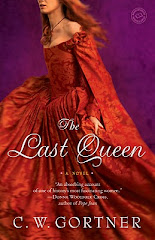
Better late than never, right? I wanted to again thank all the bloggers, in particular the fabulous ladies of The Historical Fiction Roundtable, where I'll be making my first official visit in May to promote The Confessions of Catherine de Medici. Bloggers tirelessly and enthusiastically championed my work in 2009; their support for writers is invaluable, and without them getting word out about my books wouldn't be nearly as fun or rewarding. I was also just informed by my agent that The Last Queen was mentioned on several Best of 2009 Reads, which is fantastic! I am very grateful, and so, I like to think, is Juana herself, who's definitely having the last laugh.

The Last Queen made the following Best Reads of 2009 lists:
Jo-Jo Loves to Read
The Burton Review
Historical Tapestry
Historical Fiction.com
Age 30+ A Lifetime of Books
Historically Obsessed

Thank you again, de corazon.