Pages

Monday, April 14, 2008

Interview with Judith Merkle Riley, author of THE SERPENT GARDEN

I'm honored to present Judith Merkle Riley, acclaimed author of THE SERPENT GARDEN, A VISION OF LIGHT, IN PURSUIT OF THE GREEN LION and THE WATER DEVIL (all re-issued recently by Three Rivers Press), as well as the sublime MASTER OF ALL DESIRES and THE ORACLE GLASS (soon to be reissued).

I had the tremendous good fortune to meet Judith in 2004 at the first U.S. Historical Novel Society Conference. I'd been a fan for years, and I was delighted to discover that she's as witty, observant, and intelligent as her books are. We struck up a friendship at the conference that has since flourished. She is responsible in no small measure for encouraging me to submit my work to my current agent, who ended up representing me and selling my books.

Judith writes about the medieval and renaissance periods; her lead characters are fictional women: ambitious, smart women chaffing against societal restrictions as they pursue with singular determination their heart's desires. While her characters often interact with historical events and people, what distinguishes Judith's work beyond its sparkling prose is her keen insight into the hearts of her characters and the patina of the supernatural that expertly interlaces with everyday life. No one is perfect in her worlds; and as in real life, the absurd often underscores the tragic. I rarely laugh out loud when I read a historical novel; with Judith's novels, I always do. She is a dame of the genre in every sense of the word; no one writes quite like her and her books are both delights and inspirations.

1. Judith, it's an honor to have you with us. Congratulations on the re-releases of your Margaret of Ashbury trilogy (A VISION OF LIGHT, IN PURSUIT OF THE GREEN LION and THE WATER DEVIL) and THE SERPENT GARDEN. It must be wonderful to see your work reach a whole new audience. Your novels are unique, in that you combine a scholar's historical insight and attention to detail with great wit and a dash of the supernatural. What inspired you to write historical fiction?
I LOVE historical fiction; I grew up on that and on Sci-Fi. I just didn't think I could write. In fact, as a kid, I thought fiction was some sort of eternal thought that came from another place not of this earth, and didn't "get" that actual people wrote it. I guess I still think that, even though I discovered I could write fiction myself. It all started when I wrote an academic non-fiction book, and my colleagues said it was suspect as social science because it was "too well written." Well, thought I (after much debate) if I write too well for my profession, why not try a better one? If the novel's awful, I can always hide it, and the colleagues will never know!

2. Your novels feature strong female characters who face, and often subvert or overcome, obstacles of gender and social circumstance. Margaret of Ashbury wants to write but is illiterate; Susanna, the heroine of THE SERPENT GARDEN, becomes a painter in a time when women rarely had careers. As a writer, how do you go about conceiving your lead characters? Do you find portraying their experiences as women of the past easy or challenging? Can you tell us about any methods you used to make your characters realistic and yet still accessible to the modern reader?
My lead characters are usually composites of women who actually did the things I write about. For example, writing a novel about people in the medieval period is greatly hampered by the fact that few wrote about their state of consciousness -- and who wrote about women anyway? The exception is the mystics -- and the women mystics who wrote (and usually had to dictate their writing to a priest) would generally begin:"I know I am only a woman, and should not write, but GOD told me to." So there is Margaret of Ashbury, and Margaret's God, as well. Who could resist? Susanna (of THE SERPENT GARDEN) is also a composite: she began when I discovered that Victorian-era historians had misread "paintrix" in the royal accounts for "nutrix" (nurse) because they couldn't imagine that a woman could be a painter! It's quite a feat of sexism to translate a painter into a wet nurse.

It is actually quite a challenge to portray a woman of the period and make clear the difficulties she faced without giving her a modern consciousness. In A Vision of Light, I used a framing narrative, and now I would find it very difficult to give up the first person, third person narrative. It lets one explore the social structure while keeping the "I" uncontaminated. There is also the question of portraying their relationship to their work in a realistic fashion. I once read a horrible novel about troubadours where all they did was tune their lutes in between bedroom scenes. It was pretty clear the novelist knew nothing about lutes, let alone music or musicians. We have a duty to try to put the reader into the 3-D alternative world seen by the characters. That's where the fun is, both for writer and reader.

3. Your novels take place in medieval and Tudor England, and later Renaissance France. Real historical figures often interact with your fictional leads. Do you feel responsibility to adhere to facts when recreating historical figures within a fictional framework?
I spend a lot of time with primary sources to try to keep the "real" historical characters as close as I can to what they did, saw, and felt. I don't rearrange dates or shift what is known about someone's personality into something more suitable for my purpose. (That is so '50's! I remember a book where the "She-Wolf of France" got a personality transplant and became a medieval Stepford Wife.) The problem comes when records are controversial, contradictory, or missing altogether. Sometimes you get surprises, too, when you start digging away, and someone is not at all what you have been led to believe. That makes it fun to write a "new" picture.

4. The supernatural forms a very real part of your fictional worlds, whether it's
alchemy i
n Margaret of Ashbury's England, witchcraft in THE ORACLE GLASS or devils in THE SERPENT GARDEN. Did people of these times believe in the supernatural as a real force upon their daily lives? What fascinating facts have you discovered about supernatural beliefs in your research?
As for the supernatural, it was so much a part of thinking back then, it would be unreal to leave it out. We forget that medieval people were Catholics, many went to mass every day, and they expected miracles. They also believed the Devil could pop up any time, and had probably offered one's suspiciously prosperous neighbor a slightly sulphurous contract. As for the witches in The Oracle Glass, we have the complete records of their interrogation under torture. They believed in a lot of what they did, and to the degree it was flim-flam, their clients certainly believed they had diabolical "powers." The age of enlightenment had barely gained a toehold in those days, and the wells of superstition were deep. The thing I wouldn't do, however, is stray from period beliefs -- say, putting space aliens into the 15th century. That's for another kind of fiction.

5. Historical fiction has become immensely popular of late, something we all can celebrate. Your novels defy genre conventions: they are historically accurate yet fictional in approach; they are based often on events that happened yet are transposed to suit the needs of your characters. As a novelist, you do a formidable job of combining these elements into exciting and often humorous accounts that shed more light on the realities of life in the past than many, more "serious" historical novels. Did you set out to create a novel that defied genre expectations, and if so, did you encounter difficulties during the process of submitting to publishers?
Yes to historical fiction! I never thought I was crossing genres. I just wrote what I liked to read. Luckily, I have a wonderful agent who understood what I was about and knew exactly how to sell my books. She sheltered me from difficulties and made everything work so that I could concentrate on writing.

6. How do you think your novel speaks to today's reader, or how do the events you evoke resonate in today's world?
I don't think I can write without portraying things that resonate with today's reader. Greed, the financing of wars, the bankruptcy of nations, desperate social climbing, the collapse of morals, and the struggle to survive are universal themes. But instead of writing "The French were bankrupting their state with bad accounting and tax policies and headed toward a violent revolution," I have greedy witches mocking commercial values, idiot money-hungry aristocrats, the rioting poor, and people who see clearly but differ on what to do about it. Everybody is keeping on keeping on, and hoping the whole problem will go away. Why wouldn't it resonate?

7. Please tell us about your next project.
Currently I have taken on something a little different. I am using a wonderful real-life character , and it is a challenge to keep her accurate, explain her back story without being tiresome, and keep the information about her later life from tainting the period about which I am writing. Composites are easier!

Thank you, Judith. It's been a pleasure and we're looking forward to your next book. In the meantime, readers can find the handsome new trade editions of her reissued novels whereever books are sold.

Monday, March 31, 2008

A little blatant self promotion

Okay, a little blatant self-promotion:
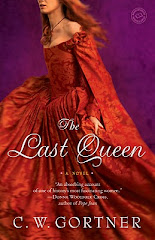
My cover art for Ballantine Books (US) of THE LAST QUEEN has arrived. I must say, I love it. I think it evokes Juana of Castile's mystery perfectly. I also have my UK cover art - well, actually a draft of it, on the left. I'm told it will undergo some PhotoShop magic, but the image is there. The contrast between the publisher approaches is fascinating: for different reasons, I like both. THE LAST QUEEN will be released on July 29, 2008 in the US and in October (tentative date) in the UK. I don't have Spanish, Italian or German cover art yet, but when I do, I'll post it. Hope you enjoy!

Monday, March 10, 2008

A Pharaoh Reborn

It's not easy to take on a well-known historical figure. Some are so familiar to readers - and often so over-written - it would seem there's nothing new anyone can say about them. In some cases, new books about such figures rely on subtle - and not so subtle! - shifts in the telling or reinterpret events through another's eyes, the "witness to history" point of view. In others, such as Karen Essex's KLEOPATRA and PHARAOH, new life is breathed into the story itself.
I've been a fan of Ms Essex's since I reviewed her third novel LEONARDO'S SWANS for the Historical Novel Society, yet when I came across used copies of her debut as a fiction writer, a two-volume set about arguably Egypt's most famous queen, I must admit I hesitated. I love historical fiction set in ancient Egypt; but I've read several novels on Cleopatra (including Margaret George's epic) and wasn't sure I cared to read another. I mean, how much more is there to know? The headdress, the grandeur, the asp: she's practically a cliche.
Fortunately, my ignorance didn't prevail over my insatiable curiosity and need to own every historical novel ever published. I bought both volumes in Ms Essex's series - KLEOPATRA and PHARAOH -and started the first one in the evening after dinner. By midnight, I had to tear myself away to brush my teeth and go to bed. And still, despite the fact that I had to work in the morning, I read for another half-hour. I finished the first volume in a week and couldn't sink my teeth into the second one fast enough. I carried these books with me everywhere. I missed a bus stop. I stole time at work to read. I didn't finish my website. I was obsessed.
Ms Essex is a marvelous writer by any standard. Her prose is luminous and precise; she structures her sentences with consummate style and her wit fits her subject matter perfectly. There were lines in these books I read over and over, simply for their beauty, such as the opening line to KLEOPATRA: "There is something about the air in Alexandria. It is said the sea-god Poseidon, who lived near the Isle of Pharos, blew a divine whisper over the town." Now, when a book starts like that, I'm all yours.
KLEOPATRA (spelled the way she herself did, according to her Greek origins) tells the story of Kleopatra's childhood to the time she inherits her throne. Her relationship with her eccentric father, Ptolemy XII Auletes, and her ruthless siblings; her fascination with Rome and keen awareness of her blood ties to Alexander the Great and to Egypt, as well as her awakening to the dangers and euphorias of power are gorgeously rendered. Even more importantly, this is a Kleopatra we haven't met. Not the adventuress, the siren, the scheming manipulative seductress - roles she's been forced into by later historians; roles so often allotted to women in history and, to this day, still perpetuated by even our allegedly enlightened society. No, here she is keenly observant, cunning, vital, bold, curious and handsome - but not beautiful: an intelligent, often narcissistic princess who learns the price she must pay for survival. The brutality of court life is not glossed over or exaggerated; it's simply there, a fact, sometimes swift and shockingly cruel. The pleasures of court life are depicted with heady aromatic sensousness and an erudite knowledge of the pagan glories that fueled the ancient world; as Kleopatra matures into the extraordinary woman she will become, we mature with her.
In PHARAOH, the story becomes more familiar as Kleopatra forges her alliances with Julius Caesar and Marc Antony, and grows all too intimate with the chaotic savagery and hypocritical refinements of Rome. Yet again, the unexpected reigns: Caesar is world-weary and set apart by his divine attributes, even as he recognizes Rome's unworthiness. Marc Antony, on the other hand, is an eager Herculean boy - pummeling his way through life with a meaty grin and ultimately fragile self-worth. As she binds herself, and the future of Egypt, to these very different men, Kleopatra herself evolves into an astute ruler whose one terrifying caveat is her dependence on the very civilization that seeks her downfall. Her myth, her courage, her lust, her mistakes: these are all here, too, portrayed with sensibility and an astonishing lack of sentimentality.
In this era, when the history is so often downplayed, oversimplified, distorted or romanticized to suit the fiction, these novels are, in my opinion, sublime examples of what a writer dedicated to authenticity can achieve, even with a character as maligned and exploited as Egypt's last pharoah. Ms Essex's new novel STEALING ATHENA will be released June 17. I can't wait.

Friday, March 7, 2008

Another exciting giveaway at LoadedQuestions.com

My friend Kelly Hewitt has announced another exciting giveaway at LoadedQuestions.com. Read an interview with Catherine Delors, debut author of the highly anticipated MISTRESS OF THE REVOLUTION, and sign up to win one of five free copies. Follow this link and good luck! http://loadedquestions.blogspot.com/2008/03/loaded-questions-free-giveway-mistress.html

Sunday, March 2, 2008

Perspective

Last week, I had a life-altering experience that put my life into perspective.
I've been distracted of late, focused on getting my new website ready for its debut in mid-March, to coincide with the mailing of the galleys (Advance Reading Copies) of THE LAST QUEEN. Last week, I also turned in the manuscript for my Catherine de Medici novel, after a feverish four months of editing following my agent's wonderfully insightful comments. It's all been quite exciting, but I've been rushing to work and to home, walking my dog Paris in between, and not very attuned to the moment, as they say.

I love going up to the park after work with Paris because it reminds me that the best things in life are, to quote a cliche, free -- fun, laughter and love. My dog has been with me for almost eight years; I got her when she was nine weeks old. I'd been inconsolable over the recent loss of my previous pet and Paris was so beautiful with her tricolored markings and milky puppy eyes, I felt she'd come to me just when I needed her.

Last Tuesday night at around 6:45, we were in the park with friends and their dogs when out of nowhere Paris let out a terrified sound unlike anything I'd heard before. I saw her being attacked by a small pitbull. It had Paris by the back of her throat, at her ruff, only two or three paces from where I stood. As my dog started screaming, I threw myself on top of the pit. I knew instinctually that unlike other scuffles we've had over the years with other dogs, this one might cost Paris her life. I straddled the pit (by now, it was dark outside, so my friends were rushing to secure their pets and try to help me) and shoved my hands into its mouth to pry its jaws off my dog. It didn't take more than half a minute to get the pit loose but it felt like eternity. My adrenaline was pumping so hard I couldn't hear my own screams, though later my friends said I was wailing, hitting the pit in the face and thrusting my hands between its jaws.

When it finally let go, its jaws snapped shut on my hand. The pain shot right up my arm into my shoulder and back, paralyzing in its intensity. I yanked my hand out as the pit lunged after Paris again. I slammed it in the face with my knee and saw it bite me, but I didn't feel anything. I scrambled to Paris, grabbed her up in my arms and went racing to my car. I could see lots of blood and she was panting hard as I put her in the car and my friends started assisting me. My hand had gone numb and was starting to swell; when I happened to glance up as one of my friends went running to her house to fetch towels, I saw the owner had leashed the pit and was staring at me with a stunned look on his face. He said, "My dog has never done this before."

One of my friends cornered him to get his information, while another called my partner and then rushed Paris and me to the emergency vet. There, they kept Paris under observation for five hours, in fear her trachea had been ruptured. Her ear was lacerated badly (part of the lower lobe was torn off) and it bled a lot, plus she had two deep punctures on her upper back where the pit grabbed her. Fortunately, she showed no trachea problems and the vets let me take her home after dosing her with antibiotics and pain meds. They didn't want to perform any surgery because they said she was too traumatized and needed to rest overnight, so the next day I took her to my regular vet where they stitched up her ear and her back. They put a shunt in her back to drain away the infection, and told me to hot compress the area four times a day.

Yesterday, the shunt came out. She appears to be healing well, physically and emotionally. My vet told me that I saved her life, as the angle of her wounds indicate to him that the pit was, in fact, trying to get her by the throat to kill her. We have no idea what provoked the pit but when I reported the attack to Animal Care and Control they said pits can do this, for no apparent reason. It was off leash and so was Paris, but my dog isn't aggressive, and I suspect the pit came after her ball. Whatever the case, all I know is that one minute we were tossing the ball and the next the pit had barreled into her.

I had to get a tetanus shot and I'm taking a 10-day course of antibiotics (the same as Paris's, only the human grade). One of my legs is punctured from the bite and the other leg is badly scraped from fighting with the pit on my knees on asphalt, near where Paris and I were playing. Oddly enough, my hand wasn't wounded save for a tooth graze from the pit's incisor on my ring finger but moving my fingers hurt for days. My doc says the tendons are inflamed and will slowly heal. I was totally freaked out, of course; the next day when it all sank in, I broke down in tears at the vet's while waiting to pick up Paris after her surgery.

The pit's owner paid the vet fees and surrendered his dog to be destroyed. He reiterated that his dog had never attacked another dog before, but then he added, "She's almost four years old and if a pit is going to turn, that's the age when they do it." I replied that he was totally irresponsible for knowing this and still letting his pit run off leash in a public park where there are other dogs, especially smaller dogs. But in the end, I mostly felt sad that the event had caused my dog so much pain and taken the life of another dog. Though I believe that after such an attack, the animal can't be trusted, I've always been a strong advocate that when things go wrong, it's not the animal's fault but rather the owner's. And it was clear to me that this guy had no idea of the type of his danger his dog might pose. Animal Care and Control informed me that every month in San Francisco there are two to three serious pitbull attacks on animals.

While it's been the most terrifying thing I've ever been through, it has put life into perspective. I feel like one of those moms who's lifted a car off her trapped child. My entire body was so sore when I woke up the next day, I knew I'd used muscles that I didn't even know I had! More importantly when I woke up, I saw Paris asleep between my partner and me, and I realized how close I'd come to losing her. Life can turn on us like a pit bull, fast and unexpected. I promised myself that henceforth I'll be super vigiliant in the park, but even more so, I'll be more aware of the importance of living every day in the moment.
Tuesday, February 19, 2008

Interview with Brandon Wilson, author of ON THE TEMPLAR TRAIL

I'm breaking the mold here at Historical Boys to feature my friend, Brandon Wilson, an amazing world traveler and writer. Though Brandon isn't an historical fiction writer, history permeates his work and I've reveled in his thrilling accounts of his travels through some of our planet's most fascinating places, where the past and the present often collide with unexpected results.

Brandon's fascination with what he calls “deliberate travel” began when he and his wife Cheryl became the first western couple to walk a traditional Buddhist trail from Lhasa, Tibet to Kathmandu. A world adventurer and perpetual pilgrim, Brandon has walked six of the world’s most important pilgrimage trails: the Camino de Santiago and Via de la Plata across Spain, the St. Olav’s Way across Norway, and he was the first American to walk the 1150-mile Via Francigena from England to Rome.

In 2006, he pioneered the 2620-mile Templar Trail, walking a peace pilgrimage through eleven countries from France to Jerusalem along the route of the First Crusades. Brandon's Wilson’s book about that journey is Along the Templar Trail: Seven Million Steps for Peace. He is also the award-winning author of Yak Butter Blues: A Tibetan Trek of Faith and Dead Men Don’t Leave Tips: Adventures X Africa. His story about a year spent living in the Arctic, “Life When Hell Freezes Over,” appeared in They Lived to Tell the Tale: True Stories from the Legendary Explorers Club.

His photos have won awards from National Geographic Traveler and Islands magazines. His 50-photo essay on the Via de la Plata will be featured in Naïve and Abroad: Limping Across Spain, A Pilgrimage Through History by Marcus Wilder.

Brandon, a member of the prestigious Explorers Club, is a walker for peace and human rights. Ti learn more about Brandon and his work, please visit: http://www.pilgrimstales.com/.

1. Congratulations on the publication of ALONG THE TEMPLAR TRAIL. It's an honor to have you with us. You've written two previous books about your incredible travels (YAK BUTTER BLUES and DEAD MEN DON'T LEAVE TIPS) but ALONG THE TEMPLAR TRAIL has special significance for you. Please tell us about how this marvelous story came about and what inspired you to take a journey of seven million steps to peace?
I have been infected with wanderlust for years now. It’s my “sweet addiction.” In 1992, during a walk across Tibet, what began as purely an adventure transformed into a journey with greater meaning. In Lhasa, once we learned that Tibetan people today are forbidden to walk to their sacred sites in Nepal, we vowed to make it in their stead. Walking across the Himalayan Plains became a transcendent experience. I was hooked on slow, deliberate travel, or travel with a purpose. Since then I’ve been fortunate to have the chance to walk many of the early pilgrimage routes across Europe. These trails provide a chance to wallow in history, art, culture, and cuisine. They also nourish a sense of brotherhood, connectedness with nature, physical and mental growth, as well as a Zen-like link to the spiritual.

In 2006, I was surprised by an invitation from an old pilgrim friend. Would I be interested in walking to Jerusalem with him? Although it was an odyssey much longer than I’d ever attempted, I instantly knew the answer. The historic path would take us over 2600 miles across eleven countries and two continents. Our route would follow that of the First Crusades and the first Knights Templar.

From the very start, I was determined to make the trek not only as a personal pilgrimage, but also as a walk for peace. I wanted to talk to folks along the way about the necessity of solving our problems in a more enlightened manner than resorting to war as we had the past millennia. To that end, I eventually hoped my book would re-launch this historic trail as an international path of peace that others could walk in brotherhood, regardless of nationality or religion, much as they follow Spain’s Camino de Santiago.

Eventually thousands will walk this same path each year, sharing blisters, food and conversation. Once they walk together, they’ll discover a connectedness, a personal peace. They’ll return to their families, jobs, communities and countries with greater tolerance and belief in our commonality as human beings. They will embrace the ideal of cooperation on our increasingly fragile planet.

2. You've traveled to some amazing places that most people have only heard of, and your books are full of the wonder of discovering new places, as well as the travails of finding yourself in situations you were totally unprepared for. Of all your experiences in your travels, which has left its biggest impact? What challenges were the most difficult to overcome? What surprising or interesting historical facts did you discover?
Each journey leaves its mark. They have all been transformative. I never return home the same person. Walking across Tibet and doing what the Chinese authorities called “Impossible,” changed my outlook. It enabled me to never again give up—even while pushing the limits of survival. My wife and I were shot at, trudged through a blizzard, slowly starved, never knew where we would spend the night—or if we’d be taken into police custody.

Yet we learned to have faith, faith that the Universe would provide, that we were meant to be there, that there was some greater purpose to it all.

More recently, walking from France to Jerusalem brought us into contact with thousands of ordinary people. Many have struggled for centuries with the devastation of war on their doorstep. Its challenges were plentiful, even though the setting was more “civilized” on the surface. The basic necessities of eating, drinking, and sleeping were always in question as we tried to follow a thousand-year-old map. Weather varied from freezing snow to weeks of rain to months of shadeless terrain with temperatures hovering near one hundred degrees.

Politics turned out to be the greatest unknown. By the time we arrived in Serbia, Israel had bombed Beirut Airport, southern Lebanon was being evacuated, there was a bombing attempt on the US Embassy in Damascus, and Western travelers were gunned down in Amman, Jordan. Oh, and an Ebola-like virus raged in central Turkey.

Still, without exception, in every country, the people were curious and kind when they discovered the reason for our journey. Our message found great acceptance. The people are so very tired of endless war and some were moved to tears when they heard of our quest. Historically, we were reminded time and time again of our cultural connections. In places like Istanbul and divided Cyprus, we were told how Muslims and Christians had historically lived and traded in peace for centuries. Muslims would often add, “We are all descended from the same tree of Abraham, right?”

By the end of 160 days, I felt even more strongly that we all share the same dreams of health, education, opportunity, security, and need of a homeland. When we realize this, we release the fears and prejudice propagated by governments, corporate sponsors of destruction, and religious demagogues. It becomes more difficult to take up arms against each other. Every war becomes a civil war when all men are brothers.

3. You've encountered a series of interesting characters in your travels, in particular that madcap assortment during the first league of your African adventure. Indeed, I find when I read your books that I learn not only about the countries you've been in but also about the foibles and eccentricities of human nature. Whom have you met during your travels that you found most enlightening, and why?
Mark Twain once said, “You never really know whether you love or hate someone until you travel with ‘em.” Traveling as I do puts you into close contact with people—sometimes too close. It wasn’t the Africans we found frustrating. Travel is an intense experience and folks travel for different reasons. We were ready to wallow in the minutiae of African life—while our companions would have been just as satisfied staying at home with cold beer and a warm bed.

Wherever I travel I truly enjoy meeting and sharing with local people and learning about their lives. Ordinary people enlighten me: former monks in Tibet, African villagers, or army officers and Palestinians in Israel. I enjoy sharing their lives however briefly. I am inspired by their strength, faith, optimism and universal hope for peace. If only we can re-channel that fortitude, we can reshape our society, re-prioritize our budgets, and wage a lasting peace. As many reminded me, only our governments stand in the way.

4. Which country would you like to return to and why? Can you tell us about the country that proved most controversial for you as a traveler and writer?
There are many countries I’d like to experience again. Even spending as much as a month at a time in one area, you only begin to scrape the surface of a culture before you move on. It’s always enlightening to go back and see how it (or you) has changed in the years since.

I would like to return to the Middle East, as it has such a vast history and culture. Although it is wracked by tension, it has such great potential to present a positive example to the rest of the world. On the other hand, I have hesitated returning to Tibet. Since the completion of the railroad from Beijing to Lhasa, millions of Chinese visitors have arrived, outnumbering the local Tibetans. Soon, Tibetan culture will become a vestige of the past. Who will be left to give the eulogy? Tibet was the ultimate challenge to me as a traveler and writer. It is disheartening that a nation can be so ravaged while the rest of the world looks away—or worse, is more concerned with making money by peddling soft drinks and hamburgers to a billion Chinese.

3. How do you think your work speaks to today’s reader and/or how does it resonate for today’s world?
I like to believe my books bridge the typical travel genre by infusing a place with adventure, history, culture, the mystical, and social conflict. I avoid using broad brush strokes to describe a place. Readers have grown tired of hearing about another beautiful sunset or charming restaurant. And I can’t blame them.

Traveling slowly, often on a small budget, I experience the good, bad and gritty of each destination. That often brings out the good and bad in people—as well as myself. At the risk of sounding like a terrible person, I strive to expose it all. I keep copious notes. That way, all the ups and downs are remembered, as well as the small triumphs and laughs that make each day unique.

In a world of constant sensory stimulation, I like to remind people about the small joys that still exist in our world. I like to share moments of magic and serenity in secluded places. I like to dispel prejudices by reminding readers how much alike we are when it’s all said and done. I like to inspire others to see the world for themselves without hesitation or fear. I like to challenge them to discover a personal peace, and as Gandhi once said, “To be the change they would like to see in the world.”

4. Please tell us about your next project.
Only the wind knows—but my walking stick is calling to me once again.
Thank you, Brandon! We look forward to reading all about your next trip!

Thursday, February 14, 2008

A Valentine's Day greeting from my friend, the poet Joan Gelfand

CUPID
Joan Gelfand


Cupid lies. With a full belly, and half smile
He dreams of the perfect shot, a bulls-eye of love!
A love that lasts a while.

One wing over his chest, one wing in repose,
Even in sleep, he cannot forget the lovers.
In readiness, he clutches his bow.

Cupid, our original baby, eternal angel
Relishes the job, don’t you think?
The challenge:
A skillful game of calculated alignment.

Or, does he dream of darker tasks --
Getting out of the business perhaps?

Oh, Caravaggio, did you really cry for love?
You sketched Cupid and legions of critics
Spent their lives unraveling your dueling passions
For a whore, and paint. Did Cupid do you wrong?
Did his arrow miss its mark?

Here’s the truth, or at least the way I see it.
Cupid was recruited for the job by his maker -- Caravaggio too.
Two destinies, one diabolical feast.

Inspired by “Amore Dormiente” by Caravaggio on display in the Pitti Palace, Florence, Italy
"Cupid" was recently published in "Oakland Out Loud" the PEN Anthology which includes such literary lights as Al Young, Ishmael Reed and Lucille Lang Day. To learn more about Joan, please visit: http://jg.typepad.com/

Thursday, February 7, 2008

Interview with Sandra Worth, author of LADY OF THE ROSES

I am honored to welcome Sandra Worth, author of the recently published LADY OF THE ROSES. Sandra has won ten awards for her Rose of York trilogy, including the First Place Prize in the 2003 Francis Ford Coppola-sponsored New Century Writers Award. Her work has been translated for publication in Spain and Russia and she recently signed a two-book deal with Berkeley (Penguin.) A dedicated researcher and writer who brilliantly evokes the complexity of Plantagenet England, she lives in Texas with her husband and their new German Shepard puppy.
1. Congratulations on the publication of LADY OF THE ROSES. It's a delight to have you with us. Set in 15th century England during the terrible years of the Wars of the Roses, LADY OF THE ROSES is a vividly dramatic and romantic account of the lifelong love affair between Isobel Ingoldesthorpe and Sir John Neville, brother of the famous Yorkist leader Warwick, the Kingmaker. Though this period in history is amply covered in fiction, these characters have not been, and the intensity of their relationship offers a compelling contrast with the violence raging around them. You yourself have written about the later years of the Wars in your Rose of York trilogy. What inspires you about this era and why did you choose to write about these characters?

Thank you. It's my pleasure to be your guest. You are correct. I began my career by writing about the later period of the Wars of the Roses. This story takes place earlier, in 1456, six years before the setting of my debut novel, Rose of York: Love & War. It is, in a way, a sort of "prologue." The reason I chose to go to go back in time for this book is that I received quite a few inquiries about John, Lord Montagu, after my debut novel came out. It seems he had touched my readers' hearts and they wanted to know if I was going to do a book on him. At the time, I had no plans since I was occupied with moving forward in the period. However, when the trilogy was completed, I decided to tell John and Isobel's fabulous, untold love story.
2. LADY OF THE ROSES offers meticulous attention to detail, including the daily household management of a manor, as well as a complex series of alliances. What challenges did you encounter while researching this book? What surprising or interesting facts did you discover about your characters and their place in history?
My greatest challenge was unearthing information about John and Isobel. Though he was the greatest military figure of his time and played an enormous role in the events that changed history, he has never been the subject of a biography. As for Isobel, there is even less information about her, simply because women were not really noted by contemporary chroniclers unless they were queens or princesses and played a significant role in politics. I had to creatively fill in the blanks in order to connect the complex historical events that took place. The most surprising-- and hopefully interesting-- fact I uncovered was that John and Isobel are the medieval ancestors of both President FDR and Prime Minister Sir Winston Churchill! When you consider they were from the enemy camps of York and Lancaster, it seems a miracle that they were able to wed. It gives me pause to consider the terrible possibilities if FDR and Churchill hadn't been here to defeat Hitler. Our modern world might be a very different, and perhaps quite terrifying place. But Destiny seems to be have worked on our behalf.
3. An interesting storyline within the novel is Isobel’s relationship with Marguerite of Anjou, the Lancastrian queen who became a byword for evil. Is there any evidence to support Isobel's relationship with the queen and why do you think Marguerite of Anjou has been judged so harshly by history?

There is no evidence to support the relationship between Isobel and Marguerite d'Anjou because virtually nothing is known about Isobel. This has been my creative invention. As to why Marguerite d'Anjou has been judged so harshy by history, we merely need to look at her actions. As they say "Actions speak louder than words" even across the chasm of centuries.

5. LADY OF THE ROSES is unique in that your lovers are not star-crossed, but rather often the only anchor in each other's lives during severe tumult and the loss of family members and loved ones. Yet you admit in your afterword that almost nothing is known about Isobel, in particular. Why do you think she has been largely ignored by history?

It's not that Isobel was ignored in particular-- just that women were ignored in general during this time frame of history. Unless they were princesses or queens, and had some impact on policy, no one really bothered to record much about them. Other records that migh illuminate Isobel over the divide of centuries, like letters she wrote, or the will she left, have not survived. Even her tomb is lost.

6. Can you tell us about any methods that you employ to give your characters authenticity?

Research, and more research! What they did, what they said, all these throw light on their character. When such information is missing, as in Isobel's case, I take the events of the period and try to view them from the standpoint of the person I'm writing about and the situation they find themselves in at that moment in time.

7. How do you think your novel speaks to today’s reader or how do the events you evoke resonate for today’s world?

Interesting question! A reviewer wrote that Isobel's story has a contemporary feel. With your indulgence, I quote: "Readers will relate to the highs and lows of the relationship between John and Isobel, the forces beyond their control that act to determine their destinies, and their everyday struggles (including money problems and long periods of single parenthood) in a world divided between Lancaster and York."

8. Please tell us about your next project.
My next novel is entitled THE KING'S DAUGHTER: A NOVEL OF THE FIRST TUDOR QUEEN, coming December 2008 on Elizabeth of York. A remarkable women who was the daughter, sister, niece, wife, and mother of English kings, she led a dramatic life that took her through four reigns. As Richard III's niece, she witnessed the disappearance of her brothers, the Princes in the Tower, and as Henry VII's queen, she was privy to the possible re-emergence of her younger brother in the Pretender. Did she, or didn't she believe the Pretender to be her brother, Richard, Duke of York? And if she believed he was, how did she deal with his execution by her husband, Henry VII? It's quite a tale. I hope you'll read more about her on my website http://www.sandraworth.com/
Thank you, Sandra. We're looking forward to reading your next book!

Wednesday, January 30, 2008

Interview with Robin Maxwell, author of MADEMOISELLE BOLEYN

I recently had the pleasure of reviewing Robin Maxwell's latest work, MADEMOISELLE BOLEYN, for the Historical Novel Reviews. In this novel, she returns to the subject of her debut bestseller, Anne Boleyn; this time, however, she depicts Anne's life in the court of France before her celebrated rise to power as Henry VIII's second queen. Robin is a delightful woman to correspond with, full of wit and verve, in addition to her extraordinary talent as a writer. She's been a favorite of mine for years and I'm honored to welcome her for her very first blog interview.

Robin Maxwell is the author of six historical novels. A 15th and 16th century history nut who can't seem to stop writing about the historical figures she feels have been overlooked by historians, or have a side of them that hasn't been properly explored, she lives in the rural high desert of California with her husband of 25 years, yogi Max Thomas and two wonderful exotic birds who are her muses. Visit her at: http://www.robinmaxwell.com/


1. Congratulations on the publication of MADEMOISELLE BOLEYN. It's a pleasure to have you with us. Set in 16th century France, MADEMOISELLE BOLEYN is a compelling, imaginative account of Anne Boleyn’s youth in France. This period in her life has hardly been addressed in fiction, compared to her later career as Henry VIII’s most famous wife, though many historians believe it was during her stay at the court of François I where Anne learned about the perils and power of becoming a royal mistress. You have of course written about Anne Boleyn before, in your wonderful debut novel THE SECRET DIARY OF ANNE BOLEYN. What inspired you to return to her as a character and explore this particular time in her life?

Thanks for having me. This is my first blog interview. When I see what's happening with web technology and how little I know about it, I sometimes feel like I'm still living in the 16th century. As for writing about one of my favorite historical personages at this specific period, it was one of those amazing graces -- no historical fiction had been written about Anne Boleyn during that most fascinating period of her life, ages 8-17. The time that she was becoming the Anne Boleyn that everyone knows, or think they know about. Here was a fabulous, sexy world -- the lascivious court of Francois I -- all ripe for the picking. Having a new angle on an oft-told story or character is, I think, one of the keys to a successful historical novel.

Interestingly, I found the same opportunity twelve years ago when I started writing SECRET DIARY. There had been a lull in fiction writing about Anne. Of course I read everything I could get my hands on -- fiction and biography. And it suddenly occurred to me that no one had truly made the connection between Anne and her daughter, Elizabeth I. Maybe a few sentences or a paragraph. But nothing about how that mother affected that daughter's life and choices. The older I get the more it becomes apparent that our parents' influence is with us from birth to death. With Anne and Elizabeth there were limitless possibilities. In MADEMOISELLE BOLEYN, it is the Boleyn sisters' father, Thomas Boleyn, who is the great and terrible influence.

2. MADEMOISELLE BOLEYN offers a fascinating look at the court of France during François I’s early years. What challenges did you encounter while researching this time? What surprising or interesting facts did you discover about the French court and Anne’s place in it?

First of all, I had never been in France (I'd been to England three times). There's so very much you can do with books and the internet. But I was particularly stumped about the feel of Paris in 1515. I mentioned this to my wonderful editor at Penguin, and she told me that her mother had spent a lot of time in France. She gave me her mom's phone number and subsequently she and I had some wonderful conversations. I asked her a lot about geography -- there was only so much I could get from maps from the period -- and she even did some research for me. She found a great website that I hadn't seen. My favorite discovery had to do with how well-loved Anne Boleyn was before she returned to England at age 17 and the whole Henry VIII saga began, a period that was filled with jealous enemies -- ones that eventually saw to it that Anne was beheaded and her reputation besmirched. In the courts of Burgundy and in France she was a little dark-eyed wonder. Precocious and charming. A quick study in French who became, at a very tender age, the English interpreter for Claude, the Queen of France. She also became a favorite of King Francois' sister, the progressive and scholarly Duchess Marguerite. This woman opened Anne's eyes to the "New Religion," Protestantism, and later Anne was the person who first brought these ideas to Henry VIII, and with it the Protestant Reformation to England.

3. An interesting storyline within the novel is Anne Boleyn’s friendship with Leonardo da Vinci, who had come to France to live at François I’s invitation. There is no extant evidence to support Anne’s meeting with Leonardo, so how did you go about creating this situation so that it would fit within the facts of her life?


I was in the process of researching THE DA VINCI WOMAN -- a novel about the Italian Renaissance seen through the eyes of Leonardo's mother -- when I decided to change course and write MADEMOISELLE BOLEYN first. When I saw the places (the French court at Amboise) and the dates I was going to be writing about in the Boleyn book, 1514 - 1522, I realized that several of those coincided with Leonardo living as a guest at the French court, in fact as a dear friend of Francois. I went rushing to my Anne Boleyn biographies, and in three of them, they mentioned that Leonardo Da Vinci was living there at the same time she was. One even suggested that it was likely that they knew each other. That was all it took, and I was off and running. That they became friends is my invention. But there is nothing in the historical record to say that they were not. The "secret passage" between Amboise and Cloux (the manor house Francois gifted Leonardo that I write about) was a discovery I made on a website about Amboise. That was like finding a gold nugget!

4. You have written not only about Anne Boleyn, but also in subsequent novels about her daughter Elizabeth I and Elizabeth’s lover Robert Dudley (THE QUEEN’S BASTARD), the pirate Grace O’ Malley and Essex (THE WILD IRISH), and the disappearance of the princes in the Tower during the time of Richard III (TO THE TOWER BORN). Can you tell us about any methods that you employ to give your characters such marvelous authenticity?

It's a combination of intensive research -- reading EVERYTHING I can get my hands on about an individual, his or her close and not-so-close relationships, and the period and places from history books and biographies and the internet. I do NOT read any historical fictions of the period, terrified of unconscious plagiarism. It's important to look deep in this reading period, because what appears as a tiny fact or a small character, can turn into an important one. A perfect example: during my research for SECRET DIARY OF ANNE BOLEYN, I read one sentence in one history book. It said that Anne had a woman fool. Nothing else. But that struck a chord. I started asking myself who that fool was. How she became a fool (did she come from a family of jesters, did she go to "fool school?"). How she ended up in Anne and Henry's court. I knew that fools were the only people who were allowed to speak the truth in that ruthless, terrifying environment, and that this character would have to be humorous. The one thing Anne's story, especially the last three years of her life as the queen, were as serious as they got, so a fool was a perfect addition. Enter Niniane. She became a wonderful character and has one of the best, most emotional lines of the book.


With THE WILD IRISH, I actually made a 3'x6' chart with every year from 1530 (year of Grace O'Malley's birth) - 1601 (end of the story) down the left hand column. Across the top I wrote the names of Grace, Elizabeth I, Tibbot Burke (Grace's son), the Earl of Essex, Richard Bingham (villain), Hugh O'Neill (arch rebel) and then "all others." Under each heading I made a column. Then I went through every history book and biography I had and filled in the blanks as in "in this year, such and such happened to Grace O'Malley - giving birth to Tibbot, what year Essex left with the English army to fight in Ireland). Then I was able to track and cross-check everything. A story emerged from the chart, one that was as close to the history of the period as possible.

Of course there are giant holes in history, action that was not reported that had to have happened, things that we'll never know about personality, what people actually said in human words to each other, what they were thinking, and especially how they were feeling. All the stuff that takes the information out of the realm of history into the realm of historical fiction. I use extrapolation to help me jump the chasm from the known to the unknown. I have to be a detective or sorts, to read between the lines, and a psychologist to figure out what a person must have been going through emotionally. I have very strong memories of my own relationships and feelings and moments in my own life, so I use them liberally. I try every chance I get to slip into a character's shoes. Say to myself, "If I were facing this person and this situation, considering my background, my history with that person and which side of the bed I got out of this morning, what would I say, what would I do?" I also believe that most of the basic emotions I write about in the 15th and 16th century -- love, lust, hatred, fear, jealousy, humiliation, pride -- are all emotions we still have today. I just try to put them into context and in words that fit the period.
That, I think, is what gives characters their authenticity.

5. Your novel offers a candid and at times difficult look at how women were used as chattel by the men who sought power through them. Both Anne and her sister Mary were exploited by their father to further the Boleyn name and prestige at court. Why do you think Anne proved the exception, in that she took charge of her own destiny, defying the odds to become queen of England? Do you believe that had she not gone abroad at such an early age, her destiny might have been different?

I definitely think that her years abroad are what took Anne from being a provincial girl to being the great woman she became. That is where she got her extraordinary education. In fact, the working title for the novel was The Sexual Education of Anne Boleyn. But of course she got much more than a sexual education. In particular, she got a religiously progressive education from Francois' beloved and indulged sister, Marguerite. Of course I think Anne had the seeds of an exceptional character from the get-go. She was eight when she went to the court of Burgundy, and by nine she had learned the French language sufficiently enough to become a royal translator for Queen Claude.

6. How do you think your novel speaks to today’s reader or how do the events you evoke resonate for today’s world?

I just wrote an op ed piece called "Hillary Boleyn." It compares Anne and Hillary Clinton, showing how it's not so different now and back in the 16th century when it comes to a woman who aspires to great things -- one who refuses to shut her mouth, one who stands up to the male establishment. How badly these women are treated, especially by spin doctors and the press, and the people who are failing to shut them up. Anne Boleyn helped bring the Protestant religion to England. For that, and having too much influence with Henry for too long, she was reviled and ended up headless. Hillary, as First Lady, took on the American "MegaChurch with Two Heads" - the pharmaceutical and health insurance companies -- and she was cut off at the knees. Told to go home and bake cookies. And let's not forget, there are still huge swaths of the world tin which women are bought and sold into marriage and even sexual slavery by their fathers. Some things change. Others don't.

7. Please tell us about your next project.

The DA VINCI WOMAN may become my masterpiece. I had to move to a different era, a different country and learn about all new personalities. I chose the most fabulous of them --- Leonardo Da Vinci, his mother Caterina, Lorenzo "the Magnificent" Medici and his brother Giuilino, Boticelli, Savonarola, Roderigo Borgia, and the members of Florence's "Platonic Academy." I took on not only the Renaissance that everybody knows about (learning about the art and architecture) but also what I call "the Shadow Renaissance," which I think is the true Rebirth. It had to do with science and philosophy, Hermeticsm, alchemy, the occult and esoteric learning. Talk about having to dig! But I found precious gems everywhere I looked (if I looked deep enough). It is an emotional book, perhaps the greatest love story I've ever written between and man and a woman, and the deepest and most beautiful relationship I've written between a parent and child.

Thank you, Robin. We're looking forward to this next novel by one of the genre's most genuine and delightful writers.

Tuesday, January 29, 2008

THE LIAR'S DIARY, in support of Patry Francis

January 29, 2008

Today is a very special day. Over 300 bloggers, including bestsellers, Emmy winners, movie makers, and publishing houses have come together to talk about THE LIAR'S DIARY by Patry Francis. This is an unprecedented grass-roots effort to showcase the book and give it the attention it deserves on its release day while Patry takes the time she needs to heal from cancer. When I was invited to participate in this event, I didn't think twice. Several of my close friends have battled cancer over the years; and Party's story touched me deeply.

Patry and I share the same literary agency. I've never met her personally, but I have met her agent. This is an agency with soul and I mean it: I'd had four previous agents and been rejected for over twelve years. Trust me, it had to take serious soul to convince me to get back on the bizarre carnival ride that is submissions. My agent Jennifer, however, took me by the hand, just as I imagine Alice took Patry, and two of my books were sold via auction to Ballantine in January of 2007. As I approach my publication date in July of this year, I'm overwhelmed by all the excitement, the hard work, the thousand and one details required of me as an author in today's highly competitive world, where we're all vying for attention and dollars against big budget Hollywood DVDs and extravagantly noisy and bloody video games. I actually feel as if I'm gearing up for a marathon race -- a hard sprint to get the book noticed, to beat the seemingly impossible odds and actually move enough copies to merit another advance, another chance to keep doing what I've wanted to do for as long as I can remember: write. Maybe one day, if I'm really lucky, I'll even get to do it full time.

I can't imagine running this race alone, much less while battling cancer. Like me, Patry's dream came true; but with her dream came an unexpected challenge that puts everything into undeniable focus. Patry is facing it with incredible grace and trust. And look! All around her has bloosomed this community of writers and bloggers who prove that soul exists still in this harsh reality of publishing and surviving. I am truly honored and blessed to have been invited to her party. I don't know her but she's me; she's you; she's all of us, who strive and struggle and believe and never know what tomorrow holds.

Patry Francis worked for years as a waitress and then went home at the end of the day to her husband and four kids, and in those rare minutes of free time, she dared to dream that one day she might write a book. After years of rejection she found the fantastic Alice Tasman at the Jean V. Naggar Literary Agency, who sold her manuscript. Just as her book was due to be released, she discovered she had an aggressive form of cancer.

The effort to get the word out for Patry has made visible a community that is, and has been, alive and kicking - a community that understands the struggle artists go through and rejoices in each other's successes. It's a community made up of many small voices, but - guess what? - those many small voices can create some noise. So while today is for Patry, it's also a symbolic gesture for all of you who work so very hard for little or no recognition, for all of you who keep going despite the rejections, and for all of you who have had illness or other outside factors force your art or your dreams aside. We are in this together.

THE LIAR'S DIARY answers the question of what is more powerful—family or friendship? this debut novel unforgettably shows how far one woman would go to protect either. They couldn’t be more different, but they form a friendship that will alter both their fates.
When Ali Mather blows into town, breaking all the rules and breaking hearts (despite the fact that she is pushing forty), she also makes a mark on an unlikely family. Almost against her will, Jeanne Cross feels drawn to this strangely vibrant woman, a fascination that begins to infect Jeanne’s “perfect” husband as well as their teenage son. At the heart of the friendship between Ali and Jeanne are deep-seated emotional needs, vulnerabilities they have each been recording in their diaries. Ali also senses another kind of vulnerability; she believes someone has been entering her house when she is not at home—and not with the usual intentions. What this burglar wants is nothing less than a piece of Ali’s soul. When a murderer strikes and Jeanne’s son is arrested, we learn that the key to the crime lies in the diaries of two very different women . . . but only one of them is telling the truth.

A chilling tour of troubled minds, THE LIAR'S DIARY signals the launch of an immensely talented new novelist who knows just how to keep her readers guessing. Patry says on her blog: "Though my novel deals with murder, betrayal, and the even more lethal crimes of the heart, the real subjects of [my book] are music, love, friendship, self-sacrifice and courage. The darkness is only there for contrast; it's only there to make us realize how bright the light can be. I'm sure that most writers whose work does not flinch from the exploration of evil feel the same."

You can buy THE LIAR'S DIARY at Amazon, Barnes & Noble, and Powell's. You can also buy directly from Penguin to save 15% (after you add the book to your cart, just enter the word PATRY in the coupon code field and click ‘update cart’ to activate the discount).
Let's show the world what we can do together! And send all our love and best wishes for a full recovery to Patry!

En vida, Christopher

Thursday, January 24, 2008

Guest Interview of Glenice Whitting, author of Pickle to Pie

My good friend in Australia, Wendy J. Dunn, author of an evocative novel about Thomas Wyatt's undying love for Anne Boleyn, Dear Heart, How like You This?, kindly offered to conduct a guest interview on this blog of author Glenice Whitting, whose debut novel Pickle to Pie was recently published.

Published by Ilura Press (ISBN 978-1-921325-02-1) is the story of Frederick Fritschenburg, a second generation Australian of German descent, who is dying in hospital. At eighty years of age Frederick recalls a life torn by two world wars and the Great Depression - a life of uncertainty and anguish, of disappointment, human frailties and estranged relationships, where nothing seems as real as the special childhood bond that existed between him and his grandmother, who raised him. The novel is available at: http://www.ilurapress.com/index.php

1: Tell us, Glen, when did the journey to writing Pickle to Pie begin?

The seeds of the journey were planted long ago in my childhood, but like many other writers, it was an unexpected incident in my life that made me write about a previously forbidden topic. In 1995 I discovered in the family home, a box of postcards dating back to the nineteenth century. The messages were written in Old High German. On translation, they revealed my hidden heritage. During my childhood I was told that in 1885 my Australian born father’s grandparents immigrated from Belgium. Later I discovered that my grandmother was German and our family name had been changed, but by then, I also knew not to ask questions.
In 1997, during a fiction writing class, my short story titled Lilliana, based on the translated postcards, was highly commended in the Judah Waten Short Story Competition. That story became the basis of Pickle to Pie.

2. You say Pickle to Pie started its life as a short story. Did writing that make you decide to write a novel?

I never set out to write a novel, however, every time I wrote I felt myself pulled back to into that particular story. I began experimenting with characters. Lilliana became Frederick, a man at the end of his long life, lost in his memories. Issues of personal courage, the sins of the father, the unknowableness of the past, snatches of remembered stories, family members and funny incidents all made their way onto the page. I became obsessed about the effect of conflicting cultures on following generations and constantly researched and wrote about the German/Australian immigrant experience.

With a name like Fritschenburg many Australians will not accept me. All they have for me is the label Kraut. I am a nothing, a nobody, but I want to feel like I did when I was eight: Before the wars, before the death of the Archduke of Austria, before Germany had ever heard of Hitler. I want to feel special again.

3: When did it begin to solidify into a novel?

I’d lived with this story for years and had two huge folders full of newspaper cuttings, handwritten notes of things I wanted to write about, the outline of a plot, historical references, character descriptions and old German recipes, such as Grossmutter’s Scripture cake and Tomato Jam. After university, I began studying Professional Writing and Editing at TAFE and during that course, I realized that I had the bones of a novel

4. Do you think you were supposed to write this novel? Why?

Looking back I can see two main reasons why I was so passionate and committed to the story. The first is the feeling that dominant cultures can control written history and I desperately wanted to add this minority voice to existing narratives. I wanted to tell the untold story of the children of the Hun. There was also the desire to record and preserve the wonderful German/Australian homeopathic remedies, favourite recipes and nursery rhymes of that era.

Cry baby bunting
Daddy’s gone a hunting

I didn’t discover the other reason until a month before the book was launched. I suddenly realized that researching and writing the novel has been my own personal journey and my way of dealing with the negative whispered background to my childhood and my inability to talk openly about my past. I’m amazed to be able to say that I’m now at peace with myself. I’m finally comfortable in my German/Australian skin.

5: So, Pickle to Pie really made you own your German heritage. Was it difficult to write a novel drawn from family history and turn it into fiction?

In the front of the book I have the inscription, Based on fact, veiled in fiction: a melding of imagination, historical events and scattered memories and feel that this aptly describes what I’ve written. The story is based on family history but it is also part of the historical fabric of Australia. I think I must be mad to even attempt to cover an entire century, two world wars and a depression. An amazing amount of research was needed to cover these historical events. Every little detail had to be checked, and double-checked, but it didn’t seem a mammoth task because I simply researched one chapter at a time. I was also aware that memories and oral histories are often fallible. Every person has their own story and sees an incident or event from his or her own perspective. I became very aware that my perception of the past was different to other members of the family. I didn’t want to hurt anyone so I decided that I would not talk to close family members about my project. At this stage I couldn’t bring myself to even think about publishing the story. I just kept on writing. However, once the story moved into fiction I had the freedom I needed to play with plot and characters while remaining true to the subject. The manuscript shifted from the personal to the historical representation of a minority group and for that reason I became convinced that it should be published.

The book is dedicated to the children of German descent who lived in Australia during the last century and struggled to come to terms with their opposing worlds. I still consider Pickle to Pie as biographically based, but also consider imaginative reconstruction as a valid means of truth. It is the only way to put flesh on the bones. Grossmutter is modeled on my great grandmother who died before I was born. The essential facts are there; that she was a midwife in Footscray and used herbal remedies to help women, but the only way I could bring her to life was to use my imagination.

6: What were the steps towards publication?

There were many small steps that led to the publication of Pickle to Pie. I entered my writing into everything and anything, magazine, literary journals, competitions etc. I applied for funding, and the manuscript was shortlisted with Varuna and also in the 2003 Victorian Premier’s Literary Award for an Unpublished Manuscript. However, two years later I was still sending out the first three chapters to agents and publishers and received enough rejection slips to cover my walls. I was just about ready to put it in the bottom drawer when I heard about a new Masters of Creative Writing course at Melbourne University and decided to give Pickle to Pie one more chance.

My tutor for Writing the Unconscious, Dominique Hecq, sent a class email outlining the details of the 2006 Ilura Press International Fiction Quest and I hastily posted a copy of Pickle to Pie. When told that the manuscript was short listed, I hardly dared to breath. Pickle to Pie had made it to many shortlists but had always just missed out. After much nail biting and hovering over the phone I was overcome with relief when told that the manuscript had co-won, along with English author James Friel, a publishing contract and $5000 advance.

7: How did you find the publishing process?

Fantastic. A wonderful learning experience. I am so lucky to be with Ilura Press. They are a new independent publishing firm that is quite unique, the members of the team are all writers. Can you imagine the joy of having people who understand the writing process, who are considerate and nurturing, in charge of publishing your book? They produce a literary journal titled Etchings featuring essays, art, photography and poetry from writers from Switzerland to Kuwait. To provide an avenue for, as they put it, ‘Creative writers whose work deserves a receptive and willing audience,’ and to launch their move into publishing novels, they ran the 2006 Fiction Quest.

8: Do you think P&P was published in the right moment of time to be appreciated by the reading public?

A Yes, especially with the recent release of the film, Romulus My Father http://romulusmyfather.com.au/about.html The story is about an immigrant family’s struggle to survive and a boy growing up in an Australian county town. I also feel that it is the right time historically. It is over sixty years since the end of the Second World War and it is important that these stories about minority groups within Australia are told.

9: And, finally, are you working on a new book?

Definitely. For at least five years, this story has been simmering alongside Pickle to Pie and I now feel free to put all my energies into it. It is titled Hens Lay, People Lie and is about my chance meeting in 1977 with an elderly American poet at the Burke and Will’s Dig Tree in Outback Australia. For over thirty years our letters have criss crossed the globe. This special relationship has withstood the pressures of time, distance, age and culture. I like to think of the story as being about ‘Two women, two countries, one dream. It is also a comparison between American culture and landscape and that of Australia. The book is based on the five times over the years that Mickey and I have managed to meet and will contain several of her poems. However, once again I’m standing at the crossroads between historical fact and fiction, and can’t wait to see where the future will take me.

Thank you, Wendy. And thanks, Glenice, for visiting us from Australia. This is a marvelous novel from a writer with great promise and we look forward to hearing more from her!

Tuesday, January 8, 2008

Interview with Geoffery S. Edwards, author of FIRE BELL IN THE NIGHT


Geoffrey S. Edwards' debut novel FIRE BELL IN THE (Touchstone/ Simon & Schuster. 2007. $15.00. Trade paperback. ISBN:1-4165-6424-1) was the first runner-up in Gather.com's First Chapters Contest, which is in of itself an extraordinary accomplishment. In addition, however, Geoffrey Edwards' book is a riveting read, conjuring a sweltering summer in 1850 in Charleston, where a series of allegedly random fire attacks coincide with the trial of a poor white farmer accused of harboring a fugitive slave and the growing divide between North and South. With a a graceful precision and eye of detail, Edwards immerses us in a cauldron of racial unrest and secrets seen through the eyes of an ambitious young reporter from New York, who travels to Charleston to cover the trial and finds himself swept into the dangerous, deceptively genteel world of slave owners -- which might just harbor a lethal conspiracy.


Geoffrey S. Edwards is thirty one years old and a full-time educational editor living with his wife in Chicago, Illinois. A passionate love of history and mysteries led him to write his first novel, FIRE BELL IN THE NIGHT. He enjoys reading, travel, and the Chicago Cubs. I'm honored to feature Geoffrey as my first author in 2008.


1. Congratulations on the publication of FIRE BELL IN THE NIGHT. It's a pleasure to have you with us. Set in Charleston, South Carolina, in the summer of 1850, this novel is a riveting account of a New York journalist who travels to the south to cover the trial of a farmer accused of harboring a fugitive slave and finds himself plunged into the racial and political tensions that led to the Civil War. What inspired you to write about this troubled period in U.S. history?

Thanks so much for inviting me. In response to your question, I have always felt a stronger attraction to the moments just before calamity than the calamitous events themselves. In retrospect, one can see the lead-up to the Civil War etched into the pages of the Constitution. However, I feel that the Crisis of 1850 marked the point of no return for the nation. It was the decisions made, and left undone, that cemented the path to dissolution of the Union. Beyond that, some tremendously mysterious events in Charleston that summer provided excellent fodder for what I hope is a thrilling story.

2. FIRE BELL IN THE NIGHT offers a fascinating look at a southern city in a time when slavery was an economic necessity. What challenges did you encounter while researching Charleston’s history? What surprising or interesting facts did you discover about Charleston and/or the south in general?

In researching the time, it becomes difficult to formulate opinions outside of the context of slavery. Personalities, rivalries, socialization, and even city aesthetics are hard to view outside of that prism. Of course, it was important to create vivid characters that felt they were not defined entirely by the system in which they lived – after all, I believe we all believe our own actions define us and not our place and time. I hope that my characters come across as individuals, not mere caricatures.

As for the surprises, they were around every corner. For example, when I began researching, I had no idea that almost a quarter of all the blacks living in Charleston were free. They operated in a social structure as varied as their white counterparts. In fact, a black “carriage class” existed; one whose members dressed with opulence, traveled by coach, and exhibited sophisticated tastes. Some of the stereotypes are true, of course. As a lot, white southerners drank excessively and were armed to the teeth. But, their opinions were as varied as their northern counterparts. By 1850, the rhetoric was warming up, but it had not devolved to the downright sloganeering that existed just before the start of the war.

3. The heart of the novel is John Sharp’s association with Tyler Breckenridge, a plantation owner with a mysterious agenda. Through them, we learn about the complexity of the relationship between the free and slave states. How did you go about creating fictional characters that fit into this era? Can you tell us about any methods you employ to give your characters authenticity? If you had to choose, which character or characters were the one (s) you most enjoyed creating?

Fortunately for writers of historical fiction, people are very much like they have always been. Therefore, we have a leaping off point into which we can throw the cultural values, morals, and aspirations of the day and blend them all together. The composite result, hopefully, is an authentic recreation of an individual of that time. In the case of Fire Bell, I created a main character from the North who came to the South to report on a trial. His world-view more closely mirrors our own, and I think this allows for an “outsider” perspective into an era into which the reader themself is an outsider. He is in awe of the beautiful mansions, elegant parties, and code of honor, just as he is appalled by the foundation on which all of that was built on: slavery.

Darcy Calhoun was my favorite character in the story. Darcy is the reason for the story, but far from the main character. It is his trial that precipitates all other events. Darcy is a simple man caught harboring a fugitive slave. However, John Sharp, the northern reporter, discovers there is much more to the man that one simple, fated event. Darcy is the one character that neither I, nor my editor, ever touched. Not a line. He exists in the pages of the book the same way he was created. He spoke, and I simply transcribed.

3. Your novel offers a personal, haunting storyline that represents a nation headed for an inevitable and ultimately tragic confrontation. We know the old south was constructed on unimaginable suffering yet we can still be seduced into seeing it as a vanished time of benign plantations and courageous hearts, despite the evil of slavery. Your book offers a fascinating look at this illusory world through the eyes of an ambitious reporter who knows it’s based on lies yet cannot help but be swept up in its vision of itself. Like the world he seeks to expose, John Sharp is a man of secrets and flaws. What is so remarkable for me about your novel is that it goes beyond the obvious clichés to examine the grayer areas of this period of time. How did you go about achieving this? Were you concerned that your analogies might stir controversy, even if it reflects historical reality?

This is the actual dichotomy I was hoping to create, and I’m glad you recognized it. Things are rarely as black and white as they appear to be. For example, even a moral individual born into this system would be hard-pressed to dent the foundation of a society dependent economically, socially, and spiritually on the suppression of another race. I hope the book makes the reader consider their own course of actions in such a system. And to be honest, I consciously tried to avoid the clichés you just spoke of.

Additionally, as with the eve of most catastrophes, no one had any idea of the scope of what was coming. This train wreck that would claim hundreds of thousands of lives would have been fantasy to most. In that respect, it’s important to view individual actions in relation to what they perceived as the possible outcomes, not what we know they were.

I think that my analogies in the book might surprise some. They offer more universal condemnation of the empowered whites in America, and not merely the slave owners. However, if anyone wishes to debate northern complicity or their own entirely unique set of horrors put into place by the advance of industrialization, I would be happy to debate them.

4. Can you tell us about your journey to publication, which is a rather unique one?

About a year ago, while questioning myself and my book for the thousandth time, I came across a blurb for the Gather.com First Chapters Contest. It was a contest that offered publication to the winner but with a different little twist – the public would be the initial judges. I entered without expectations, but with a little bit of hope. That hope began to evaporate when I found out the number of entrants reached 1,600; just slightly above the 250 expected. However, I advanced through round after round of voting until my book and four others were sent to the Big Wigs from Borders and Simon and Schuster for the final decision. That’s when I found out… I didn’t win. But the judges thought 2 books deserved publication. I tell you what, I think I am the happiest Runner-Up ever!

5. How do you think your novel speaks to today’s reader or how do the events you evoke resonate for today’s world?

I did not set out to write a novel that tackled contemporary political issues. Rather, I wanted my readers to look at history from a different perspective. If you consider some of today's significant issues - war, national security, immigration, privacy - people have very different opinions. By the same token, there was no clear consensus in 1850; certainly not on the issues of slavery, the Western territories, or even the value of all the states remaining together as one Union. So, my point with Fire Bell was to transport the reader back in time to when everything was seen the shade of grey you mentioned before. By grasping that it gives the issues more immediacy, which I think allows people to feel more connected, as they do to their present circumstances.

6. Please tell us about your next project.

It’s set in the time just before the American Revolution in Boston. The main character is a ghost writer, or Pamphleteer, who writes inflammatory articles attacking the Crown and her policies using an alias. When things begin to deteriorate, a wild series of real historical events fall into place, and the main character finds himself in the middle of a possible conspiracy…with his life on the line. It will hopefully be a tremendously exciting story with a thrilling, and unexpected ending.


Thank you, Geoffrey, for visiting with us. I'm looking forward to your next book, as are your many readers.

GIVEAWAY! Geoffrey will be interviewed by Kelly Hewitt on LoadedQuestions.com and offering three lucky readers a signed copy of his novel. I'll notify readers here as soon as the contest is underway.