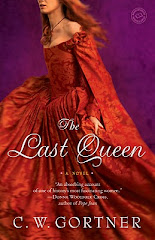
Starting today, I'm officially on a virtual blog tour for The Confessions of Catherine de Medici. Blog tours are always fun events that include reviews, interviews and giveaway opportunities. If you'd like to follow along with me while I tour, here's this week's schedule:
June 1 http://www.thehotauthorreport.com/
June 1 http://womenslit.bellaonline.com/
June 2 http://thisbookforfree.com/?p=1737
June 2 http://www.rundpinne.com/
June 3 http://thebookconnectionccm.blogspot.com/
June 3 http://amusingreviews.blogspot.com/
June 4 http://heatherlo.wordpress.com/
June 7 http://www.pumpupyourbook.com/
And speaking of giveaways, here's one together with a very nice review from A Musing Review!
Hope you can join me on tour. I look forward to seeing you.
Tuesday, June 1, 2010


Wednesday, May 26, 2010
Release Day: A Day Late
The Confessions of Catherine de Medici went on sale yesterday - a rainy day here in SF. On sale days are odd amalgams of excitement, apprehension, and relief. The book is now officially out of my hands, no more fussing over a missed verb or awkward phrase; now,  it belongs to readers and I must start the process of supporting it promotionally even as I must let go of my creative protectiveness. Having been through this before, I thought I'd be okay but I woke up early yesterday, overcome by the urge to check my amazon rank obsessively while simultaneously rushing out to every bookstore within a 100-mile radius to see the book.
Fortunately, I had other duties as assigned, including a radio interview with the divine Liz St John at Radio Alice 93.7 AM. Liz's passionate support of authors is greatly appreciated; she is a devoted reader and her insightful questions helped me re-focus on my energies on more productive concerns. (See pic of me with Liz at the studio; the camera flash went on, unfortunately!).
I also have had online activities, including a review and interview at Margaret Donsbach's HistoricalNovelsInfo, a guest post at Historical Tapestry, a guest post at fellow author Christy English's blog, an interview at my good friend Sarah Johnson's Reading The Past, and a review at Devourer of Books. As always, bloggers have been so enthusiastic; in this era of ever-dwindling marketing dollars, I owe them a huge debt of gratitude.
On June 1, I'll start my official virtual tour, during which I'll visit 35 blogs; I'll post the schedule here for those who'd like to join me. I'm looking forward to it; tour organizer Cheryl Malandrinos of PumpUpYourBook Promotion has done a terrific job of bringing together a diverse selection.
Off to a good start, I think. More later, and thanks as always to you, my readers, for all your support. I truly hope you will enjoy Catherine de Medici's story.
 it belongs to readers and I must start the process of supporting it promotionally even as I must let go of my creative protectiveness. Having been through this before, I thought I'd be okay but I woke up early yesterday, overcome by the urge to check my amazon rank obsessively while simultaneously rushing out to every bookstore within a 100-mile radius to see the book.
Fortunately, I had other duties as assigned, including a radio interview with the divine Liz St John at Radio Alice 93.7 AM. Liz's passionate support of authors is greatly appreciated; she is a devoted reader and her insightful questions helped me re-focus on my energies on more productive concerns. (See pic of me with Liz at the studio; the camera flash went on, unfortunately!).
I also have had online activities, including a review and interview at Margaret Donsbach's HistoricalNovelsInfo, a guest post at Historical Tapestry, a guest post at fellow author Christy English's blog, an interview at my good friend Sarah Johnson's Reading The Past, and a review at Devourer of Books. As always, bloggers have been so enthusiastic; in this era of ever-dwindling marketing dollars, I owe them a huge debt of gratitude.
On June 1, I'll start my official virtual tour, during which I'll visit 35 blogs; I'll post the schedule here for those who'd like to join me. I'm looking forward to it; tour organizer Cheryl Malandrinos of PumpUpYourBook Promotion has done a terrific job of bringing together a diverse selection.
Off to a good start, I think. More later, and thanks as always to you, my readers, for all your support. I truly hope you will enjoy Catherine de Medici's story.
Thursday, May 20, 2010
Guest post from Mitchell James Kaplan, author of BY FIRE, BY WATER
I am honored to present the following guest post by Mitchell James Kaplan, author  of the forthcoming novel BY FIRE, BY WATER. Set in 15th century Spain during the reign of Isabella and Ferdinand, this beautifully written tale is about the ordinary men and women swept up in the chaos and upheaval of the Inquisition and the 1492 Expulsion of the Jews. Publisher's Weekly has praised the novel as "a naturally cinematic narrative" and Patricia Sullivan for The Historical Novels Review calls it "an engrossing read... [with] real men and women rather than historical caricatures."
This can be very difficult subject matter for a novelist, both because of its complex historical context as for its tendency to incite a modern-day viewpoint of events that happened over 500 years ago. Mr Kaplan, however, has created a vividly rendered and sensitive account of this intense time as seen through the eyes of Aragon's converso chancellor, Luis de Santangel, who helped convince Queen Isabella to finance Columbus, and Judith Midgal, aunt of Columbus's official translator. His portrayal of this remarkable man and woman and their struggles to reconcile their past with their future amidst a rising storm of persecution humanizes his tale; and his evocation of a troubled Spain at the crossroads of its own past and future is equally well drawn.
Please join me in welcoming Mr Kaplan, who has offered us this post about the circumstances leading up to his decision to write By Fire, By Water.
My Circumstances at the Time by Mitchell James Kaplan
I was living in Paris, in the chambre de bonne (maid’s room) of Monsieur M, a French political figure, and his wife, an attorney. I had very little money, so in lieu of rent I conversed over breakfast with Monsieur and Madame’s three children. My job was simply to keep their English fluent. A maid, a cook, and a chauffeur attended to their other needs. After breakfast, I lay on my bed and immersed myself in the literary worlds of Balzac, Baudelaire, Proust, Julien Gracq, Albert Cohen, and other French writers. I yearned to become a novelist, myself. I wanted to write a book that would grab readers and not let them go, a book that would say something important about the human condition. The problem was, I had no subject. So I kept reading. Reading was a form of prayer.
Sometimes, in the afternoon, I crossed the Pont Royal to the Bibliotheque Nationale. Housed in the seventeenth-century palace of Cardinal Richelieu, of Three Musketeers lore, the French National Library allowed visitors to circulate in its outer salons, where a manuscript by Gustave Flaubert sat in a long glass case. I marveled at the great author’s perfectly balanced, sweeping penmanship, the handwriting of an extreme perfectionist.
Visitors like me were not allowed to enter the main reading room. I peered inside, thinking: That’s where the real writers hang out. I asked a librarian how I might obtain a card. “Je suis désolé, Monsieur.” He shook his head and shuffled away solemnly, as if saddened to encounter yet another lost soul in the labyrinth of literary dreams. In the Centre Américain, Madame Boyd, a middle-aged volunteer who made it her job to look after American students, gave me a business card. “This man is a movie producer. He wants English lessons. I know you’ll hit it off.”
The movie producer, D, took his English lessons over dinner, offering plenty of wine with the boeuf bourgignon or coq au vin. My liver, utterly untrained in these matters, had no idea what to do with so much alcohol. I stumbled home through the small streets of Paris, wondering where life was leading me.
It didn’t take long for D to learn that I was an aspiring writer. He introduced me to a book editor who worked for the publisher Robert Laffont. Two days later, I received a letter on the publisher’s stationery, addressed to the management of the Bibliothèque Nationale. Armed with this letter, I once again presented myself to the librarian, who placed a card in his typewriter and asked for proof of my identity. I’ll never forget the pride I felt. Only “real” writers and editors had the right to this little rectangle of cardboard. From then on, I spent my afternoons reading there instead of in my little chambre de bonne.
It was in the Bibliothèque Nationale that I came across a curious little book that contained a list of the sailors who accompanied Christopher Columbus on his voyage of discovery in 1492. Most were men and boys from southern Spain; others hailed from Galicia, the Basque country, Portugal, Venice, Genoa, and Calabria. All possessed skills deemed necessary for a long voyage aboard a fifteenth-century sailing vessel – except one. Luis de Torres was Columbus’s “interpreter.” He spoke Hebrew, Aramaic, Arabic, and Spanish. I wondered: Why did Columbus need a translator who spoke Hebrew, Aramaic, and Arabic? Where, exactly, did Columbus think he was going? What did “the Indias” really mean, to Columbus?
The question stayed with me. It nagged me. I began reading books about Spain at the end of the middle ages. Little by little, the pieces of a jigsaw puzzle appeared in my mind, but try as I might, I could not discern how they fit together. I knew that when they did, they would form my first novel. What I did not know was that years would pass before I would be able to write that novel, that life would intervene in unpredictable ways between the conception and the delivery.
I had so much to learn.
Thank you, Mitchell. All the best of success with your novel! To learn more about Mitchell James Kaplan and his work, please visit him at his website.
 of the forthcoming novel BY FIRE, BY WATER. Set in 15th century Spain during the reign of Isabella and Ferdinand, this beautifully written tale is about the ordinary men and women swept up in the chaos and upheaval of the Inquisition and the 1492 Expulsion of the Jews. Publisher's Weekly has praised the novel as "a naturally cinematic narrative" and Patricia Sullivan for The Historical Novels Review calls it "an engrossing read... [with] real men and women rather than historical caricatures."
This can be very difficult subject matter for a novelist, both because of its complex historical context as for its tendency to incite a modern-day viewpoint of events that happened over 500 years ago. Mr Kaplan, however, has created a vividly rendered and sensitive account of this intense time as seen through the eyes of Aragon's converso chancellor, Luis de Santangel, who helped convince Queen Isabella to finance Columbus, and Judith Midgal, aunt of Columbus's official translator. His portrayal of this remarkable man and woman and their struggles to reconcile their past with their future amidst a rising storm of persecution humanizes his tale; and his evocation of a troubled Spain at the crossroads of its own past and future is equally well drawn.
Please join me in welcoming Mr Kaplan, who has offered us this post about the circumstances leading up to his decision to write By Fire, By Water.
My Circumstances at the Time by Mitchell James Kaplan
I was living in Paris, in the chambre de bonne (maid’s room) of Monsieur M, a French political figure, and his wife, an attorney. I had very little money, so in lieu of rent I conversed over breakfast with Monsieur and Madame’s three children. My job was simply to keep their English fluent. A maid, a cook, and a chauffeur attended to their other needs. After breakfast, I lay on my bed and immersed myself in the literary worlds of Balzac, Baudelaire, Proust, Julien Gracq, Albert Cohen, and other French writers. I yearned to become a novelist, myself. I wanted to write a book that would grab readers and not let them go, a book that would say something important about the human condition. The problem was, I had no subject. So I kept reading. Reading was a form of prayer.
Sometimes, in the afternoon, I crossed the Pont Royal to the Bibliotheque Nationale. Housed in the seventeenth-century palace of Cardinal Richelieu, of Three Musketeers lore, the French National Library allowed visitors to circulate in its outer salons, where a manuscript by Gustave Flaubert sat in a long glass case. I marveled at the great author’s perfectly balanced, sweeping penmanship, the handwriting of an extreme perfectionist.
Visitors like me were not allowed to enter the main reading room. I peered inside, thinking: That’s where the real writers hang out. I asked a librarian how I might obtain a card. “Je suis désolé, Monsieur.” He shook his head and shuffled away solemnly, as if saddened to encounter yet another lost soul in the labyrinth of literary dreams. In the Centre Américain, Madame Boyd, a middle-aged volunteer who made it her job to look after American students, gave me a business card. “This man is a movie producer. He wants English lessons. I know you’ll hit it off.”
The movie producer, D, took his English lessons over dinner, offering plenty of wine with the boeuf bourgignon or coq au vin. My liver, utterly untrained in these matters, had no idea what to do with so much alcohol. I stumbled home through the small streets of Paris, wondering where life was leading me.
It didn’t take long for D to learn that I was an aspiring writer. He introduced me to a book editor who worked for the publisher Robert Laffont. Two days later, I received a letter on the publisher’s stationery, addressed to the management of the Bibliothèque Nationale. Armed with this letter, I once again presented myself to the librarian, who placed a card in his typewriter and asked for proof of my identity. I’ll never forget the pride I felt. Only “real” writers and editors had the right to this little rectangle of cardboard. From then on, I spent my afternoons reading there instead of in my little chambre de bonne.
It was in the Bibliothèque Nationale that I came across a curious little book that contained a list of the sailors who accompanied Christopher Columbus on his voyage of discovery in 1492. Most were men and boys from southern Spain; others hailed from Galicia, the Basque country, Portugal, Venice, Genoa, and Calabria. All possessed skills deemed necessary for a long voyage aboard a fifteenth-century sailing vessel – except one. Luis de Torres was Columbus’s “interpreter.” He spoke Hebrew, Aramaic, Arabic, and Spanish. I wondered: Why did Columbus need a translator who spoke Hebrew, Aramaic, and Arabic? Where, exactly, did Columbus think he was going? What did “the Indias” really mean, to Columbus?
The question stayed with me. It nagged me. I began reading books about Spain at the end of the middle ages. Little by little, the pieces of a jigsaw puzzle appeared in my mind, but try as I might, I could not discern how they fit together. I knew that when they did, they would form my first novel. What I did not know was that years would pass before I would be able to write that novel, that life would intervene in unpredictable ways between the conception and the delivery.
I had so much to learn.
Thank you, Mitchell. All the best of success with your novel! To learn more about Mitchell James Kaplan and his work, please visit him at his website.
Tuesday, May 18, 2010
Some Good News!
In midst of the exciting Historical Fiction Bloggers Roundtable Event, I got some good news: My UK editor at Hodder & Stoughton has acquired my work-in-progress The Princess Isabella, and the first three novels in The Elizabeth I Spymaster Chronicles, starting with The Tudor Secret, which will be published by St Martin's Press in the US. I owe my agent really expensive shoes! She's one of the hardest working women in the business and she champions me shamelessly.
The Roundtable event is now officially over and I want to again thank the fantastic bloggers who invited me and gave me their all. Their creative posts, reviews, and other material really made this event fun and I'm very fortunate indeed to have been a part of it. To see the event in its entirety and visit the different blogs and posts, please click here.
Last but not least, the marvelous Sharon Kay Penman, one of my all-time favorite authors, has interviewed me over at her blog. Please stop by. Besides my interview, Sharon has a very active blog with many comments and interesting posts about her books, research, love for animals, and other diverse interests. She's a great lady, and a great friend.
Only 7 days till The Confessions of Catherine de Medici arrives in stores! I'm like a hen on an egg . . .
The Roundtable event is now officially over and I want to again thank the fantastic bloggers who invited me and gave me their all. Their creative posts, reviews, and other material really made this event fun and I'm very fortunate indeed to have been a part of it. To see the event in its entirety and visit the different blogs and posts, please click here.
Last but not least, the marvelous Sharon Kay Penman, one of my all-time favorite authors, has interviewed me over at her blog. Please stop by. Besides my interview, Sharon has a very active blog with many comments and interesting posts about her books, research, love for animals, and other diverse interests. She's a great lady, and a great friend.
Only 7 days till The Confessions of Catherine de Medici arrives in stores! I'm like a hen on an egg . . .
Sunday, May 9, 2010
The Roundtable Event Begins!
As promised, the Historical Fiction Bloggers Roundtable Special Pre-Launch Event for The Confessions of Catherine de Medici has begun. These hard-working and extremely creative ladies have designed a marvelous programme of events, the first of which are already up. To get a complete list of the events, please visit the HFBRT calendar here.
I hope to see you as I tour these great blogs!
I hope to see you as I tour these great blogs!
Tuesday, May 4, 2010
Historical Novels Review - Editor's Choice
I'm very honored that the Historical Novel Society's Historical Novels Review has selected The Confessions of Catherine de Medici as an Editor's Choice for their May 2010 edition. The HNS has been such an instrumental organization for me, both professionally and personally, and I have to admit, this is my favorite review so far. I am re-producing it here, with HNS permission.
THE CONFESSIONS OF CATHERINE DE MEDICI
C. W. Gortner, Ballantine, 2010, $25.00, hb, 416pp, 9780345501868 / To be pub by Hodder & Stoughton in 2011
Catherine de Medici came to the French court as a reluctant princess: young and naive, and yet somehow she knew her destiny was to guide France to glory. She was the last legitimate descendant of Lorenzo de Medici; she carried her pride well. It is written that she had second sight, and with this gift and her consultations with Nostradamus, Catherine was guided to act. After her husband’s death, her mediocrity faded and she gained increasing power. She emerged as an astute, formidable, and shrewdly confident regent who maintained a tenacious hold on governing France during her time. Religious tolerance was her mantra, and the survival of France was paramount.
To know Catherine, the reader must understand her culture, social life, and children. Romance eluded her, with the exception of her often-overlooked friendship with Coligny, the Protestant leader whom she would later hunt down. The chasm between the followers of Calvin, the Huguenot heretics, and the Catholics who were the dominant power is historically important to her life’s story. Gortner interweaves this pivotal, complex issue into his novel, bringing with it clear understanding.
Gortner’s story provides a compelling and fascinating view of Catherine’s life and world, her world being France. The reader will empathize with Catherine, ache for her, and sometimes recoil in disgust when her actions become too extreme. The details and the chronology of historical events told as Catherine’s confessions in first-person narrative are personal and emotionally realistic. When Hercule, her crippled son, is drawing his last breath, the scene is woefully tragic, so beautifully penned that the passage will beseech tears. You will devour this read desperate to satiate your curiosity. The writing is as illuminating and powerful as the character of infamous legend known as Catherine de Medici. Highly recommended without a doubt! - Wisteria Leigh
THE CONFESSIONS OF CATHERINE DE MEDICI
C. W. Gortner, Ballantine, 2010, $25.00, hb, 416pp, 9780345501868 / To be pub by Hodder & Stoughton in 2011
Catherine de Medici came to the French court as a reluctant princess: young and naive, and yet somehow she knew her destiny was to guide France to glory. She was the last legitimate descendant of Lorenzo de Medici; she carried her pride well. It is written that she had second sight, and with this gift and her consultations with Nostradamus, Catherine was guided to act. After her husband’s death, her mediocrity faded and she gained increasing power. She emerged as an astute, formidable, and shrewdly confident regent who maintained a tenacious hold on governing France during her time. Religious tolerance was her mantra, and the survival of France was paramount.
To know Catherine, the reader must understand her culture, social life, and children. Romance eluded her, with the exception of her often-overlooked friendship with Coligny, the Protestant leader whom she would later hunt down. The chasm between the followers of Calvin, the Huguenot heretics, and the Catholics who were the dominant power is historically important to her life’s story. Gortner interweaves this pivotal, complex issue into his novel, bringing with it clear understanding.
Gortner’s story provides a compelling and fascinating view of Catherine’s life and world, her world being France. The reader will empathize with Catherine, ache for her, and sometimes recoil in disgust when her actions become too extreme. The details and the chronology of historical events told as Catherine’s confessions in first-person narrative are personal and emotionally realistic. When Hercule, her crippled son, is drawing his last breath, the scene is woefully tragic, so beautifully penned that the passage will beseech tears. You will devour this read desperate to satiate your curiosity. The writing is as illuminating and powerful as the character of infamous legend known as Catherine de Medici. Highly recommended without a doubt! - Wisteria Leigh
Monday, May 3, 2010
Historical Fiction Bloggers Roundtable and a new review
It's May! Less than a month to go for the official launch of The Confessions of Catherine de Medici. I'm getting excited - and nervous, of course. Promoting a book is tougher than ever these days; bookstores are cutting back on events because of lousy attendance; blogs are swamped with publicity requests; the economy is still sluggish, at best - in short, the odds are daunting. Still, it's my job to market my work, so let the fun begin. This blog will feature henceforth various examples of shameless promotion as I advertise my wares - but not to worry, I'll also try to make it as interesting as possible :)
To start us off on a high note, please join me on the Historical Fiction Bloggers Roundtable Event, starting on May 8. If you happened to miss the banner hanging over my masthead with my pensive writer's mug or the one of the side of the blog with the pretty pearl bauble (both graphics courtesy of the multi-talented Lizzy Johnson of Historically Obsessed) then check it out and stop by if you can. I'll try to keep you up to date on where I'll be during the event, too, via this blog. The event will feature interviews, guest posts, reviews and a special giveaway at the end from yours truly: this is a special pre-launch party organized by the terrific, hard-working ladies of the Roundtable, who go all out to support writers and deserve a very warm round of recognition for balancing kids, jobs, boyfriends and fashion emergencies in order to blog for the rest of us. Thank you, my fair maidens of the Roundtable! I'm in awe of all of you.
Next, I just got a new 4-stars review from Romantic Times. Here is an excerpt:
Gortner has reimagined the life of one of the most controversial women in history in a fresh, well-researched and powerful portrait of a queen and mother in the turbulent 1500s. With great sensitivity, he gives readers a woman struggling to keep her children and country safe. Readers will come away with new ideas, and that's just what historical fiction is supposed to do - open our eyes to new possibilities. - Kathe Robin.
Other reviews are in from Booklist and the Historical Novel Society but currently embargoed until publication. As soon as I can, I will post them.
To start us off on a high note, please join me on the Historical Fiction Bloggers Roundtable Event, starting on May 8. If you happened to miss the banner hanging over my masthead with my pensive writer's mug or the one of the side of the blog with the pretty pearl bauble (both graphics courtesy of the multi-talented Lizzy Johnson of Historically Obsessed) then check it out and stop by if you can. I'll try to keep you up to date on where I'll be during the event, too, via this blog. The event will feature interviews, guest posts, reviews and a special giveaway at the end from yours truly: this is a special pre-launch party organized by the terrific, hard-working ladies of the Roundtable, who go all out to support writers and deserve a very warm round of recognition for balancing kids, jobs, boyfriends and fashion emergencies in order to blog for the rest of us. Thank you, my fair maidens of the Roundtable! I'm in awe of all of you.
Next, I just got a new 4-stars review from Romantic Times. Here is an excerpt:
Gortner has reimagined the life of one of the most controversial women in history in a fresh, well-researched and powerful portrait of a queen and mother in the turbulent 1500s. With great sensitivity, he gives readers a woman struggling to keep her children and country safe. Readers will come away with new ideas, and that's just what historical fiction is supposed to do - open our eyes to new possibilities. - Kathe Robin.
Other reviews are in from Booklist and the Historical Novel Society but currently embargoed until publication. As soon as I can, I will post them.
Tuesday, April 27, 2010
Review of THE HYPNOTIST by M.J. Rose
A priceless sculpture that hides an ancient secret; an FBI investigator haunted by the past; and a terrorist plot involving the theft of magnificent works of art all combine to create THE HYPNOTIST, the unputdownable thriller and third entry in M.J.Rose's superb Reincarnationist series (The Reincarnationist and The Memorist).
No author currently writing in the suspense/thriller category does quite what M.J. Rose does; underpinning her novels is the haunting premise that all of us have past lives that connect us to the present, and within this framework she's conjured a high-stakes world of treacherous business dealings, international intrigue, and the often lethal search for the elusive Memory Tools - objects that can assist people to access their pasts and which, if found and harnessed, could provide their owner with unimaginable power. At the center of this web is Dr Malachi Samuels of the Phoenix Foundation, a gifted yet amoral reincarnation expert who allegedly will stop at nothing to possess the Memory Tools.
These entwined themes are spun throughout the series; however, each novel can be enjoyed on its own merits and The Hypnotist is no exception. When Lucian Glass, FBI criminal art investigator, is called in by the Metropolitan Museum in New York City to investigate the horrific mutilation of a stolen painting, he is plunged into a search for the man who, years ago, destroyed his youth and aspiring career as an artist. His investigation leads him back into the elegant, dangerous milieu of the Phoenix Foundation, where a young girl is being treated for nightmarish visions, and the presence of a mysterious woman who might hold the key to his quest. As Lucian begins to uncover a plot centered around a millennial-old sculpture that has surfaced after years of neglect, he finds himself caught up in an intricately linked conspiracy of art smuggling, terrorism, and the race to claim a coveted Memory Tool.
The Hypnotist stands out from the other entries in the series for its lyricism and the timely question: Who truly owns art? In this novel, which is replete with Ms Rose's trademark moments of breathtaking suspense and secrets-within-secrets, Rose has gone d eeper into her mythology, detailing the subtle ways in which senseless tragedy shifts and defines us, and the hallowed effect that art exerts on our beings. While her previous novels have all featured lost souls seeking redemption, in The Hypnotist something of Rose's own complex soul comes into display, and it is a fascinating glimpse into a writer who, with this novel, has both matured and exceeded the very high expectations she has set for herself and her readers.
 sculpture that hides an ancient secret; an FBI investigator haunted by the past; and a terrorist plot involving the theft of magnificent works of art all combine to create THE HYPNOTIST, the unputdownable thriller and third entry in M.J.Rose's superb Reincarnationist series (The Reincarnationist and The Memorist).
No author currently writing in the suspense/thriller category does quite what M.J. Rose does; underpinning her novels is the haunting premise that all of us have past lives that connect us to the present, and within this framework she's conjured a high-stakes world of treacherous business dealings, international intrigue, and the often lethal search for the elusive Memory Tools - objects that can assist people to access their pasts and which, if found and harnessed, could provide their owner with unimaginable power. At the center of this web is Dr Malachi Samuels of the Phoenix Foundation, a gifted yet amoral reincarnation expert who allegedly will stop at nothing to possess the Memory Tools.
These entwined themes are spun throughout the series; however, each novel can be enjoyed on its own merits and The Hypnotist is no exception. When Lucian Glass, FBI criminal art investigator, is called in by the Metropolitan Museum in New York City to investigate the horrific mutilation of a stolen painting, he is plunged into a search for the man who, years ago, destroyed his youth and aspiring career as an artist. His investigation leads him back into the elegant, dangerous milieu of the Phoenix Foundation, where a young girl is being treated for nightmarish visions, and the presence of a mysterious woman who might hold the key to his quest. As Lucian begins to uncover a plot centered around a millennial-old sculpture that has surfaced after years of neglect, he finds himself caught up in an intricately linked conspiracy of art smuggling, terrorism, and the race to claim a coveted Memory Tool.
The Hypnotist stands out from the other entries in the series for its lyricism and the timely question: Who truly owns art? In this novel, which is replete with Ms Rose's trademark moments of breathtaking suspense and secrets-within-secrets, Rose has gone d
 eeper into her mythology, detailing the subtle ways in which senseless tragedy shifts and defines us, and the hallowed effect that art exerts on our beings. While her previous novels have all featured lost souls seeking redemption, in The Hypnotist something of Rose's own complex soul comes into display, and it is a fascinating glimpse into a writer who, with this novel, has both matured and exceeded the very high expectations she has set for herself and her readers.
M.J. Rose is the international bestselling author of over nine novels, including the acclaimed Reincarnationist series. To learn more about her and her work, please visit her website.
A special thank you to Meryl Moss Media for sending me an advance copy of this novel.
Monday, April 19, 2010
Interview with Christy English, author of THE QUEEN'S PAWN

Please join me in welcoming Christy English to Historical Boys.
Hi, Christy. What inspired you to write THE QUEEN’S PAWN?
About four years ago, I moved to New York to focus on my writing, and I wondered what my next book was going to be. As I was walking along Broadway, going to the train to meet my agent for dinner, this still, small voice spoke in my ear. “Do you remember Alais from THE LION IN WINTER? Would you like to hear her story?” I love THE LION IN WINTER. Peter O’Toole and Katherine Hepburn are two of the best actors who have ever lived, in my opinion. But I had never before thought of the young girl in that movie, the French princess.
My novel begins with nine-year-old Princess Alais leaving her family to marry her father’s enemy. That little girl had to face political realities beyond anything most adults ever deal with, and she did it with courage. After I wrote the first chapter, I saw that there was a lot more to this princess than was portrayed in THE LION IN WINTER, and I knew I had a fascinating story on my hands. The novel has changed a lot over many drafts, but that first chapter is still in there.
You tell the story of THE QUEEN’S PAWN from the points of view of Princess Alais and Eleanor of Aquitaine. How did Eleanor of Aquitaine come to be one of the narrators?
I had been working with THE QUEEN’S PAWN for over two years before Eleanor came on board. I was taking editorial notes from all over town, trying to make the book better. But it just wasn’t working. As strong as Alais is, her voice was not dynamic enough to make the novel soar. This was not the character’s fault. It was mine. But I could find no way to solve the problem. It was pretty frustrating.
Claire Zion of NAL liked my voice enough that she wanted to meet me and talk over ideas for trying to make the novel work. We had plans to meet for lunch on a Tuesday, and I had no idea how to fix the book. The weekend before our lunch, I was sitting in my apartment on the Upper West Side, wondering what on earth I was going to say to Claire when I met her in two days, and Eleanor showed up.
What do you mean, “showed up?”
Both Alais and Eleanor had strong presences from the beginning. Eleanor had always been one of the characters in my novel. But that Sunday, as I sat wondering what on earth I was going to tell Claire in two days, Eleanor volunteered to take over telling of half the story. I don’t know how other writers work, but in my experience, my characters always choose me. I’m lucky Eleanor did. Before including her, I thought I knew what the book was supposed to be. I had a very set idea in my head about the arc of the action and how all the characters related to one another. But then I sat down to write with Eleanor’s voice in my ear, and she blew all my pre-conceived notions out of the water.
So what happened at your meeting with the editor?
Claire had the same idea, completely independently, to include Eleanor as a narrator in the book. That was when I knew THE QUEEN’S PAWN was going to come together. I still had a lot of work ahead of me, but with the voices of Eleanor and Alais balancing each other, shoring each other up, things really started to cook on the page.
How many drafts did it take once you and Claire started working together?
It took three more drafts before we were both satisfied. It turns out that I am working with the perfect editor for me. Claire is as much of a perfectionist and a workaholic as I am. But I love writing… as hard as it is sometimes, I love it.
It's always marvelous to have an editor who inspires you. Have there been any authors or books that have inspired you?
 Claire is definitely an inspiration. But as far as other authors, my all-time favorite has been and always will be Mary Renault. My favorite novels are THE PERSIAN BOY and THE MASK OF APOLLO, but every one of her books has taught me something, both as a writer and as a human being. She died in the late 1970’s, but her work is the most wonderful I have ever read. Mary Renault lifts me out of the modern world, and sets me down in the middle of another place and time. She doesn’t spend time on exposition, she just leaps into the river of the narrative, and her writing is so good that exposition really isn’t needed. My goal is to write as well as she does by the time I’m fifty. I’m not sure I’ll make it.
Can you tell us about your next book?
Yes! I'm very excited that my second novel, TO BE QUEEN, is coming out with NAL in April 2011. In that book, Eleanor of Aquitaine marries Louis VII of France, goes with him on Crusade, then divorces him. And in the midst of all that, she battles the Church, becomes a political powerhouse, and meets her second husband, the man who later becomes King Henry II of England.
Thank you for visiting, Christy. Best of luck and I look forward to your next novel. To learn more about Christy and her work, please visit her website.
Tuesday, April 13, 2010
ANGELOLOGY by Danielle Trussoni
 A few weeks ago, Michael Joseph, a UK imprint of Penguin, offered me a review copy of Danielle Trussoni's ANGELOLOGY. I agreed at once, as the book was on my TBR list already, first because of its massive auction and movie-rights deal, and second because its theme - that hybrid angelic beings walk among us - intrigued me. I've never been much for seraphs and cherubs; to me, angels have always been scary creatures, with those enormous statures and huge wings, and I was delighted to discover that Angelology satisfied my deepest fears.
Angelology combines the best of the traditional grand old novel with the suspense of a modern-day thriller, sweeping the reader up in its fantastic premise from the very first page. Once you start reading, you never want to leave this strange world again. It starts with the discovery in 1943 of the corpse of a Nephilim - a cross-breed between fallen angels and humans, which has evolved into a powerful race of beings who have infiltrated human society since Biblical times and wreaked havoc, garnering unassailable prestige and wealth in the process. Organized into a collection of distinctive dynasties with their own hierarchy and status symbols, disguised in plain view within our society, the Nephilim have been behind humanity's most tragic events; but now, in the 20th century, on the eve of the Millennium, they face a grave threat: a lethal virus, which is reducing their near-immortal lifespans and destroying their irreplaceable wings.
Working behind the scenes against the Nephilim since their beginning is a secret society of gifted, dedicated humans called angelologists. Descendants themselves of some of the world's greatest thinkers, they are devoted to hiding ancient artifacts that could bring about the Nephilim's salvation and grant them unstoppable power over the world. The angelologists have been involved in countless battles against Nephilistic beings throughout their long history, including two lethal expeditions into the mountains of Greece, where a deep gorge called the Devil's Throat contains a horrifying secret.
Veering from a convent in 20th-century upstate New York, where a young nun comes face-to-face with her family's legacy, to the perils of Nazi-occupied France, where two competitive angelological students are caught up in a struggle against the most powerful Nephilistic clan, Angelology is replete with fascinating theological, anatomical, and historical details that mythologize the origins of the Nephilim and their rise. Nevertheless, this neo-classical approach to its theme does not impede its hair-raising premise and genuinely creepy moments, which include a confrontation with a brutal warrior class of angels and a breath-taking plunge into a cavern.
Veering from a convent in 20th-century upstate New York, where a young nun comes face-to-face with her family's legacy, to the perils of Nazi-occupied France, where two competitive angelological students are caught up in a struggle against the most powerful Nephilistic clan, Angelology is replete with fascinating theological, anatomical, and historical details that mythologize the origins of the Nephilim and their rise. Nevertheless, this neo-classical approach to its theme does not impede its hair-raising premise and genuinely creepy moments, which include a confrontation with a brutal warrior class of angels and a breath-taking plunge into a cavern.
Angelology is that rare book: an accomplished thriller that twists the confines of its genre into something unique, a thinking-person's tale that will keep you reading far into the night. To learn more about the book, the author and their world, please visit Danielle Trussoni's website.
Angelology is published by Viking Penguin in the U.S. and Michael Joseph Penguin in the UK.
(Author photo: Kailin Ruchev)
Monday, April 12, 2010
Review of UNDER HEAVEN by Guy Gavriel Kay
Acclaimed bestselling fantasy writer Guy Gavriel Kay returns to his roots in Under Heaven, a sweeping vivid adventure set in a fantastical world that closely resembles China during the glory and fall of the 8th century Tang  Dynasty. Kay's signature talent for interweaving various characters, motifs and storylines are on full display here, as we enter the life of Shen Tai, a general's second son, whose two years spent burying the bones of those who died on a long-forgotten battlefield as mourning for his father is cut short by the unexpected visit of an illicit assassin and potentially lethal gift of two hundred horses from an impervious queen.
 Dynasty. Kay's signature talent for interweaving various characters, motifs and storylines are on full display here, as we enter the life of Shen Tai, a general's second son, whose two years spent burying the bones of those who died on a long-forgotten battlefield as mourning for his father is cut short by the unexpected visit of an illicit assassin and potentially lethal gift of two hundred horses from an impervious queen.
As Shen Tai grapples with the immensity of the responsibility thrust upon him and embarks on a journey back to the intrigue-laden imperial city, we are immersed in a time and place of deep  spiritual reflection, sudden violence, implacable tradition, and haunting fragility. A host of characters that includes Shen Tai's female warrior protector, an exiled poet, Shen Tai's ennobled sister, a bewitched barbarian prince, and a doomed concubine all come together to enrich Kay's meditation on the nature of mortality and ephemeral longing in an imperfect world.
 spiritual reflection, sudden violence, implacable tradition, and haunting fragility. A host of characters that includes Shen Tai's female warrior protector, an exiled poet, Shen Tai's ennobled sister, a bewitched barbarian prince, and a doomed concubine all come together to enrich Kay's meditation on the nature of mortality and ephemeral longing in an imperfect world.
Fans of historical fiction and fantasy will not find a more perfect blending of the two genres than Under Heaven. This is an epic novel by a master storyteller whose gift for evoking richly imagined universes that reflect our own is truly unparalleled.
Wednesday, March 31, 2010
Guest post from Mary Sharratt, author of DAUGHTERS OF THE WITCHING HILL
 I am delighted to welcome Mary Sharratt, author of the upcoming DAUGHTERS OF THE WITCHING HILL, an evocative and haunting novel that recreates the Pendle witch trials in Lancashire in the 16th century. Mary lives in the area and has woven a masterpiece of imagination and fact around the women and men caught up in the hysteria of this event. She twists the tale with the possibility that one of the women may have actually possessed supernatural gifts, infusing her book with vivid details of life in a dangerously superstitious era. This is a gorgeously rendered account of faith, persecution, and tragedy that I could not put down and has been called "uplifting in its portrayal of women who persevere, and mothers and daughters who forgive" by Publishers Weekly; and "a fascinating tale . . .unfolds without melodrama and is therefore all the more powerful" by Library Journal.
 Mary is the winner of the 2005 WILLA Literary Award and a Minnesota Book Award Finalist and the author of the critically acclaimed novels Summit Avenue (Coffee House 2000), The Real Minerva (Houghton Mifflin 2004), and The Vanishing Point (Houghton Mifflin 2006), which was a UK Guardian Readers’ Book of the Year. She is also the co-editor of the subversive UK fiction anthology, Bitch Lit (Crocus Books UK 2006), a celebration of female anti-heroes. Mary’s short stories have been widely published in journals and anthologies on both sides of the Atlantic, including the recent Twin Cities Noir (Akashic Books 2006). She also happens to be delightfully witty in person and a devoted equestrian; I am privileged to call her a friend.
 Please join me in welcoming Mary Sharratt to Historical Boys.
Daughters of the Witching Hill: In Search of the Pendle Witches
by Mary Sharratt
In 2002, I moved to the Pendle region in Lancashire, Northern England. It didn’t take long before the wild, brooding landscape cast its spell on me and inspired my new novel, Daughters of the Witching Hill.
Pendle Hill is famous throughout the world as the place where George Fox received the ecstatic vision that moved him to found the Quaker religion in 1652. But this rugged countryside is also haunted by the legacy of the Pendle Witches.
In 1612, seven women and two men from Pendle Forest were executed for witchcraft, but the most notorious of the accused, Bess Southerns, aka Old Demdike, cheated the hangman by dying in prison.
"Allow me to introduce you to a woman of power who changed my life forever": this is how Thomas Potts describes her in The Wonderfull Discoverie of Witches in the Countie of Lancaster: "She was a very old woman, about the age of Foure-score yeares, and had been a Witch for fiftie yeares. Shee dwelt in the Forrest of Pendle, a vast place, fitte for her profession: What shee committed in her time, no man knowes. . . . Shee was a generall agent for the Devill in all these partes: no man escaped her, or her Furies."
Reading the trial transcripts against the grain, I was amazed at how Bess’s strength of character blazed forth in the document written to vilify her. Bess freely admitted to being a healer and a cunning woman. She lived as a matriarch with her family at Malkin Tower and instructed her daughter and granddaughter in the ways of magic. Her neighbours called on her to cure their children and their cattle. What fascinated me was not that Bess was arrested on witchcraft charges but that the authorities turned on her only near the end of her long, productive career. She practiced her craft for decades before anybody dared to interfere with her.
Cunning craft—the art of using charms to heal both humans and livestock—was Bess’s family trade. Their spells, recorded in A Wonderfull Discoverie, were Roman Catholic prayer charms—the kind of folk magic that would have flourished before the Reformation. Yet she also drew on an even older source of power: Tibb, her familiar spirit, who appeared to her in the guise of a beautiful young man.
Other books have been written about the Pendle Witches—both nuanced and lurid. Mine is the first to tell the tale from Bess’s point of view. I longed to give Bess Southerns what her world denied her—her own voice.
History is a fluid thing that continually shapes the present. As a writer, I am obsessed with how the true stories of our ancestors haunt the landscape. No one in Pendle can remain untouched by the witches’ legacy. As contemporary British storyteller, Hugh Lupton, has said, if you go deep enough into the old tales and can present them in a meaningful way to a modern audience, you become the living voice in an ancient tradition. Bess Southerns’s voice deserves to be heard.
Long after their demise, Bess and her fellow witches endure, their spirit woven into the land, its weft and warp, like the stones and the streams that cut across the moors. This is their home, their seat of power, and they shall never be banished. By learning their story, I have become an adopted daughter of their living landscape, one of many tellers who spin their unending tale.
Mary Sharratt’s acclaimed new novel, DAUGHTERS OF THE WITCHING HILL will be published on April 7 by Houghton Mifflin Harcourt. To learn more, please visit her website at http://www.marysharratt.com/ and join her on her virtual tour: http://booktour.com/author/mary_sharratt#new-event
Sunday, March 14, 2010
Guest post from Stephanie Cowell, author of CLAUDE AND CAMILLE
I am delighted to welcome my friend Stephanie Cowell. A marvelous novelist whose work includes the exuberant Marrying Mozart and The Players: A novel of young Shakespeare, on April 6 Crown Publishers will release Stephanie's new novel Claude and Camille, the haunting, passionate story of Claude Monet's youthful love affair with his wife and muse.


Already, the reviews are stunning. Publisher's Weekly calls it "A convincing narrative about how masterpieces are created and a detailed portrait of a complex couple. Cowell's novel suggests that a fabulous, if flawed, love is the source of both the beauty and sadness of Monet's art." And Library Journal adds, "Moving through war, illness, prosperity, and poverty, Cowell writes the couple's love story with an eye for perspective as skilled as any painter's."
I had the honor of endorsing this book, and was captivated from beginning to end by Stephanie's elegant language and sensitive insight into the emotion and torment of this great artist. I highly recommend her unique portrait of Monet as he began his career, and of the woman whose inspiration and secrets he could never forget.
Stephanie Cowell has kindly offered this guest post for Historical Boys, to celebrate the upcoming release of Claude and Camille. Please join me in welcoming her!

Visiting old places with an historical novelist
My parents and I were walking down a street in one of those Italian Swiss hill towns a little before dusk. It was a narrow cobbled street which few cars could pass, lined with squat stone houses which had stood there far beyond memory and low cracked wood doors. To me they were not ordinary houses for I felt the ghosts who had lived there in previous times and walked slower and slower, trying to catch their voices and what they were saying. My father’s call rang from far ahead. “Where are you, daughter? We’re going to eat!” “Oh here I am!” I replied, startled into the present. “Just five centuries and fifty feet behind you, you know…”
I suppose my friends and family are used to it by now. We go to Mozart’s birthplace, a narrow street in Paris where Monet had a studio in his youth or the packed old City of London, where ancient churches rub walls with glass skyscrapers. The names of the streets are Fishmonger’s Lane, Cheapside, Love Street. Friends see the skyscrapers, I see the half timbered house in 1591 on Wood Street where Shakespeare hurried at night, lighting his way with a torch, to the house of his old acting colleague Jack Heminges.
There goes Will and Jack! I want to tell cry. I watch as a hint of brown doublet rounds a corner and is gone. There they were! Most the time my husband waits for me. “You don’t see anything?” I ask him. “Just the financial district,” he replies. “But you see things, Stephanie! I can see your face.”
It is true. The past touches and takes hold of my shirt and draws me back. No, it hurls me back. I never know when it is going to happen. It was so intense when entering the room with the Parthenon marbles in London that I had to leave for a time. I almost passed out before one of Queen Victoria’s dresses. And when we visited the newly constructed Globe Theater on Bankside in London I had no idea if I were in 1601 or 2001. T.S. Eliot says, “The communication of the dead is tongued with fire beyond the language of the living.” Madeleine L’Engle says that characters come to us and demand, “Enflesh me!”
New England graveyards at dusk, my footsteps on the floors of Windsor Castle, and staring at the spot in the Tower of London where Anne Boleyn was executed. Show me a 300-year-old shoe, a ruined church, the moors behind Haworth. I stand and stare. I write furiously in a notebook. I discovered one winding, deserted street in Vienna in front of the Cathedral after dark and stood as if stunned. I had no idea what was on that street. In daylight I returned and found that Mozart and his wife had lived there in 1785.
Once a kind guard approached as I sat among the ruins of the old boy’s school in Canterbury. “All right then, dearie?” “It’s ok,” I managed, “I’m a novelist.” He retreated, looking a bit bewildered.
We are fortunate, we who love history and historical fiction and who write it for we live in many worlds. The past opens to us in a hidden street, an old pen, a signature of someone long gone. We are wealthy; we share many lives and we listen to older voices. “Don’t mind me; I’m just walking five centuries behind you,” you can say to your friends. If they know and love you, they will understand and be waiting when you show up at the restaurant for dinner.
Stephanie Cowell is the author of several novels. To learn more about her and her work, please visit her at: http://www.stephaniecowell.com/
I had the honor of endorsing this book, and was captivated from beginning to end by Stephanie's elegant language and sensitive insight into the emotion and torment of this great artist. I highly recommend her unique portrait of Monet as he began his career, and of the woman whose inspiration and secrets he could never forget.
Stephanie Cowell has kindly offered this guest post for Historical Boys, to celebrate the upcoming release of Claude and Camille. Please join me in welcoming her!

Visiting old places with an historical novelist
My parents and I were walking down a street in one of those Italian Swiss hill towns a little before dusk. It was a narrow cobbled street which few cars could pass, lined with squat stone houses which had stood there far beyond memory and low cracked wood doors. To me they were not ordinary houses for I felt the ghosts who had lived there in previous times and walked slower and slower, trying to catch their voices and what they were saying. My father’s call rang from far ahead. “Where are you, daughter? We’re going to eat!” “Oh here I am!” I replied, startled into the present. “Just five centuries and fifty feet behind you, you know…”
I suppose my friends and family are used to it by now. We go to Mozart’s birthplace, a narrow street in Paris where Monet had a studio in his youth or the packed old City of London, where ancient churches rub walls with glass skyscrapers. The names of the streets are Fishmonger’s Lane, Cheapside, Love Street. Friends see the skyscrapers, I see the half timbered house in 1591 on Wood Street where Shakespeare hurried at night, lighting his way with a torch, to the house of his old acting colleague Jack Heminges.
There goes Will and Jack! I want to tell cry. I watch as a hint of brown doublet rounds a corner and is gone. There they were! Most the time my husband waits for me. “You don’t see anything?” I ask him. “Just the financial district,” he replies. “But you see things, Stephanie! I can see your face.”
It is true. The past touches and takes hold of my shirt and draws me back. No, it hurls me back. I never know when it is going to happen. It was so intense when entering the room with the Parthenon marbles in London that I had to leave for a time. I almost passed out before one of Queen Victoria’s dresses. And when we visited the newly constructed Globe Theater on Bankside in London I had no idea if I were in 1601 or 2001. T.S. Eliot says, “The communication of the dead is tongued with fire beyond the language of the living.” Madeleine L’Engle says that characters come to us and demand, “Enflesh me!”
New England graveyards at dusk, my footsteps on the floors of Windsor Castle, and staring at the spot in the Tower of London where Anne Boleyn was executed. Show me a 300-year-old shoe, a ruined church, the moors behind Haworth. I stand and stare. I write furiously in a notebook. I discovered one winding, deserted street in Vienna in front of the Cathedral after dark and stood as if stunned. I had no idea what was on that street. In daylight I returned and found that Mozart and his wife had lived there in 1785.
Once a kind guard approached as I sat among the ruins of the old boy’s school in Canterbury. “All right then, dearie?” “It’s ok,” I managed, “I’m a novelist.” He retreated, looking a bit bewildered.
We are fortunate, we who love history and historical fiction and who write it for we live in many worlds. The past opens to us in a hidden street, an old pen, a signature of someone long gone. We are wealthy; we share many lives and we listen to older voices. “Don’t mind me; I’m just walking five centuries behind you,” you can say to your friends. If they know and love you, they will understand and be waiting when you show up at the restaurant for dinner.
Stephanie Cowell is the author of several novels. To learn more about her and her work, please visit her at: http://www.stephaniecowell.com/
Monday, March 1, 2010
Library Journal weighs in!
Gortner, C.W. The Confessions of Catherine de Medici. Ballantine. Jun. 2010. c.416p. ISBN 978-0-345-50186-8. $25.
History has depicted Catherine de Medici (1519–89), wife of one king and mother of three, as a grotesque monster, poisoning and murdering to gain and maintain control over the French throne. After the death of Henri II, she began the struggle of her life—keeping one son after the other on the throne through the religious wars that threatened to tear France apart. In this meticulously researched novel, Gortner (The Last Queen) gives us a Catherine who is passionate yet sometimes naive. Most of her decisions following her husband's death are made to keep peace in France or safeguard her children. Yet she is still held responsible for the 1572 St. Bartholomew's Day massacre, in which thousands of French Protestants were slaughtered. VERDICT While the Catherine depicted here is in some ways similar to Jeanne Kalodigris's protagonist in The Devil's Queen, Gortner breathes more life into his queen. Historical fiction fans will appreciate the vivid details of Renaissance France. [Library marketing.]—Pamela O'Sullivan, Coll. of Brockport Lib., SUNY
History has depicted Catherine de Medici (1519–89), wife of one king and mother of three, as a grotesque monster, poisoning and murdering to gain and maintain control over the French throne. After the death of Henri II, she began the struggle of her life—keeping one son after the other on the throne through the religious wars that threatened to tear France apart. In this meticulously researched novel, Gortner (The Last Queen) gives us a Catherine who is passionate yet sometimes naive. Most of her decisions following her husband's death are made to keep peace in France or safeguard her children. Yet she is still held responsible for the 1572 St. Bartholomew's Day massacre, in which thousands of French Protestants were slaughtered. VERDICT While the Catherine depicted here is in some ways similar to Jeanne Kalodigris's protagonist in The Devil's Queen, Gortner breathes more life into his queen. Historical fiction fans will appreciate the vivid details of Renaissance France. [Library marketing.]—Pamela O'Sullivan, Coll. of Brockport Lib., SUNY
Publisher's Weekly Review is in!
And it's a nice one, despite the evident gender confusion. Guess I should take it as a compliment that the reviewer thought I was a girl :)
The Confessions of Catherine de Medici / C.W. Gortner.
Ballantine, $25 (400p) ISBN 978-0-345-50186-8
Catherine de Medici uses her natural and supernatural gifts to protect the French throne in Gortner's (The Last Queen) portrait of a queen willing to sacrifice happiness and reputation to fulfill her family's royal destiny. Orphan Catherine has her first vision at age 10, and three years later is betrothed to Henri d'Orleans, brother of the sickly heir to the French throne. She heads to France with a vial of poison hidden among her possessions, and after negotiating an uneasy truce with her husband's mistress, she matures into a powerful court presence, though power, she learns, comes at a price. Three of her sons become king in succession as the widow Catherine wields ever-increasing influence to keep the ambitious de Guise clan at bay and religious adversaries from murdering each other. Gortner's is not the first fictional reinterpretation of a historical villainess—Catherine's role in the St. Bartholomew's Day Massacre, for instance, is recounted in a way sympathetic to her—but hers (should be "his") is remarkably thoughtful in its insight into an unapologetically ruthless queen.
The Confessions of Catherine de Medici / C.W. Gortner.
Ballantine, $25 (400p) ISBN 978-0-345-50186-8
Catherine de Medici uses her natural and supernatural gifts to protect the French throne in Gortner's (The Last Queen) portrait of a queen willing to sacrifice happiness and reputation to fulfill her family's royal destiny. Orphan Catherine has her first vision at age 10, and three years later is betrothed to Henri d'Orleans, brother of the sickly heir to the French throne. She heads to France with a vial of poison hidden among her possessions, and after negotiating an uneasy truce with her husband's mistress, she matures into a powerful court presence, though power, she learns, comes at a price. Three of her sons become king in succession as the widow Catherine wields ever-increasing influence to keep the ambitious de Guise clan at bay and religious adversaries from murdering each other. Gortner's is not the first fictional reinterpretation of a historical villainess—Catherine's role in the St. Bartholomew's Day Massacre, for instance, is recounted in a way sympathetic to her—but hers (should be "his") is remarkably thoughtful in its insight into an unapologetically ruthless queen.
Wednesday, February 10, 2010
Quick Update
I thought I'd give a quick update on what's happening, seeing as I'm waiting on a few guest posts from fellow authors.
First off, my website has been re-designed and I hope you like it. There's a new section under Books with special features for each of my titles, as well as a section called Fun Stuff. I'll be adding more as I get closer to the launch of The Confessions of Catherine de Medici, but if you don't find anything you like to see on my site, please let me know. I'm hoping it's easy to navigate and worth spending a bit of time on.
Second, I'm working on Princess Isabella and in fact just hit 106 pages. Rarely has a first draft poured out of me so fast, and I'm delighted to report that I'm discovering all kinds of interesting information about her that is rarely reported. Isabella was far more dynamic and fascinating than the image of that stern, pious matron that has come down to us through history; and I'm really enjoying walking with her at the moment. Of course, as with all characters I choose, she has a more somber side, but to me, it's this juxtaposition between light and dark that makes her so compelling. She truly was the first queen of the Renaissance, and the systems she fought to set up in Spain, such as a strong centralized monarchy, to which the nobility must bow; a codified system of justice; reorganization of the Church; a civilian police force that could be summoned to serve as a national guard, to cite a few - became the model for the reigns of Western European monarchs to come, including Henry VIII, Francois I, Charles V, and Elizabeth I. Without Isabella's accomplishments, the landscape of European soveriegnity might have looked much different.
First off, my website has been re-designed and I hope you like it. There's a new section under Books with special features for each of my titles, as well as a section called Fun Stuff. I'll be adding more as I get closer to the launch of The Confessions of Catherine de Medici, but if you don't find anything you like to see on my site, please let me know. I'm hoping it's easy to navigate and worth spending a bit of time on.
Second, I'm working on Princess Isabella and in fact just hit 106 pages. Rarely has a first draft poured out of me so fast, and I'm delighted to report that I'm discovering all kinds of interesting information about her that is rarely reported. Isabella was far more dynamic and fascinating than the image of that stern, pious matron that has come down to us through history; and I'm really enjoying walking with her at the moment. Of course, as with all characters I choose, she has a more somber side, but to me, it's this juxtaposition between light and dark that makes her so compelling. She truly was the first queen of the Renaissance, and the systems she fought to set up in Spain, such as a strong centralized monarchy, to which the nobility must bow; a codified system of justice; reorganization of the Church; a civilian police force that could be summoned to serve as a national guard, to cite a few - became the model for the reigns of Western European monarchs to come, including Henry VIII, Francois I, Charles V, and Elizabeth I. Without Isabella's accomplishments, the landscape of European soveriegnity might have looked much different.
Tuesday, February 2, 2010
Review of O JULIET by Robin Maxwell
Taking on the Bard is no mean feat; Shakespeare's work has become so ingrained in our collective cultural consciousness (whether or not we've ever actually read him) that iconic characters like Romeo and Juliet seem, well, untouchable.
This is partially why Robin Maxwell's new novel O JULIET is so interesting. It tak es some chutzpah to clamber onto this particular ledge and she wisely doesn't attempt to re-write Shakespeare's tale. Instead, she utilizes the underpinnings of the famous play as a springboard to deliver an exuberant and at times shamelessly romantic story of first love, as told through the lovers' eyes. She also returns the story to its historical roots by setting it in Florence. However, she selects Florence under the Medici, where Mafia-like techniques co-existed alongside the Renaissance's intoxication with classical antiquity, infusing the story with the era's quioxtic passion and violence.
Juliet dominates the narrative, the daughter of a silk merchant contemplating with distaste, as no doubt did most girls of her era, an arranged marriage. Juliet is best friends with Lucrezia Tornabuoni, a proper Florentine girl about to wed into the Medici clan. At a banquet to celebrate the nuptials, Juliet dances with a virile youth in a wolf mask; soon, they find themselves exchanging barbed bits of Dante and getting that warm oozy feeling we've all have experienced at least once in our lives. Maxwell's Juliet is brash and rebellious; more intriguingly, she's an aspiring poet and Dante-obsessed, and her aspirations clash with her family's expectations of her. Romeo, on the other hand, is everything Romeo should be, including demonstrating a streak of testosterone-driven recklessness that gets him into serious trouble.
In Maxwell's novel, they are truly first-time lovers, smitten with desire and flown on the hyperbole of their hearts, unaware they're careening toward danger. Maxwell excels at depicting the excesses Romeo and Juliet feel for each other, as well as the lengths they're willing to go to indulge them. She brings 15th century Florence alive, particularly a night climb to the Duomo, and evokes the immortal joy and tragedy of youth in an unapologetic paean to a love that transcended death.
This is partially why Robin Maxwell's new novel O JULIET is so interesting. It tak
 es some chutzpah to clamber onto this particular ledge and she wisely doesn't attempt to re-write Shakespeare's tale. Instead, she utilizes the underpinnings of the famous play as a springboard to deliver an exuberant and at times shamelessly romantic story of first love, as told through the lovers' eyes. She also returns the story to its historical roots by setting it in Florence. However, she selects Florence under the Medici, where Mafia-like techniques co-existed alongside the Renaissance's intoxication with classical antiquity, infusing the story with the era's quioxtic passion and violence.
Juliet dominates the narrative, the daughter of a silk merchant contemplating with distaste, as no doubt did most girls of her era, an arranged marriage. Juliet is best friends with Lucrezia Tornabuoni, a proper Florentine girl about to wed into the Medici clan. At a banquet to celebrate the nuptials, Juliet dances with a virile youth in a wolf mask; soon, they find themselves exchanging barbed bits of Dante and getting that warm oozy feeling we've all have experienced at least once in our lives. Maxwell's Juliet is brash and rebellious; more intriguingly, she's an aspiring poet and Dante-obsessed, and her aspirations clash with her family's expectations of her. Romeo, on the other hand, is everything Romeo should be, including demonstrating a streak of testosterone-driven recklessness that gets him into serious trouble.
In Maxwell's novel, they are truly first-time lovers, smitten with desire and flown on the hyperbole of their hearts, unaware they're careening toward danger. Maxwell excels at depicting the excesses Romeo and Juliet feel for each other, as well as the lengths they're willing to go to indulge them. She brings 15th century Florence alive, particularly a night climb to the Duomo, and evokes the immortal joy and tragedy of youth in an unapologetic paean to a love that transcended death.
Friday, January 29, 2010
Watch PAST LIFE on February 9
On February 9 at 9:00 p.m. (8 central) please tune in to watch the exciting preview of PAST LIFE, a series inspired by fellow author and my friend MJ Rose's bestselling novel The Reincarnationist. Springing off the premise of MJ's spellbinding series, whic h feature the Talmadage Center for Behavioral Health, where the study of reincarnation is a scientific pursuit, this new television show promises an incredible journey into past life regression coupled with a thrilling police procedural unlike anything seen before on television. The special preview on February 9 will be followed by the series premiere on Thursday, February 11.
I'm a big fan of mythological shows like Fringe and crime shows like CSI: New York, so Past Life looks just like the type of show I'd like to see more of on our reality-glutted screens. I also love MJ's novels in the series, The Reincarnationist and The Memorist - both of which, together with her upcoming new release The Hypnotist, will be published with gorgeous new cover designs, so you can read as well as watch!
I hope you will join us! If you do, please come back here and post your comments so we can talk about the show. (I might even coax MJ herself to make a guest appearance :)
 h feature the Talmadage Center for Behavioral Health, where the study of reincarnation is a scientific pursuit, this new television show promises an incredible journey into past life regression coupled with a thrilling police procedural unlike anything seen before on television. The special preview on February 9 will be followed by the series premiere on Thursday, February 11.
I'm a big fan of mythological shows like Fringe and crime shows like CSI: New York, so Past Life looks just like the type of show I'd like to see more of on our reality-glutted
 screens. I also love MJ's novels in the series, The Reincarnationist and The Memorist - both of which, together with her upcoming new release The Hypnotist, will be published with gorgeous new cover designs, so you can read as well as watch!
I hope you will join us! If you do, please come back here and post your comments so we can talk about the show. (I might even coax MJ herself to make a guest appearance :)
Subscribe to:
Posts (Atom)