al novels. Her latest is LADY OF THE ENGLISH, the dramatic tale of Matilda, daughter of Henry I, and Adeliza, Henry's widowed queen. Both Adeliza and Matilda are strong women in a tumultous age, prepared to stand firm for what they know is right. But in a world where a man's word is law, how can Adeliza obey her husband while supporting Matilda, the rightful queen? And for Matilda, what price must she pay to win the crown she believes is hers?
Please join me in welcoming Elizabeth Chadwick!
Getting out the dressing up box, 12th-century style
by Eliza
 beth Chadwick.
Hello and thank you to the brilliant C.W. Gortner for inviting me to guest post on Historical Boys! I thought it might be interesting to answer the question. What did a 12th century woman wear? Let’s take a look at how a lady living at the time of Lady of the English would have dressed.
Underwear:The answer to this is that no one knows what mediaeval women wore under their dresses when it came to covering their most intimate areas. There is very little evidence and historians ar
 e still arguing among themselves. So with sensible speculation, what might a 12th century lady have worn? She might have used a similar arrangement to that employed by men, which basically consisted of a pair of very baggy underpants, a bit like very oversized boxer shorts, to which were attached hose by means of straps or ties. he might have worn some form of loincloth, or she might have worn nothing at all. We don't even know what kind of arrangements women made at certain times of the month because no one wrote about it at the time. Most chroniclers were men of a clerical persuasion and such subjects would have been totally inappropriate. Not even the medical treatises deal with the practicalities of menstruation. There are very vague hints about linen cloths that might have been used – presumably attached to a belt, but there is no full and concrete evidence.
Covering her from neck to toe, the lady would wear a chemise. This is a sort of petticoat come under-dress that would usually be made out of linen. In the 12th century very fine linen was made for chemises and wimples in Flanders and imported to Britain. The chemise was a garment loose on the body but was often tight on the sleeves from elbow to forearm. It was fastened with ties or a brooch at the neck, but never a drawstring in this period. Buttons were known, but used as decorations to be sewn on dresses. In the 12th century, they were not used as fasteners.
Legs: On her legs and feet the lady may have worn stockings made out of wool, linen or silk, held in place by pretty garters made out of ribbon or braid. http://www.flickr.com/photos/claning/3673629562/ She might also have worn in winter, thick woolly socks. Both socks and stockings could be made by a technique that the Vikings called naalbinding. It's a form of knitting done with one needle. You can see an archaeological find here. http://www.yorkarchaeology.co.uk/artefacts/sock1.htm
And here is an example of a replica pair of socks. https://blogger.googleusercontent.com/img/b/R29vZ2xl/AVvXsEgeZmaQ4YhVJ0sqlOrhYHuZvragR81Ft_KGxWlaYEhuw8VV8haFFODUO_fE-F6MWFp-8t1XkXPl4AQc-WsYS1NQm4DQv9CMqdLqWUSiiwB1KCgjMkDg1YdAfWArb-eH0kVxcwogo6AwGyzP/s1600/elsashukka1.jpg
Feet: Her shoes would have been made from leather – cowhide and goatskin usually , and came in a variety of styles, but without heels at this date, and frequently made by what is called the turn shoe method - where the shoe is stitched inside out and then turn the right way when it's done. This is a photo of a pair of my shoes. (add photo titled My medieval shoes). The vamp strips down the middle are made of silk and dyed with woad.
Dress: The dress in this period follow several styles, but generally speaking if one was high status, the gown would involve plenty of fabric to show you were rich enough to afford cloth which was labour intensive to make, and it would be made of a top quality wool, dyed in expensive colours such as dark red or dark blue. Deep colours cost more because the dying process was more involved – a garment might have to be dyed more than once to acquire the correct shade, and dyes such as woad involved lengthy preparation processes.
As well as having yards of material in the skirt, the high status gown might have extravagant hanging sleeves. This wasn't always the case, but it was a fashion option. Often the gown was decorated with jewels, jetons and embroidery. For the extremely wealthy there was silk, which was imported from the Middle and Far East. After the 12th century silk began to be manufactured in Europe in Italy and the price dropped slightly but it was still a luxury item and only the rich could afford to wear it. Only royalty and the highest magnates in the land could afford to wear purple silk. This dye was more expensive than gold and was made from Mediterranean sea snails. http://en.wikipedia.org/wiki/Tyrian_purpleLegs: On her legs and feet the lady may have worn stockings made out of wool, linen or silk, held in place by pretty garters made out of ribbon or braid. http://www.flickr.com/photos/claning/3673629562/ She might also have worn in winter, thick woolly socks. Both socks and stockings could be made by a technique that the Vikings called naalbinding. It's a form of knitting done with one needle. You can see an archaeological find here. http://www.yorkarchaeology.co.uk/artefacts/sock1.htm
And here is an example of a replica pair of socks. https://blogger.googleusercontent.com/img/b/R29vZ2xl/AVvXsEgeZmaQ4YhVJ0sqlOrhYHuZvragR81Ft_KGxWlaYEhuw8VV8haFFODUO_fE-F6MWFp-8t1XkXPl4AQc-WsYS1NQm4DQv9CMqdLqWUSiiwB1KCgjMkDg1YdAfWArb-eH0kVxcwogo6AwGyzP/s1600/elsashukka1.jpg
Feet: Her shoes would have been made from leather – cowhide and goatskin usually
 , and came in a variety of styles, but without heels at this date, and frequently made by what is called the turn shoe method - where the shoe is stitched inside out and then turn the right way when it's done. This is a photo of a pair of my shoes. (add photo titled My medieval shoes). The vamp strips down the middle are made of silk and dyed with woad.
Dress: The dress in this period follow several styles, but generally speaking if one was high status, the gown would involve plenty of fabric to show you were rich enough to afford cloth which was labour intensive to make, and it would be made of a top quality wool, dyed in expensive colours such as dark red or dark blue. Deep colours cost more because the dying process was more involved – a garment might have to be dyed more than once to acquire the correct shade, and dyes such as woad involved lengthy preparation processes.
The Treasury of Roger of Palermo in Sicily boasts a surviving purple silk gown from the empress’s period and you can see it here: http://medieval.webcon.net.au/extant_holy_roman_tunicella.html%22%3Ehttp://medieval.webcon.net.au/extant_holy_roman_tunicella.html
Dresses were often laced at the sides to enable them to cling to the figure. Back lacing, often seen in modern illustrations and dramas on TV appear to be a lot less likely. Dresses of ordinary people used less fabric and were of coarser cloth (usually wool), and cheaper dyes. In essence they were less sumptuous relations to the garments of the aristocracy.
Cloak: The aristocratic noble lady of the 12th century would usually wear a circular floorlength cloak fastened either with clasps or a brooch. Very high status ladies would have cloaks lined with animal fur such as Russian squirrels (vair), red squirrel and sable. Royalty would wear ermine, which was the winter fur of the stoat. Lesser folk made do with linings of cat and lambskin. There was also a garment called a mantle which was similar to a poncho in shape with a hole in the middle for the head and full sides to cover the body. Rectangular cloaks were known too.
Headdress: Generally, all married women wore head coverings. They would wear a line n cap, with a wimple over the top. The wimple was a large rectangular piece of linen that was draped over the head and pinned into place. There is a great deal of speculation and experimentation still ongoing among historians and practical archaeologists as to how wimples were arranged. Wimples tended to cover head and throat. When just the head was covered, then the garment is often called a veil. Sometimes for the high status lady, the wimples were made of silk.
Accessories: Accessories were used to accentuate certain aspects of the female body in attractive ways. Finger rings were popular at this period and a great show made the hands and hand ges tures. Ornate and decorated belts drew the attention to the waistline and hips, and the side lacing is where the chemise might just poke through the gaps and give a man a thrill! The rich used magnificent brooches and cla
 sps to pin cloaks and mantles. The poor use less ostentatious decoration but again of similar type.
So, there you have it. The everyday outfit of a 12th century woman at the time of the Empress Matilda. Would you like to dress like this?
Cloak: The aristocratic noble lady of the 12th century would usually wear a circular floorlength cloak fastened either with clasps or a brooch. Very high status ladies would have cloaks lined with animal fur such as Russian squirrels (vair), red squirrel and sable. Royalty would wear ermine, which was the winter fur of the stoat. Lesser folk made do with linings of cat and lambskin. There was also a garment called a mantle which was similar to a poncho in shape with a hole in the middle for the head and full sides to cover the body. Rectangular cloaks were known too.
Headdress: Generally, all married women wore head coverings. They would wear a line
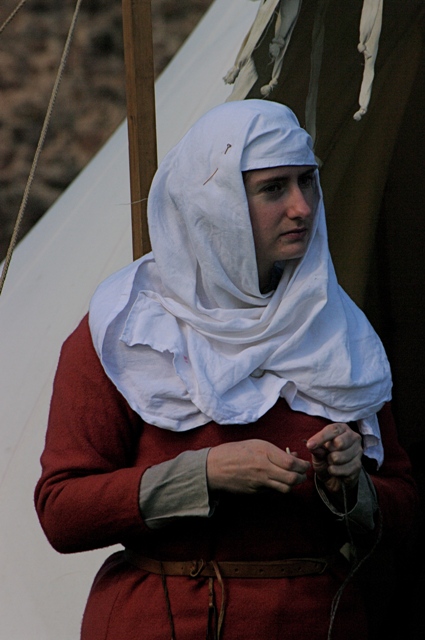 n cap, with a wimple over the top. The wimple was a large rectangular piece of linen that was draped over the head and pinned into place. There is a great deal of speculation and experimentation still ongoing among historians and practical archaeologists as to how wimples were arranged. Wimples tended to cover head and throat. When just the head was covered, then the garment is often called a veil. Sometimes for the high status lady, the wimples were made of silk.
Accessories: Accessories were used to accentuate certain aspects of the female body in attractive ways. Finger rings were popular at this period and a great show made the hands and hand ges
 tures. Ornate and decorated belts drew the attention to the waistline and hips, and the side lacing is where the chemise might just poke through the gaps and give a man a thrill! The rich used magnificent brooches and cla
 sps to pin cloaks and mantles. The poor use less ostentatious decoration but again of similar type.
So, there you have it. The everyday outfit of a 12th century woman at the time of the Empress Matilda. Would you like to dress like this?