ocieties; in her new novel FINDING EMILIE, released on April 12, she offers us the evocative and poignant story of Lili du Chatelet, daughter of the free-thinking Emilie du Chatelet, who liveds in the crumbling world of pre-revolutionary France. Abandoned as a baby, Lili seeks to uncover the startling legacy of her mother, as life in aristocratic society constricts around her like the excruciating corsets she is forced to wear. But she is soon compelled to discover much more than where she comes from and gain the courage to fashion her on life as the world around her undergoes cataclysmic upheaval.
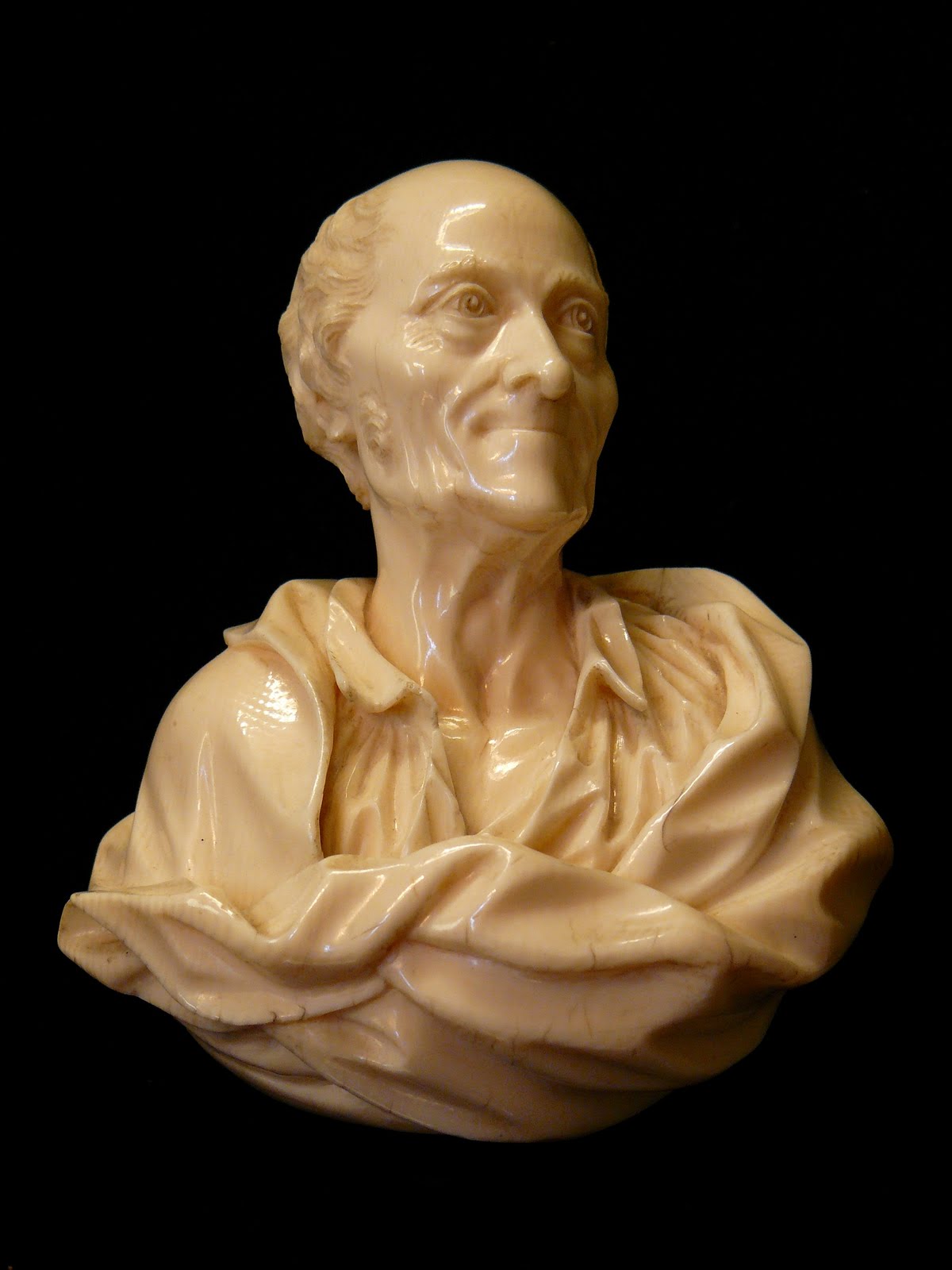
In celebration of FINDING EMILIE's release, Laurel has offered us this guest post. Please join me in welcoming Laurel Corona. Voltaire: Bad Boy of the Enlightenmentby Laurel Corona "The ungodly arch-villain has died like a dog,” Wolfgang Amadeus Mozart is reputed to have said upon hearing of Voltaire’s death in Paris in 1778. Undoubtedly, similar sentiments were expressed over much of France at the news. Voltaire’s death was consistent with his life. Toothless and bald, the octogenarian
 hypochondriac had finally caught a real illness, and he used his little remaining strength to turn his back on a priest who had come to hear his confession and give him communion. “Just let me die in peace,” he growled. Those were his last words. Peace was not something Voltaire had offered the church in return--or any of the entrenched institutions in France.
With his passionate convictions about intellectual and political honesty and social justice, Voltaire’s acid wit cut a wide swath, sparing no one he considered a hypocrite or liar. Poet, historian, playwright, philosopher, essayist, and satirist, Voltaire used his prodigious talent to combat what he called “l’infame”--the infamy of using a position of authority to take advantage of others. The church lied and abused power to instill fear, the state to foster obedience. No one, it seemed, in Voltaire’s words, “dared to think.” Think for yourself. That’s all Voltaire asked, but whenever he thought for himself he could count on trouble.
He was imprisoned a number of times for problems with the censors, was banished to England, and later was sequestered for fifteen years under loose house arrest at the home of the Marquis du Châtelet, Voltaire’s lover Emilie du Châtelet’s tolerant husband. Throughout his life numerous lettres de cachet, arrest warrants granted as royal favors, were taken out against him by powerful individuals with a grudge. With what amounted to a bull’s eye painted on his back and arrows in the hands of most of the powerful forces in France, after Emilie’s death he lived out his life as a landed gentleman in Ferney, close enough to the Swiss border to escape on horseback at a moment’s notice. He was on that horse more than once. His books were routinely published abroad and smuggled into France, while Voltaire threw up his hands as if this were beyond his control. It was his popularity with a restive public that brought the books to France, not he himself--or so he would have it. Those books include his Philosophical Dictionary, an alphabetized collection of essays skewering one or another pretension. Church teachings were his primary target, but he also took aim at the monarchy and government, an
 d at common people who ought to know better than to believe anything authorities say.
My favorite entry is the one on Adam, where Voltaire pretends not to understand how Adam could be the father of all humankind and yet no one in China seems to have heard of him. Not heard of their original forefather? Voltaire suggests that it must have been a very effective campaign indeed to have so thoroughly destroyed all the monuments that must once have been erected to him, and all the writings other than the Bible that told the same story. Fellow philosophers did not escape his pen, the most notable being Leibniz, whose philosophy of optimism is dismantled by the adventures of Voltaire’s most famous character, Candide. Anecdotes about Voltaire reveal that he practiced in his life the same disdain for authority and illogic.
Stories abound, such as the one Voltaire recounts to my protagonist, Lili, in Finding Emilie. He tells her he once told a police officer searching his room for contraband writing, that he threw the materials down the privy. The officer probed the excrement-filled privy with such enthusiasm that sewage ended up spraying the tavern downstairs when a pipe burst. Voltaire never discarded any papers at all. He just wanted a fit punishment for someone who did not dare to think, and who made his living enforcing censorship laws. Voltaire was rich, having gotten his initial wealth from a successful strategy to manipulate a glitch in the French lottery and win the grand prize.
By the time he needed a new retreat near the Swiss border, he had enough money to purchase not just the chateau at Ferney but the entire town. The tiny town’s church spoiled the view from the chateau, so Voltaire tore it down without church permission, intending to build another in a new location. The church went on the attack, demanding he rebuild on the hallowed ground where it once stood. Voltaire had no choice but to go along. A Deist, he believed that God created and ran the universe through natural law, and that the church distorted that reality through ludicrous doctrines and stories. Above the new church door Voltaire had a different kind of dedication carved: Deo Erexit Voltaire, “Voltaire erected this church to God.” The church in his town would not be named for a saint, based on the foolish notion that some heavenly being would intercede for the people of Ferney. It would honor the God of the Deists, and nothing further. The inscription and the pyramid-shaped tomb he had built to be his final resting place, half in and half out of the church, can be seen by visitors to the Chateau at Ferney today. The town itself was renamed Ferney-Voltaire in his honor. Voltaire is actually entombed in the Pantheon in Paris, but like all the great men honored there, he had painful shortcomings. Many of his writing are painfully anti-Semitic, and he took credit that really belonged to Emilie du Châtelet for scientific work they undertook together. His plays and poetry, for which he was best known at the time, are so dated they are hardly ever read. Still, there is no question Voltaire led one of the great lives of his, or any era, and that he is indeed the undisputed bad boy of the Enlightenment.
Thank you, Laurel. We wish you the best of success with FINDING EMILIE! To find out more about Laurel and her work, please visit her website.