Pages

Showing posts with label books. Show all posts

Friday, December 9, 2011

Happy Holidays 2011!

Dear Readers and Friends,
Wow! It seems as if this year went by really fast. I can't believe it's almost 2012. Looking back, however, I realize this is because it was such a jam-packed year for me, one I've been lucky to share with many of you. Here are some of the highlights:

February 2011 saw the publication of THE TUDOR SECRET, the first novel in my Elizabeth I Spymaster Chronicles - a wonderful achievement for me, as this is my little-novel-that-could. After years of rejection, I decided to independently publish this novel as The Secret Lion. That version's success helped me regain the confidence that the bruising cycle of submission and rejection had sapped; more importantly, it eventually gained me the attention I needed to catch my agent's eye. In an ironic twist of fate, it was sold, along with the next two in the series, to the same editor who read my very first novel, submitted by my very first agent, 13 years previously. All in all, proof that persistence is everything. To date, THE TUDOR SECRET has been sold in 7 countries and is poised for a massive bestseller campaign in Italy in February, 2012. Apparently, February is turning out to be a good luck month for me!

May 2011 saw publication of the paperback edition of THE CONFESSIONS OF CATHERINE DE MEDICI, another novel that underwent a long period of gestation, challenge, and change. From its original 798 pages, it was edited down during various submissions before it finally found its home, and transformed in the process from an epic recounting of 16th century France under Catherine's reign into a far more intimate story of this often vilified and misunderstood woman. The hardcover edition made several Top Reads of 2010 lists and sold out; I like to think that wherever Catherine is today, she's smiling :)

June 2011 brought the gathering of the historical fiction tribe in San Diego for the 4th US Historical Novel Society Conference. Beside the sparkling bay, readers, writers, bloggers, and fans of the genre congregated for two and a half days of panels, dinners and lunches, impromptu meetings, outings, and much laughter and celebration. Some of the highlights for me were lunch with my fellow authors of the Jean V. Naggar Literary Agency; C.C. Humphreys in blue velvet, playing the libidinous earl of Rochester in the late-night sex scene reading from Gillian Bagwell's The Darling Strumpet; seeing my agent at the podium, receiving the accolade she so richly deserves for all of her and the agency's hard work representing some of our genre's most celebrated authors; drinking wine with my editor; sharing time on panels with fellow authors, and of course fun with friends.

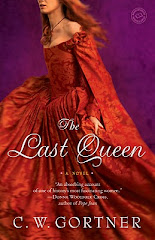
July through September saw me hard at work on THE QUEEN'S VOW, my novel about Isabella of Castile, which will be published on June 12, 2012. I loved returning to early Renaissance Spain and re-discovering Isabella, who'd played such a significant supporting role in my first book, The Last Queen. One of my continuing joys in writing historical fiction is recognizing my own prejudices and preconceived notions, and seeing how my research has influenced these beliefs. Like Catherine de Medici and Juana la Loca (who was Isabella's daughter) Isabella of Castile has suffered from history's verdict, her reign one of great accomplishment but also dark controversy. I hope this novel about her early years and tumultuous rise to the throne, as well as her struggles as a young bride and queen, will help to humanize her for readers. For in the end, that is what historical fiction does best: it helps us to see these long-gone characters from the past as people, first and foremost.

As the year comes to a close, I'm currently at work on the editorial revision of my second Spymaster book, tentatively titled The Tudor Deception. I plan to finish the revision by the start of 2012 and then turn my full attention to my next stand-alone novel, Borgia's Daughter, about the early years of another infamous woman I find fascinating: Lucrezia Borgia.

It's been an incredibly busy and productive year, one which certainly could not have been possible without your ongoing support. Every reader who bought my book; every book club who invited me to chat; every blogger who reviewed my work, interviewed me, or posted a guest post; every recommendation, criticism, or mention - these are integral to my success. I owe it all to you and I want to extend my most heartfelt appreciation.

I wish you all a very happy holiday season, filled with health and love. May we find better ways to live together as a community; to treat our fellow beings, animal and human, with love and respect; to find peace and restore harmony to our much beleaguered planet.

And may we always tell and read stories, for story is the universal tie that binds us.

Tuesday, July 12, 2011

Guest post from Donna Russo Morin, author of TO SERVE A KING

I'm delighted and honored to welcome Donna Russo Morin, author of several adventurous historical novels set in Italy and France, including her latest novel, TO SERVE A KING. Donna always offers exciting fresh settings and intriguing plots; this marvelous guest post from her offers a glimpse into Donna's creative process.

Please join me in welcoming Donna Russo Morin.

I consider myself extraordinarily blessed that my profession allows me the indulgence of historical research. Self-confessed nerd, I happily spend hours, days, weeks, months with my nose stuck firmly in centuries old public records, estate accounts, and paper-and-ink-pungent text books, pouring over account after account of any one man or woman’s life. A sketch is rendered, it’s given dates of birth and death and momentous moments, its clothed in activities and choices and consequence. But it is a flat translation, so like the paper dolls I played with as a child, with little consideration of emotional motivation. Perhaps it is my own sensitive nature, perhaps it is the psychology degree I obtained by accident, but as I lay the clunky antiseptic tomes aside, lean my head back, and close my eyes, my mind—and my muse—ruminate on the emotions—the elation and the torment—that is the true essence of any human life.

In my first book, The Courtier’s Secret (2009) it was the Sun King, Louis XIV, who intrigued me the most. The charismatic, libidinous man dedicated his life to the puppet-master manipulation of his nobles, creating ritual after ritual, requirement heaped upon requirement—many of such convolution that few could wade through the depths and succeed in finding his favor. In truth, none would ever truly have it, for the man who would be the longest ruling sovereign in France’s history hated all nobles with caustic venom. His life would be forever imprinted by the fear such nobles had infused in him when, as a child, they threatened his life and that of his mother in the rebellion known as the Fronde. It was a childhood trauma—as devastating and long-lasting as any abuse. Heedless of the child in their midst, the blue-bloods of the age came at his home with weapons and anger, vicious hate upon their tongues. From the moment he reached his majority, from beneath the guise of rule, Louis would make them pay for their violent disloyalty for the rest of his life. And yet it was these very actions—his dedication to be the most privileged king of all—which would lead to the destruction of his progeny, a heart-rending vicious circle of emotional flotsam, the thick, gooey stuff that pronounces us as humans, not just a compendium of dates.

Genius, fanatical curiosity, profound religious beliefs crashing against scientific fervor…all this and much more percolated beneath the surface of Galileo Galilei. But perhaps the most formidable undercurrent of his life was the haunting command of survivor’s guilt. As portrayed in my 2010 release, The Secret of the Glass, Galileo was the only man to survive a bizarre encounter from which others were not so fortunate. While on a walking tour of the Tuscan region, thirty-eight-year-old Galileo and a few of his migliori amici, his most beloved friends, were inadvertently exposed to the noxious vapors festering from out of the Caves of Costozza. Each one died, save Galileo. Though he too was stricken with illness, an auto-immune-like condition that would plague him the rest of his days, it was his guilt as the sole survivor that impelled him to make his life—the only spared on that fatal day—worthy of the gift. It kept him resolute, even as the Vatican itself did its utmost to grind him and his heretical scientific work to a halt. Galileo’s deep and abiding need, one too powerful to be denied, coupled with his beliefs, would allow no such obstruction, no matter the cost.

My latest release, To Serve a King, is based on nothing if not the proposition that with true remorse, one may find true redemption. It is true of my main fictional character; it is true of the king that haunts her so. François I is forever portrayed as a cruel and lecherous hedonist, and justifiably so. But little is said of him in his years of decline. When writing François I, I was not unmindful or blind to his brutish youth, however I was deeply aware of the personal hardships he had encountered—the loss of spouse, the loss of beloved children, the slow torture of watching his own power diminish as he aged. In the major biographies read during my research, I found a great dichotomy between his early years and those of his latter days. I was struck by the notion, and the hope, that we have the ability to become truly conscious beings and in the clarity of vision such consciousness affords, we can look back and see the road behind us with all its potholes and wrong turns. It is distasteful to have regrets—the acidity sticks in the craw and repeats offensively—but if conscious of their power, the enlightened can use them to find remorse, and it is in remorse that we are redeemed. Thus was how I found François; it is how I wrote him. I can say with certainty there was a wish in such a rendering.

I’ve lately just finished my next book, the first where I base a main character on the life of an actual person. But in this, The King’s Agent, as in my others, the true question will not be what he did—the illegal procurement of precious works of art—but why he did it.

I was recently asked in an interview what it was that most intrigued me about historical fiction and I answered…the human experience, that which is found deep within every one that shares this existence… human experiences that are unchanged whether ten days or ten centuries apart. It is that resounding repetition that I seek to uncover as I immerse myself—happily, readily—to those hours, days, weeks, and months of research.

Thank you, Donna! To learn more about Donna and her work, please visit her website.

Thursday, March 10, 2011

SINS OF THE HOUSE OF BORGIA

In celebration of the US trade paperback of my friend Sarah Bower's gorgeous novel, SINS OF THE HOUSE OF BORGIA, I'm re-posting a previous, wonderful guest post from Sarah on history, the importance of dogs, and that bad boy of Renaissance Italy, Cesare Borgia.

Set in early 16th century Italy during the dangerous reign of the Borgias, SINS OF THE HOUSE OF BORGIA tells the story of Esther, a young Jewess who escapes with her family from Isabel of Castile's Spain, only to find herself enraptured by, and ensnared in, the intrigues and lethal attractions of Cesare Borgia and his sister, Lucrezia. Readers will be enthralled by this mesmerizing tale of an innocent's journey into the dark secret heart of one of Italy's most infamous papal dynasties.

One Man and His Dog
by Sarah Bower

In the beginning of the Powell and Pressburger film A Matter of Life and Death (1946), a wartime airman is washed up on a beach after his aircraft is shot down over the sea. He believes he is dead and has gone to heaven. As he walks up the beach, he encounters a black Labrador.
‘I always hoped there’d be dogs,’ he says as he pats the animal’s head.

The room where I write contains two desks, two computers, an inexplicably large number of books (do they breed, I wonder, while my back is turned? Should I worry about leaving my Freud next to my Austen..?), and two golden retrievers. These retrievers – Clarence and Floyd (named after two characters from the same movie) – are apparently inert. To the uninitiated they might seem to be rugs, moth-eaten leftovers from a golden age of big game hunting, or possibly evidence of a bizarre taste for taxidermy. Yet despite the fact that they sleep away my working hours, only snapping into a flurry of dancing, whimpering and tail wagging when I rise from my desk and intone the word, ‘walk’, or possibly, ‘tea’, they make an invaluable contribution to my fiction.Walking is itself a great spur to creativity, of course. Keats, it is said, composed verses in his head while walking on Hampstead Heath and committed them, fully formed, to paper when he arrived home.
He took
In his knapsack
A book
Full of vowels
And a shirt
With some towels –(From John Keats, A Song About Myself: The Complete Poems, Penguin Classics 3rd edition 1988)

You can almost hear the rhythm of his feet, can’t you? History does not relate ( I don’t think) if he walked with a dog, but I’m certain many authors do. Among the many memorable characters in J. G. Farrell’s novel, The Singapore Grip, set in the period just before the fall of Singapore to the Japanese in 1942, is a mangy, half-blind King Charles spaniel, nicknamed The Human Condition. The Human Condition survives bombing and shelling, several attempts to take him to the vet to be put down, and beats most of the human characters on to the last ship away from the island before the invading force arrives. He left me suspecting that Farrell, like me, wrote in the presence of dogs.

The decision to give Bishop Odo in The Needle in the Blood a favourite dog was straightforward. One of the themes of that book is – perversely – the Englishness of the Normans, the fact that William the Conqueror and those who accompanied him on his great adventure are as much the ancestors of P. G. Wodehouse’s Lord Emsworth as they are the proto-Nazis much beloved of the champions of Harold Godwinson and his Anglo Saxon kingdom. English gentlemen – just like Powell and Pressburger’s gallant bomber pilot, played by that quintessential English actor, David Niven – have dogs. Much as J. G. Farrell’s lamentable King Charles spaniel acquired his Human Condition, however, I found that Bishop Odo’s dog, Juno, developed a role and character of her own and began to make interventions in the narrative as a kind of interpreter of human emotions, a channel of communication between human characters bent on misunderstanding one another.

So, by the time I came to plan my latest book, Sins of the House of Borgia, which looks at the lives of Cesare and Lucrezia Borgia through the eyes of a young Jewish conversa, I was very conscious of the need to add dogs to the mix. There are two dogs of importance in the book - Alfonsino, a lap dog given to Lucrezia as a betrothal gift by her last husband, Alfonso d’Este, and Tiresias, a blind hound belonging to Cesare. A theme of the novel is doubling: Esther, the Jewess, and Lucrezia are very similar in appearance, a fact which has enormous consequences for Esther. One way in which I chose to signify this was to set up a rapport between Esther and the dog. She becomes its principal carer, and this in turn leads her into certain circumstances which change her life. Lucrezia begins by disliking the dog but shifts towards affection for it as she settles into a marriage which was, if not an idyllic love affair, a long and successful one which eventually enabled her to escape the lurid reputation she had acquired as a girl in Rome. In Ferrara, where the Este were the ruling family, she is remembered with great fondness for her cultivated court and her gallantry in defending the city during the War of the League of Cambrai.
Tiresias was a late addition to the novel. He didn’t appear in the first draft at all and it was only while I was proof reading The Needle in the Blood it occurred to me that Cesare Borgia needed a dog every bit as much as Bishop Odo, perhaps more so, as my initial motivation in giving him Tiresias was quite shamelessly manipulative. I wanted to make my readers like him more. Cesare Borgia has been fictionalised in many ways, from the wonderfully subtle portrayal by Nigel Balchin in The Borgia Testament, in my view the best of all novels about the Borgias, to the wicked and clever comedy of Somerset Maugham’s Then and Now to the gloriously predatory ogre of Gregory Maguire’s Mirror, Mirror. He is a godsend to the novelist in many ways, having led a life which his biographer, Sarah Bradford , describes as having all the ingredients of a Greek tragedy. He is also (and I suspect, wherever he is now, with or without dogs, this must be a source of great satisfaction to him) impossible. As many headed as the hydra that was his emblem, every time you think you’ve got a grasp on his character, he slips away. The atheist son of a Pope, the womaniser who took no account of any woman other than his mother and his sister, possibly the greatest military and political genius of his age who nevertheless ended in complete failure, the inspiration for Machiavelli’s Prince – but then we have to ask ourselves, what is The Prince? Is it a serious treatise on government or a deeply ironical joke levelled at the tyrannical Medici by a dyed-in-the-wool republican?

These contradictions, the evasiveness and trickery of the man even 500 years beyond the grave (he died in 1507), challenges the novelist to transform him into either hero or villain with any conviction. He forces her to do what, of course, she should be doing, to recreate out of the facts and the myths an authentic human being. All human beings have their loveable side, even if only their own mothers can see it. Unfortunately, my plot dictated that Cesare’s relationship with his mother would not show his best side. If we’re lucky, we get unconditional love from our mothers, but everyone gets unconditional love from their dog. How better to show Cesare to advantage than by giving him a dog? Of course, like any other gentleman of his age, he would have owned a lot of dogs, hounds of various kinds for hunting (though hunting with leopards was one of his favourite pastimes – how wonderfully over-the-top Renaissance of him) and would have put considerable resources into breeding them. What, then, would he do with a puppy born blind? Well, have it destroyed, of course.

An exercise I often set my students is to turn a convention on its head and see where it takes you. What, for example, happens to the story if you turn Cinderella into a boy or give Don Juan a conscience? With Tiresias, I did exactly the same thing – instead of putting him down, Cesare keeps him. He says it’s because, being blind, he will have a good nose for truffles, but you kind of know that’s just an excuse, a pragmatic front put up to shield the sentimental streak in his nature. So, Tiresias stands for the goodness in Cesare, for the side of him that is capable of love and loyalty and straight dealing. His lifespan is also exactly that of the papacy of Alexander VI, Cesare’s father, and thus, by his untimely, violent and avoidable death, he foreshadows his master’s own end. Oh, and he gives Cesare the idea for the chestnut orgy. Chestnut orgy? Well, if you want to know more, you’ll have to read Sins of the House of Borgia, which explores many different kinds of love, not least that of a man for his dog and vice versa.

Sarah Bower is the author of two historical novels. The Needle in the Blood was Susan Hill’s Book of the Year 2007. The Sins of the House of Borgia, first published as Book of Love, is now released in the US in trade paperback from SourceBooks. Thank you, Sarah. We wish you much success in your latest US debut!

Tuesday, August 3, 2010

Win a copy of CONFESSIONS OF CATHERINE DE MEDICI

Want to win a personalized copy of my latest novel and visit a great blog? Please click over to History and Women and enter to win!

August 2 to 6 on http://www.historyandwomen.com/ and August 16 to 20 on http://historicalnovelreview.blogspot.com/

A very special thank you to the fantastic, talented Mirella Patzer for hosting me. Check out her own books while you're there!

Tuesday, June 29, 2010

Four Books I Recommend: Mini Reviews

THE PASSAGE by Justin Cronin
This is being buzzed as the Big Book of the Year, and with reason: it was bought for a colossal sum at auction by Ballantine Books; film rights sold to Ridley Scott, director of Alien and Gladiator within days, and it's drawn comparisons to the best of Stephen King. Being a fan of King's earlier novels (The Shining is one of my all-time favorites) I was intrigued by Cronin's apocalyptic tale of a scientific experiment gone awry and a world overcome by virological vampires, aptly dubbed "virals." At the center of this huge story spanning over 700 pages is an enigmatic girl named Amy, whose abandonment by her mother propels her into the horrific events leading up to the end of civilization as we know it, and the creation of a much-altered and frightening post-collapse society, where clusters of surviving mortals hide behind enclosed homesteads and banks of battery-powered lights which are slowly but inexorably losing power. The cast is immense, as befitting an epic, though at times this proves challenging both in remembering who everyone is and investing in any single person, particularly as you never know when said person will fall prey to the marauding, tree-leaping, blood-thirsty virals who've quite literally "eaten the world." These virals, however, are more than toothy creatures; and it's their secret, as well as Amy's role in it, that drives the story to its long-winded but ultimately creepy conclusion. THE PASSAGE requires immersion and patience; but for the intrepid reader there are rewards to be had, including the first 250 pages, which are a pitch-perfect icy soak into the terrors of science taken to extreme, and later on, a particularly nasty confrontation with hordes of virals in devastated Las Vegas. Mr Cronin is working on the next book in a proposed trilogy.

THE ILLUMINATOR by Brenda Rickman Vantrese
This is another book that generated serious buzz when it sold to St Martin's Press years ago and I bought a first edition because, frankly, the cover looked like a gold-laminated Faberge egg. Unfortunately, I didn't get around to reading it until recently, though I've faithfully bought the next two books by Ms Vantrese based on reviews. And let me just say for the record: Why did I wait so long?! THE ILLUMINATOR is a magnificent, thought-provoking and defiantly anti-anachronistic plunge into the turmoil and tragedy of 14th century England. The story, on the surface, appears deceptively simple: a widow, Lady Kathyrn - portrayed refreshingly in middle age, rather than the dewy glamour of youth- is fighting to save her estate as inheritance for her sons from the rapacity of the Church and ill-intentioned suitors. Enter a mysterious illuminator named Finn and his evanescent daughter; after a mishap on the road involving a pig and a dwarf, Finn is conscripted into plying his trade as an illuminator of manuscripts for the local bishop and comes to live in Lady Kathyrn's manor, where his presence sets off a chain of life-shattering events. Vantrese's true strengths lie in her superb grasp of the era and understanding of the complex importance of spirituality to people striving to overcome every-day suffering. This is not a romanticized historical recreation; THE ILLUMINATOR transports you into a time both fascinating and repellent in its contradictions. Ms Vantrese is also the author of The Mercy Seller and The Heretic's Wife, which loosely connect with her first book and are now at the top of my TBR list.

DAUGHTER OF FORTUNE by Isabel Allende
Let me say it upfront: I'm a devoted fan of Ms Allende. From her House of the Spirits to Zorro, I have reveled in her quixotic, sensual, unabashedly sprawling explorations of family ties, the toll and joys of love in all its diverse forms, and the independent spirit of the immigrant. DAUGHTER OF FORTUNE was the book selected by Oprah for her book club and of course it garnered enormous acclaim; while I bought it, it was another that sat on my shelf unread, for some inexplicable reason. Nevertheless, the wait was worth it. Infused with Ms Allende's trademark turns of phrase ("fate lashed its tail and changed her life forever") and cast of eccentric characters driven by private obsessions, this novel takes place in the 1800s, starting in Chile with the discovery of a baby in a soap crate, left on the threshold of the very proper but secret-riddled English family of the Sommers. The child, named Eliza, is raised by the delightful wasp-waisted Ms Rose Sommers, indoctrinated in the limited methods a girl can employ to survive in their rarefied society; but when Eliza falls passionately and unexpectedly in love with a common clerk, she flees the safe emptiness of her cloistered existence for feral California, embarking on an adventure that awakens her to life's vast potential and cracks the fragile veneer in which the Sommers themselves have dwelled. Ms Allende's deft pen conjures to vivid, humane life both the hypocrisy of Victorian mores in South America as well as the savage abandon of the Gold Rush; her cast is wide and diverse, ranging from the mourning Chinese physician who accompanies Eliza to a caravan of prostitutes led by a transgender humanitarian. Very few writers today can claim the mastery of color and depth of Gabriel Garcia Marquez's work; I humbly suggest that Ms Allende is definitely one of them.

THE SHEEN ON THE SILK by Anne Perry
Anne Perry departs from her bestselling Victorian mysteries for this epic, yet at times uneven, tale of 13th century Byzantium featuring a female physician who disguises herself as a eunuch to uncover the truth about her twin's involvement in the assassination of a politician. Still reeling from a Venetian-led assault that devastated its populace and exiled its imperial family, Byzantium is a city of crumbling secrets, besieged noble families, and labyrinthine intrigues; into this dangerous yet seductive crossroads between East and West enters Anna, a.k.a. Anastasius, determined to prove her brother's innocence. While Anna's story is compelling in and of itself, it is her patroness Zoe, an aging but still beautiful noblewoman intent on revenge, who steals the plot — seductive, lethal, and uncompromising, Zoe has never forgotten the debt that Venice has incurred for destroying the city, even as her own past is haunted by tragedy and violence. Woven throughout the novel's ambitious narrative are various supporting characters, including a conflicted Roman priest whose contact with Byzantium throws his own faith into question; a Venetian sailor seeking his hidden past; and a spiritually pliant bishop of the Orthodox faith determined to prevent ecclesiastical union with Rome. Perry excels in her characterizations and in creating an ambiance that shifts easily between the gilded corridors of Byzantium’s sea-scented palaces to the corrupt intrigues of the Vatican to the arid expanse of the Sinai desert; however, at times her pacing can be challenging both because of the wide cast of characters and the novel's meditations on the meaning of religion in a world overcome by upheaval.

Wednesday, June 23, 2010

Does the Prize make the Genre?

Hilary Mantel's recent win of The Walter Scott Prize for Historical Fiction is a definite boon for a genre that has suffered more than its fair share of critics. In the days leading up to the award of this prestigious UK-based prize, both author Sarah Dunant – a nominee - and academic Jerome de Groot wrote pieces in the Times and The Scotsman, respectively, which attest to, and attempt to explain, the current popularity of the historical novel. Both pieces offer valid points and rejoice in our genre's resurrection; and no one who has read my blog can deny my own admiration for Dunant’s work, in particular.

However, for me, both pieces exude a slight whiff of troubling elitism prevalent within the genre. It's almost as if historical novelists must justify the reason for their work while being  divided into categories: the literary; the commercially popular; and, well, the rest. While we cannot deny a class status within the genre, as in all forms of writing, I believe there are more deserving novelists working in the arena of historical fiction than just the ubiquitous nominees. There seems to be a general reluctance to acknowledge this fact, as if in doing so we might risk opening the floodgates to a tidal wave of undesirables who will inundate our shelves; as if by paring the list to a few well-heeled and universally acclaimed names, we can restrain  the growth of this rather checkered genre and keep it in its proper place, so to speak.

Surely the time has come to cease casting aspersions based on a tarnished past? Jean Plaidy, Anya Seton, Georgette Heyer, et al are our grand dames, who deserve respect, if nothing else, for popularizing a genre mired in 19th century convention. While few today would deem their books as serious literary endeavors, they remain compulsively readable. Even more important, these hard-working, prolific novelists helped make the genre accessible to thousands of readers who otherwise might never have picked up, much less read, an historical novel.

The archaic confusion between romance novels with historical settings—where the romantic interaction always assumes precedence over history— and the current vogue in novels featuring real historical figures appears to be a partial culprit in our current elitist stance. No one, it seems, wants to be caught dead being dubbed the descendant of a bodice ripper. Nor do some literary-aspiring novelists want to be caught dead doing the “marquee name” while others, conversely, shun stories about ordinary people living in the past, with nary a guttering beeswax candle or flicker of velvet in sight.

But in truth, these divisions are blurring. While it can be said we’re experiencing an overemphasis on queens, which in turn risks exposing the genre to all the historic criticisms leveled against it, such as lack of veracity, distortion of facts, etc., the genre is also more popular than ever— and that in and of itself is a remarkable feat, a testament to the fact that readers love what we write and there is room for variations on a theme.

I’m all for excellence in our craft; indeed, I strive for it. I just feel there is more of it around us than the rest of the world wants to admit and we must celebrate our diversity, rather than merely exalt our loftiest achievements.

Wednesday, March 31, 2010

Guest post from Mary Sharratt, author of DAUGHTERS OF THE WITCHING HILL

I am delighted to welcome Mary Sharratt, author of the upcoming DAUGHTERS OF THE WITCHING HILL, an evocative and haunting novel that recreates the Pendle witch trials in Lancashire in the 16th century. Mary lives in the area and has woven a masterpiece of imagination and fact around the women and men caught up in the hysteria of this event. She twists the tale with the possibility that one of the women may have actually possessed supernatural gifts, infusing her book with vivid details of life in a dangerously superstitious era. This is a gorgeously rendered account of faith, persecution, and tragedy that I could not put down and has been called "uplifting in its portrayal of women who persevere, and mothers and daughters who forgive" by Publishers Weekly; and "a fascinating tale . . .unfolds without melodrama and is therefore all the more powerful" by Library Journal.

Mary is the winner of the 2005 WILLA Literary Award and a Minnesota Book Award Finalist and the author of the critically acclaimed novels Summit Avenue (Coffee House 2000), The Real Minerva (Houghton Mifflin 2004), and The Vanishing Point (Houghton Mifflin 2006), which was a UK Guardian Readers’ Book of the Year. She is also the co-editor of the subversive UK fiction anthology, Bitch Lit (Crocus Books UK 2006), a celebration of female anti-heroes. Mary’s short stories have been widely published in journals and anthologies on both sides of the Atlantic, including the recent Twin Cities Noir (Akashic Books 2006). She also happens to be delightfully witty in person and a devoted equestrian; I am privileged to call her a friend.


Please join me in welcoming Mary Sharratt to Historical Boys.

Daughters of the Witching Hill: In Search of the Pendle Witches

by Mary Sharratt

In 2002, I moved to the Pendle region in Lancashire, Northern England. It didn’t take long before the wild, brooding landscape cast its spell on me and inspired my new novel, Daughters of the Witching Hill.
Pendle Hill is famous throughout the world as the place where George Fox received the ecstatic vision that moved him to found the Quaker religion in 1652. But this rugged countryside is also haunted by the legacy of the Pendle Witches.

In 1612, seven women and two men from Pendle Forest were executed for witchcraft, but the most notorious of the accused, Bess Southerns, aka Old Demdike, cheated the hangman by dying in prison.
"Allow me to introduce you to a woman of power who changed my life forever": this is how Thomas Potts describes her in The Wonderfull Discoverie of Witches in the Countie of Lancaster: "She was a very old woman, about the age of Foure-score yeares, and had been a Witch for fiftie yeares. Shee dwelt in the Forrest of Pendle, a vast place, fitte for her profession: What shee committed in her time, no man knowes. . . . Shee was a generall agent for the Devill in all these partes: no man escaped her, or her Furies."

Reading the trial transcripts against the grain, I was amazed at how Bess’s strength of character blazed forth in the document written to vilify her. Bess freely admitted to being a healer and a cunning woman. She lived as a matriarch with her family at Malkin Tower and instructed her daughter and granddaughter in the ways of magic. Her neighbours called on her to cure their children and their cattle. What fascinated me was not that Bess was arrested on witchcraft charges but that the authorities turned on her only near the end of her long, productive career. She practiced her craft for decades before anybody dared to interfere with her.

Cunning craft—the art of using charms to heal both humans and livestock—was Bess’s family trade. Their spells, recorded in A Wonderfull Discoverie, were Roman Catholic prayer charms—the kind of folk magic that would have flourished before the Reformation. Yet she also drew on an even older source of power: Tibb, her familiar spirit, who appeared to her in the guise of a beautiful young man.

Other books have been written about the Pendle Witches—both nuanced and lurid. Mine is the first to tell the tale from Bess’s point of view. I longed to give Bess Southerns what her world denied her—her own voice.

History is a fluid thing that continually shapes the present. As a writer, I am obsessed with how the true stories of our ancestors haunt the landscape. No one in Pendle can remain untouched by the witches’ legacy. As contemporary British storyteller, Hugh Lupton, has said, if you go deep enough into the old tales and can present them in a meaningful way to a modern audience, you become the living voice in an ancient tradition. Bess Southerns’s voice deserves to be heard.

Long after their demise, Bess and her fellow witches endure, their spirit woven into the land, its weft and warp, like the stones and the streams that cut across the moors. This is their home, their seat of power, and they shall never be banished. By learning their story, I have become an adopted daughter of their living landscape, one of many tellers who spin their unending tale.

Mary Sharratt’s acclaimed new novel, DAUGHTERS OF THE WITCHING HILL will be published on April 7 by Houghton Mifflin Harcourt. To learn more, please visit her website at http://www.marysharratt.com/ and join her on her virtual tour: http://booktour.com/author/mary_sharratt#new-event

Sunday, March 14, 2010

Guest post from Stephanie Cowell, author of CLAUDE AND CAMILLE

I am delighted to welcome my friend Stephanie Cowell. A marvelous novelist whose work includes the exuberant Marrying Mozart and The Players: A novel of young Shakespeare, on April 6 Crown Publishers will release Stephanie's new novel Claude and Camille, the haunting, passionate story of Claude Monet's youthful love affair with his wife and muse.

Already, the reviews are stunning. Publisher's Weekly calls it "A convincing narrative about how masterpieces are created and a detailed portrait of a complex couple. Cowell's novel suggests that a fabulous, if flawed, love is the source of both the beauty and sadness of Monet's art." And Library Journal adds, "Moving through war, illness, prosperity, and poverty, Cowell writes the couple's love story with an eye for perspective as skilled as any painter's."

I had the honor of endorsing this book, and was captivated from beginning to end by Stephanie's elegant language and sensitive insight into the emotion and torment of this great artist. I highly recommend her unique portrait of Monet as he began his career, and of the woman whose inspiration and secrets he could never forget.

Stephanie Cowell has kindly offered this guest post for Historical Boys, to celebrate the upcoming release of Claude and Camille. Please join me in welcoming her!

Visiting old places with an historical novelist
My parents and I were walking down a street in one of those Italian Swiss hill towns a little before dusk. It was a narrow cobbled street which few cars could pass, lined with squat stone houses which had stood there far beyond memory and low cracked wood doors. To me they were not ordinary houses for I felt the ghosts who had lived there in previous times and walked slower and slower, trying to catch their voices and what they were saying. My father’s call rang from far ahead. “Where are you, daughter? We’re going to eat!” “Oh here I am!” I replied, startled into the present. “Just five centuries and fifty feet behind you, you know…”

I suppose my friends and family are used to it by now. We go to Mozart’s birthplace, a narrow street in Paris where Monet had a studio in his youth or the packed old City of London, where ancient churches rub walls with glass skyscrapers. The names of the streets are Fishmonger’s Lane, Cheapside, Love Street. Friends see the skyscrapers, I see the half timbered house in 1591 on Wood Street where Shakespeare hurried at night, lighting his way with a torch, to the house of his old acting colleague Jack Heminges.

There goes Will and Jack! I want to tell cry. I watch as a hint of brown doublet rounds a corner and is gone. There they were! Most the time my husband waits for me. “You don’t see anything?” I ask him. “Just the financial district,” he replies. “But you see things, Stephanie! I can see your face.”

It is true. The past touches and takes hold of my shirt and draws me back. No, it hurls me back. I never know when it is going to happen. It was so intense when entering the room with the Parthenon marbles in London that I had to leave for a time. I almost passed out before one of Queen Victoria’s dresses. And when we visited the newly constructed Globe Theater on Bankside in London I had no idea if I were in 1601 or 2001. T.S. Eliot says, “The communication of the dead is tongued with fire beyond the language of the living.” Madeleine L’Engle says that characters come to us and demand, “Enflesh me!”

New England graveyards at dusk, my footsteps on the floors of Windsor Castle, and staring at the spot in the Tower of London where Anne Boleyn was executed. Show me a 300-year-old shoe, a ruined church, the moors behind Haworth. I stand and stare. I write furiously in a notebook. I discovered one winding, deserted street in Vienna in front of the Cathedral after dark and stood as if stunned. I had no idea what was on that street. In daylight I returned and found that Mozart and his wife had lived there in 1785.

Once a kind guard approached as I sat among the ruins of the old boy’s school in Canterbury. “All right then, dearie?” “It’s ok,” I managed, “I’m a novelist.” He retreated, looking a bit bewildered.

We are fortunate, we who love history and historical fiction and who write it for we live in many worlds. The past opens to us in a hidden street, an old pen, a signature of someone long gone. We are wealthy; we share many lives and we listen to older voices. “Don’t mind me; I’m just walking five centuries behind you,” you can say to your friends. If they know and love you, they will understand and be waiting when you show up at the restaurant for dinner.

Stephanie Cowell is the author of several novels. To learn more about her and her work, please visit her at: http://www.stephaniecowell.com/

Monday, January 4, 2010

It's 2010; time to win some bling!

Happy New Year. I hope you had a lovely time ringing out the decade. May 2010 bring you much love, health, and success.

Now, time to win some bling! Fellow historical fiction author and good friend Robin Maxwell is launching her "O, Juliet Love Games" in celebration of her upcoming novel O, JULIET - a sumptuous, first-time-ever novelized account of the legendary lovers. Today, Monday, January 4th, and on the next two Mondays to follow, you can enter to win a signed copy of the book and a heart necklace (one hand-crafted solid silver, one blown glass, and one carved Thai silver) on Robin's blog. All you need to provide is your email address and answer a simple question about love. You can read a sneak peek of O, JULIET here.

Good luck! What better way to start the new year than with books and jewelry?

Wednesday, December 23, 2009

To Self-Publish or Not: That is the Question

So, tomorrow is Christmas Eve; a time of alleged peace and goodwill toward men, and I just got my shorts in a knot over this post. Now, I know Harlequin's decision to start a self-publishing branch sent its authors into a tailspin and had the internet and industry at large buzzing like a disturbed hornet's nest, and all for good reason. I've been quite interested, having resided on both sides of the fence, so to speak; now, after reading this post and its underhanded stab at agents, I have an opinion to express.

I must start out by saying I just love it when self-publishing companies boast about how much they're helping out writers because they offer a service we can take or leave; they are so forward-thinking they're on the edge of a life-shattering industry-wide change; and, my all time favorite, among their thousands of paying clients lies a trove of unrecognized talent which ended up in the slushpile. Every time I hear such declarations, heralding the dawn of a new age for writers everywhere, I shudder and think how much more self-serving can they get? Well, this guy hits a new high, and while I can't pretend to know if he's sincere or not, I do think I can speak for the every-day writer he stands to make money on, regardless of whether said writer ever sells a single book.

When I first started writing, I was always of the mind that I wrote to be read. For me, the act of writing is incomplete without the reader. I am a novelist; that is my trade. So, being published was my ultimate goal; but after years of rejection I had no other choice than to look into the alternative. It was either that or stop writing. I therefore approached independent publishing in a wary fashion, much as you might approach a potentially dangerous beast. I spent a year researching every aspect and method, and spent countless hours on a forum attended by perhaps the largest gathering of self publishers and independent publishers on the planet. Through them, I learned a lot, not enough to not make mistakes, but enough to know that if I wanted to give my work some semblance of integrity, I should never sign with one of the large self-publishing companies. Indeed, I must avoid them at all costs. This was my impression; evidently, many other writers would beg to differ.

Instead, after months of networking, I published for no advance (and a $99 set-up fee) with a micro start-up press in San Francisco. It was self publishing but without the accumulative extras; for $99, they did a nice job getting the book ready. But distribution issues were a nightmare and when the press eventually went belly-up, to keep my then modest-selling book in print, I entered into a venture with two other partners to establish an independent press using POD. One of my partners decided to eschew the stigma of POD by printing a offset run of her books; to date, I believe a quantity of them remain in boxes in a warehouse. Her intentions were sound; but as we soon discovered, independently published authors, no matter how well dressed, rarely get invited to bookstores. I , in turn, cleaved to POD. I never expected to secure bookstore distribution and was therefore unwilling to shell out the thousands of dollars required for a print run; and frankly, all of this made me feel faintly humiliated. While I was proud of what I'd accomplished (my sales had by then risen to a few thousand copies), I must admit I was not at all willing to look booksellers in the eye and negotiate consignment deals. Like most writers, I dreamed of my book appearing on shelves, not hand-delivering copies for a 50/50 split.

I once read an article where a self-published author who'd secured a mainstream publishing contract said: "I self-published to escape self-publishing." Looking back, while I cannot say I did it deliberately, for me the end result was the same. I eventually got an agent who believed in me; she got editors interested. There was an auction; I sold two books; and I never looked back. Not once. Having an agent I adore, who fights for me every step in the way, has helped me establish a fledgling career and made me more money via one traditional book deal, let alone all the foreign rights, than I ever made in five years of dedicated independent publishing. Agents fight for their clients because everything they decide to represent they take on faith and on commission: if you don't get paid (or, in this case, acquired) they don't. The above linked post makes a stab at agents when in fact without them, we writers would truly be at the mercy of people like him. And while self-publishing companies may be a "disruptive force", mainly they're disruptive to the would-be author's bank account, because most of the time they're profit-driven operations disguised as altruism, designed to lure the uninformed writer into the belief that his or her dream can come true. Whether or not the work has merit or sales potential beyond family and friends is secondary, if ever considered. The goal is to make money off the writer, not the reader. This alleged new pardigam in self-publishing may tout itself as the missing link between vanity and traditional, but in the end the company always make money – they charge a fee, remember? - while the author in the majority of the cases does not.

As for undiscovered talent, it's doubtlessly true, and very sad, that many gifted writers never see publication. But how much of it is publishers' lack of foresight and how much is that many gifted writers, after having been knocked about for years in the marathon combat arena that is submissions, toss their manuscript into a drawer and take up rock climbing? An editor in NY who read my work fourteen years ago but was unable to offer at the time called me up to tell me: "You have talent. But that alone doesn't mean much. It's the writers who keep trying who make it. Never give up." As harsh as it is, talent isn't necessarily going to make the cut and neither is perseverance; but armed with both, a writer does stand a chance as long as publishers are acquiring books. Not every writer, and not for years for many, but in the final round some editor, somewhere, is going to recognize the talent and take the chance, if stars are in alignment and the marketplace right.

The above-mentioned post states: "Many would-be authors don’t need a traditional publishing house. That’s the dirty little secret. They already have access to an audience and can reach it without the help of a traditional publisher." Excuse my French, but this is merde. It is true that a few writers have "built-in" audiences before they start, but by and large they are specialists with already-established reputations in related fields, like speakers with a following, gurus, self-help workshop leaders, cult figures, etc. The rest of us usually just start out being famous at home at dinnertime and so we need publishers to recognize our work, just as publishers need us so they can publish new voices and sell books. The real dirty secret is that self-publishing companies since time began have dangled this particular parcel of lies as bait to reel in desperate writers who need to believe their work has enough merit to make it, New York be damned. While the sentiment is admirable, indeed commendable, these writers often find themselves in for a very rude surprise. The long-anticipated revolution in self-published books that sell a fraction of what the average NY Times bestseller does has thus far failed to materialize. Nevertheless, if you approach self-publishing fully cognizant that every odd in the industry is stacked against you and unless you hustle hard and often, you'll most likely never sell enough to compensate what you paid to see your book in print , then you're "informed" and entering it with your eyes wide open. Even so, in my experience, the resultant disappointment can be crushing. Very few writers relish failing to find readers. It's just not in our nature.

Publishers take the risk on unknown writers and it's a gamble they sometimes lose: that has always been the name of game. Traditional publishers pay an advance and offer a royalty structure; they edit the manuscript (more or less); design and typeset the book; print it; promote it (again, more or less) and, most importantly, get it into stores where readers can find it at no additional cost to you, the author.

Not too long ago, after I spoke at an event about my marketing efforts, a writer came up to me to ask how spending my money on marketing was any different from spending money to self-publish. After all, it's my money and it's going toward my book, right? The truth is, building a successful career has more and more in recent years fallen upon the author's shoulders. While never stated openly by the publisher, most of us are fully aware that if we're going to keep publishing books, we must promote and market diligently, using our own money, to augment the publisher's efforts because in this age of dwindling readership and marketing dollars, publishers still have thousands of titles to sell, while we, on the other hand, just have ours. But I see a crucial difference. I get an advance and elect to use a percentage of it to market my work; it's voluntary on my part. I put my hard-earned advance dollars to work for my book, which is very different from paying my hard-earned day job's money to a self-publishing company, which in turn will do nothing for my book.

Do I think every writer should have the choice to self-publish? Of course, I do. I’m certainly glad I did. I might never have attracted the attention of my agent without it. Was it my first choice? Never. It was my last choice, after all else failed; and it only worked for me because one lone agent found my book online paired in a Better Buy Together with a current client of hers (who pointed me out to her, by the way) and she took the time and effort to locate me. I know how incredibly fortunate I am. If approximately 400,000 new titles were published last year and almost half were self-published, just calculate the odds.

But of course, self publishing companies are hoping you won't.

Sunday, November 15, 2009

Book Trailer Sunday: THE GREATEST KNIGHT by Elizabeth Chadwick

So, I've been mired in reading my first-pass pages for The Confessions of Catherine de Medici. These are the actual typeset pages of the book, still unbound; basically, this is my final opportunity to correct typos, editorial inconsistencies, etc. and of course I'm finding far more of these than I'd thought there would be (amazing what typesetting will reveal!)

In the meantime, I missed last week's book trailer Sunday, as I'd just landed back in the US after 10 days in Guatemala. I'll post trip pics soon, but for now I'm delighted to feature the trailer for Elizabeth Chadwick's latest release in the US, The Greatest Knight. I think this is a very dynamic and dramatic trailer that fits the book's subject perfectly. Enjoy!


Tuesday, November 3, 2009

Guest post and giveaway from Terence Hawkins, author of THE RAGE OF ACHILLES

Historical Boys is proud to welcome Terence Hawkins, author of the novel The Rage of Achilles. Praised by Tom Perotta, author of Little Children, as a "a genuinely fresh take on a classic text," this modern retelling of Homer's The Iliad has tells the story of Achilles, Paris, Agamemnon, and of the countless Trojans, Achaeans, warriors and peasants caught up in the conflict, their families torn apart by a decade-long war.

In celebration of the novel's publication, Mr Hawkin's publisher has kindly offered a book to giveaway. If you'd like to enter for a chance to win, please leave a comment. A random winner will be drawn from comments on November 10.

Now, please join me in welcoming Terence Hawkins!

The Rage of Achilles was intended as a realistic account of The Iliad. The natural first question is whether I think the Iliad is history or fiction. And the natural answer is both. The structure of the Iliad itself demonstrates that it was composed neither at one time nor by one person; rather, its creation spanned generations of bards. In some of its books, for example, iron is treated as a precious metal, which it unquestionably was in the earlier Bronze Age; in other books, however, it’s common enough for use as arrowheads. Also, a barbarian invasion and subsequent dark age separated the Trojan War from what we think of as classical Greece. So for a lot of reasons it’s entirely reasonable to place little faith in the Iliad as an historic record.

But it’s equally reasonable to believe that the Trojan War actually occurred. Archaeologists have discovered ruins at Hisarlik in Turkey that they’ve identified as Troy-multiple Troys, destroyed and rebuilt successively over thousands of years. One level, labeled Troy VIIa, shows evidence of having fallen at human hands-skeletal fragments with broken jaws and skulls, bronze arrowheads, signs of fire. This level has been dated to 1190 BCE, close to the time assigned to the war by the classical Greeks. It therefore seems safe to conclude that the Iliad is an unreliable account of an actual event. So an historical novelist has a free hand. Or so it would appear.

There is, of course, a problem. The gods. I wanted to stay as close to the original text as possible without violating the limited historical knowledge we have. But in the original almost every action is driven by divine intervention from a nasty and capricious pantheon. How to write a realistic novel in which every development is a holy practical joke? The answer is Julian Jaynes. As I started writing I remembered having read a review of a book called The Origin of Consciousness in the Breakdown of the Bicameral Mind, a title as facially specious as Extraordinary Popular Delusions and the Madness of Crowds. Which I not only possess but heartily recommend. In any event, Jaynes’ hypothesizes that the development of complex language provoked hemispheric dominance, so that the portion of the brain containing the speech center essentially overpowered the other half . Hemispheric dominance allowed abstract reasoning and the development of the modern self-observing consciousness. Until that point, Jaynes believed that humans were automata reacting to messages between halves of the brain, messages they perceived as the voices of the gods. Relying on both internal and extrinsic linguistic evidence, Jaynes placed this epochal transition at about the time of the Iliad.


Crazy? Maybe. In The God Delusion, Richard Dawkins said that the idea was either a complete crock or the greatest intellectual revolution of the twentieth century. The jury’s still out. (Interestingly, Jaynes also speculated that because both schizophrenia and religious experiences tend to involve “hearing voices”, both are the product of a malfunction of hemispheric dominance. As I worked on the book I spoke to religious friends who said they’d heard God’s voice; all described it as so loud and clear that they were startled that those around them didn’t hear it as well.) But in any event, the idea gave me a solution that was not a cheat: In The Rage of Achilles, the gods appear not as actors, but as hallucinations driving men to act, often not in their best interest. And it also allowed me to portray Odysseus as what he may have been-the first modern man, who realized that the voice in his head was only his own.


Another question was one of detail. I had in mind two opposite models, both favorites: Gore Vidal’s Julian, in which most attention was focused not on appearance or the mechanics of daily life in early Byzantium but the political, religious, and military considerations that occupied his character’s minds; on the other, George Garrett’s The Death of the Fox, so effortlessly rich in period that it might be a text. Here the decision was made for me by the comparative poverty of knowledge of Bronze Age Mycenae. If I were writing about Marlborough’s wars it would be easy enough to go to a museum to look at a dummy in russet velvet with a Steenkirk cravat stuffed through a buttonhole trimmed with Brandenberg braid. But Troy three thousand years ago? Not so much. So my decision, ultimately, was to allow the story itself, rather than the period in which it is set, to control the book.


Oh yeah-sex and violence. In the original the former appears not at all; the latter is as stylized as Kabuki. As to the latter the work’s first audience knew what war with edged weapons was like-been there, done that-so it was unnecessary for the bards to describe it. We, fortunately, don’t know what it feels like in the shoulder to pry a sword out of a head you’ve just split open. So in order to recreate the immediacy that the work first had I had to imagine it. Let me hasten to emphasize imagine-no headless corpses in my freezer. As to the former, the original was driven by sex: Paris, after all, didn’t commit the unspeakable crime of a breach of hospitality and kidnap Helen to gaze at her from afar. Boy wanted her, bad. And of course the relationship between Achilles and Patroclus has been sanitized beyond reason, as though anything but what it was would have been natural in a bisexual cultural that had had an army on a foreign beach for ten years. All that said, the Iliad is a story of almost indescribable richness and humanity. I can’t hope I’ve done it justice; I do hope I’ve done it no offence.

Terence Hawkins was born in Uniontown, Pennsylvania, and graduated from Yale. His work has appeared in Poor Mojo's Almanac(k), Keyhole, Pindeldyboz, Ape Culture, Eclectica, Megaera, the Binnacle, and the New Haven Register. It has also appeared on Connecticut Public Radio. He is a trial lawyer in Connecticut. You can visit him at: http://terencehawkins.net/.

Sunday, November 1, 2009

Book Trailer Sunday: CLEOPATRA'S DAUGHTER

Sometimes, an author really gives us a cinematic trailer! My dear friend, the fabulous Michelle Moran, author of the national bestseller Nefertiti and its stand-alone sequel The Heretic Queen went the Hollywood route for the trailer for her most recent novel, Cleopatra's Daughter. This trailer is like a mini-movie, with live action, costumes, and sets. Enjoy!


Thursday, July 9, 2009

Interview with Rory Clements, author of MARTYR

As some of you may know, I'm a big fan of historical thrillers, so I was excited when I heard about MARTYR by Rory Clements, a novel set in the later years of Elizabeth I's reign that introduces us to the intelligencer John Shakespeare, older brother of the playwright. While investigating the brutal murder of a noblewoman, Shakespeare finds himself drawn into an assasination plot against Sir Francis Drake and the hunt for a deadly Jesuit; what he discovers will shake his belief in himself and the world around him. (Picture: US cover / Bantam)
Mr Clements excels in his debut. While he can write spine-tingling action with flair, his best asset is his ability to render believable, flawed characters, as well as the complexities of a society torn apart by religious discord, poverty, and greed. I invited the author to an interview and I'm delighted to introduce him to you here on Historical Boys. Please join me in giving a warm welcome to Rory Clements!

1. Congratulations on the publication of MARTYR. It's an honor to have you with us. Set in the Elizabethan era shortly before the Armada invasion, MARTYR depicts a dark and dangerous time of religious discord in England, and introduces us to the intelligencer John Shakespeare, older brother of the famous playwright. This is not the habitual look at Queen Elizabeth's reign, which is usually given a Renaissance Faire air, but rather a gritty true-to-history depiction of the intrigue and violence that both Catholics and Protestants indulged in to further their cause. Through Shakespeare's adventures, you offer a balanced look at this terrible conflict. What inspired you to write about this particular time in the Tudor period?
Difficult question - it’s a bit like asking a junkie what inspired him to take up heroin. The truth is I’m not entirely sure what drew me in, but I confess that I am now well and truly addicted to the late 16th century – it’s where I have lived a lot of my internal life these past fifteen years or so.
Hollywood barely scratches the surface of Elizabeth’s England, which is a shame because there are a lot of great stories down there. For me, the bit-part players are often more interesting than the well-known knights and nobles. Take my villain Richard Topcliffe, a licensed brute and rapist who makes Goldfinger look like a charity worker. One US reviewer in the School Library Journal asks whether he could be so consistently evil. Well, yes, I’m afraid he was – and he evidently delighted in his cruelty.

Nor was Elizabeth a saint. She ruled with ferocity and connived at the tearing apart of men’s and women’s bodies for the “crime” of being a Catholic (though it was dressed up as treason). But she was also a very cultured lady without whom there would have been no Will Shakespeare, Christopher Marlowe or Ben Jonson.

In your question you say I offer a balanced look at the conflict. I was glad you said that, because I tried hard to be fair. There were atrocities on both sides and the threat to England in 1587 must have seemed as real and terrifying as the threat posed by Hitler in 1939.

2. MARTYR is a great read, fast-paced, involving, and full of twists and turns. It also offers a vivid and rare depiction of the common people of London, including prostitutes, tavern keepers, and others. You also bring give us a fascinating look at the ways in which Jesuit priests inflitrated the country, were hidden by sympathizers and hunted down by men in the Queen's pay. What surprising or interesting facts did you discover about the way these common people lived and how they were affected by religious issues?
I discovered their incredible courage and their utter belief in their own versions of Christianity. As an occasional church-goer who was brought up in the Church of England, I cannot imagine being willing to die for my faith. But in the 16th century many ordinary English people were prepared to undergo the torments of fire and steel for their beliefs. One man, a tailor named Nicholas Horner, was hanged by Topcliffe simply for making a jerkin for a priest. (Picture: UK cover /John Murray)

3. A key plotline within the novel is Shakespeare’s struggle to save Sir Francis Drake from a Catholic assasination attempt. How much of this is based on actual events?
In 1582, King Philip of Spain put a price of 20,000 ducats on Drake’s head. I mention this in Martyr. My 1587 plot is fictional – but it certainly wouldn’t be a major surprise if there had been other attempts on his life which went unreported. One thing is certain – Philip was happy to resort to political assassination to further his cause, as he proved in the case of the killing of William the Silent in 1584.
4. Besides John Shakespeare, of all the other characters in the book, which ones did you most enjoy creating and which presented the greatest challenge?
I love Drake. He wasn’t big physically, but his character was huge. I just hope I have done him justice. But I didn’t create Drake, I just interpreted him. I did enjoy creating Boltfoot Cooper, Gilbert Cogg, Harry Slide and Starling Day. All the ordinary folks, the people who don’t get their names in the history books.
5. Can you tell us about your journey to publication?
This goes back a long way. I always wanted to write novels, so I went into journalism hoping it would teach me to write well. I don’t know if it did – but I think it probably taught me to spot a good story and tell it clearly and with verve. I have tried my hand at various novels along the way, but without much conviction because earning my daily bread always intruded.
Then some years ago, as I became more and more engrossed in the Elizabethan era, I conceived the basic idea for the John Shakespeare series. It took me a long time to work it all out but finally, in 2007, I had time to give it my undivided attention. I wrote off to an agent called Teresa Chris (who seemed to fit the bill as she was listed as liking crime novels and historicals). She called me back and said she liked the idea but I had to write it first – she couldn’t sell it on the basis of a synopsis. So I settled down to write and six months later I felt it was ready.
I sent the finished manuscript to Teresa. She contacted me within days saying she loved it. A few days later it had been bought in a pre-emptive strike by Kate Miciak at Bantam Dell in America. That was one of the best days of my life. Soon after that, it sold to John Murray in the UK, Karakter in Holland, Piemme in Italy, Lubbe in Germany and Agave in Hungary.
6. How do you think your novel speaks to today’s reader or how do the events you evoke resonate in today’s world?
There are obvious echoes. You might think that Darwin would have done for religious strife, but it looms as large as ever. As for terrorism, political assassination and torture, well, what’s changed? That said, I do hope my book resonates with today’s readers. I have tried to give it a modern edge because, let’s face it, the Elizabethans saw themselves as the most modern, enlightened people there had ever been – just as we do today. This was the age of William Shakespeare, for heaven’s sake!
7. Please, tell us about your next project.
My next book, the second in the John Shakespeare series, is called Revenger and is scheduled to be published by Bantam Dell in the US next spring/summer. It’s 1592 - five years on – and Walsingham is dead. With Elizabeth about to enter her 60th year, the question of who will succeed her is more fevered than ever. Meanwhile, her courtiers Essex, Ralegh and Cecil are fighting like ferrets in a sack. And there is a dark mystery to solve – with a distinctive American flavour to it. Don’t forget, England had a foot in America long before the Pilgrim Fathers ever arrived…
Thank you, Rory. I'm really looking forward to your next book and we wish you much success. To find out more about Rory and his work, please visit:

Sunday, June 21, 2009

The HNS Conference

So, I mentioned I'd do a brief re-cap of my experience at the Historical Novel Society Conference, which I attended last weekend. The first thing I want to say is: Wow! I had so much fun. Honestly, I didn't expect to have as much fun as I did. I had of course been looking forward to it; I attended the first U.S. HNS conference in Salt Lake City in 2004, shortly after The Secret Lion was published, and enjoyed it immensely; I met several authors I admired and through one of them, my marvelous friend Judith Merkle Riley, I eventually found my current agent and sold my books. So, I knew the HNS conferences offered important networking opportunities, interesting panels, as well as the only gathering where the historical fiction tribe can congregate and shamelessly share its obsession with the past.

This year I had the opportunity to sit on two panels: "Breaking in and Staying in the Historical Fiction Game" with Michelle Moran and Karen Essex; and "Historical Boys" with authors Doug Jacobson, Tony Hays, and last minute replacements, Margaret George and Karen Essex. The panels were great; Michelle, Karen and I focused on how marketing has become integral to an author's longevity and the different approaches we take to it. On "Historical Boys" we had a lively interactive discussion about writing in the POV of a different gender and about the political correctness /branding that has seeped into publishing and limited our ability to pitch ideas that are seen as contrary to our brand. Each panel had dynamic Q&A sessions.

I also attended an editor's panel on selling historical fiction, featuring Trish Todd of Touchstone, Barbara Peters of Poisoned Pen Press, and Shana Drehs of Sourcebooks. The different perspectives presented by each editor were fascinating and helped answer some questions I had as to how editors acquire historical fiction and which manuscripts are most likely to be seen as successful. Not surprisingly, characters that are 'marquee' names (famous people in history) and a strong female perspective continue to dominate the genre.

The evening banquets and keynote speeches by Margaret George, Sharon Penman and Trish Todd were marvelous; but it was the late-night sessions at the bar that were true highlights for me. Meeting other writers and readers over copious amounts of wine and having robust conversations on everything from eras that fascinate us to the ways books are sold made me realize just how important that elusive 'face time' is, i.e., getting off the computer and getting out there. I've always valued personal interaction and the HNS Conference only further cemented for me the essential fact while we may be a virtual culture, as human beings we still need to talk to one another in person. I think all of us who attended the conference will agree.

If you love historical fiction and haven't yet attended a Historical Novel Society Conference, I cannot recommend it enough. These are terrific, well-organized events that offer a variety of panels for writers and readers.(In photo, left to right: Karen Essex, Michelle Moran, Margaret George and me).

Monday, June 15, 2009

I'll do anything for publicity . . .

I'm back home after a whirlwind, exciting and fun time at the Historical Novel Society in Schaumberg, Il. I'll blog later about the wonderful writers I met, the new friends I made and the overall terrific and exhaustive efforts the entire HNS committee made to create what is certainly the most comprehensive and delightful reunion for the historical fiction tribe. (In picture, left to right: Me, Cynthia Miller, Margaret George, Val Perry, Michelle Moran and Kate Forsythe).

I also met the lovely and witty Barbara Vey, blogger extraordinare of Beyond Her Book at Publishers Weekly. Barbara is truly a book lover and author's best advocate and she asked me to give her a "drive-by" video for her Monday morning blog, a request I simply could not resist. After three days of little sleep and much socializing, it just goes to show that I'll do almost anything for publicity. Enjoy! (and please don't hold it against me :)