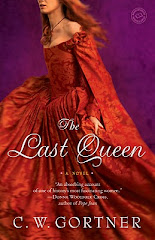
For the last week or so, I've been in an odd mood and I couldn't figure out what was the matter. Life is basically good: the book is selling well enough to warrant another print run; I've turned in the Medici manuscript; and now I have that much-anticipated free time I've been craving to catch up on my reading and relax.
Instead, I've been restless. I am reading, but I always do that; as for relaxing, I'm not enjoying it as much I thought I would. Of course, I know this free time is limited and so I called a good friend who happens to be a writer and mentioned that I thought I might need Prozac. She laughed and said, "Do you feel depressed?"
I told her, "Yes, kind of. Not exactly sad, but just . . . you know, blah. And the worst part is, I'm guilty about it. So many writers out there are fighting every day to get published and see their book in print. I feel like an ungrateful cur. Why can't I just enjoy it?"
"It's writer's empty nest syndrome," she replied. "We all get it after the book comes out and we turn in the next one. You've let your babies go out into the world on their own and you're at sixes and nines over it. The only cure I know of is to start a new project. ASAP."
Now, let me just say that I've never referred to my books as "babies." I've heard other writers use the term and that's fine, but I personally can't do it. Books are words on paper: they are not flesh and blood beings. If they get lost or misplaced or stolen, I can always buy or print out another. But as I considered my friend's words I started to wonder. I was feeling "sixes and nines-ish", as though something was missing from my life. I realized I've been writing steadily since I sold these two books early last year, first with the revisions to The Last Queen and then cutting Catherine. And in between, I had copy edits, marketing plans, interviews here on the blog; in short, not a spare moment. Sure, I caught a movie and went out to dinner and lived, but I always knew in the back of my mind that I had work waiting. I realized that I thrived on the deadlines and now, without any, I was bewildered.
"It's a sickness unique to writers," my friend explained. "We aren't ourselves if we're not kvetching or rhapsodizing over our latest creation. We're Frankenstein. We must stimulate our brain daily or perish."
Just as an experiment (no pun intended) I finally went to my desk - now cleared of the atom-bomb explosion of papers and open books that comprised the Medici revision - and took out the spiral-bound notebook where I outline upcoming projects. The next novel is there, fully realized. I stared at it for a while, then started reading it. I then pulled out the research books I'll need and ordered on the shelf I reserve for books I use when I'm writing. I did all this rather tentaively, thinking as I did, "Am I nuts? I just finished a manuscript and haven't even heard back from my agent or editor yet. I should be catching up on Netflix."
Then I left my study quickly and went to make dinner. As I cooked, I felt at ease. Relaxed. I felt . . . like me. I had to chuckle. My friend was right. I'm just not myself if I don't have a book brewing. It doesn't actually matter whether I've started physically writing it; the ideas have to be percolating , the words disentangling and arranging themselves like threads on the loom. I must know, soon I will start to write. And if I do, I'm okay.
So much for free time. Have a wonderful Labor Day weekend, everyone!
No doubt, I'll be writing.
Wednesday, August 27, 2008


Wednesday, August 20, 2008
In memory
I was deeply saddened today to hear of the devastating airplane accident in Madrid. Though no one I knew personally was affected, the horror of the event itself and the sudden loss of life that has plunged so many families into grief has been truly heartbreaking.
A mis paisanos, aunque estoy lejos, en espiritu estoy con vosotros en esta hora tan dificil.
A mis paisanos, aunque estoy lejos, en espiritu estoy con vosotros en esta hora tan dificil.
Saturday, August 16, 2008
Between the cape and the sword
 Okay, I'm back from 16th century France.
At 10:43 on 8/15/08, I finally finished the edits/revisions to The Confessions of Catherine de Medici . This was without a doubt the most challenging edit I've ever done, not only in terms of the volume of sheer work, but in all the subtle adjustments that had to be made both mentally and emotionally as the novel morphed into its current incarnation.
At times, I honestly thought the book would crumble apart and found myself ruing the day I decided I could tackle such a difficult subject. Catherine led a long, eventful, and unbelievably complicated life; the decision during this revision rapidly became one that often put me, as they say in Spain, between the cape and the sword. I had to make very tough decisions between what must stay and wha
 t must go; and when you're writing a historical novel that covers an actual person's life, that is not an easy thing to do. In fact, I had an agonizing few weeks when I wondered if I could even do her justice, given the constraints.
Nevertheless, by the end I had cut 193 pages; wrote 10 new scenes and revised 35 others; removed 5 secondary characters and 2 major ones; and, much to my surprise, fashioned what I think is a far more concise and accessible book, one that can be enjoyed by every reader, including those without knowledge of the history of France at this time. Go, figure.
The manus
 cript is now off to my agent, who'll read it and let me know if I've done my job. I desperately need fresh eyes. Working so intensely on a book as I have these past months ends up blinding you to its flaws. Living with Madame de Medici has been an immensely rewarding, demanding, exhausting and exhilarating journey. Now, all I want for the moment is bad TV!
I also have some great news to share: THE LAST QUEEN will be going into a second printing. Also, I've posted event photos throughout this post for you to chuckle ove
 r. These were taken on 8/7 at Bookshop West Portal. We had a Last Queen cake, wine, cheese and lots of people celebrating the book's release. Wish some of you could have been there!
Friday, August 1, 2008
Appearances and radio interviews
Just to let you know, I'll be doing the following publicity in the next coming weeks. I'll be adding mp3s of the radio interviews to my website, as these become available. If you're in the area or can tune into these interviews, I'd delighted to meet you!
Tuesday, August 5
12:30 pm
In-Studio Radio Interview
KLCC-FM / Radio Alice
Contact: Liz Saint John, liz@sfradio.cbs.com
7:00 pm
Talk & Signing
Book Passage
51 Tamal Vista
Corte Madera, CA 94925
Event Coordinator: Dana Kelly, 415/927-0960, x239 or dkelly@bookpassage.com
Thursday, August 7
8:40 am-8:55 am PT
LIVE Radio Phoner
KSCO-AM / Good Morning Monterey Bay
Host: Jeff Galipeaux
Contact/Co-Host: Rosemary Chalmers, rosie@ksco.com
7:00 pm
Talk & Signing
Bookshop West Portal
80 West Portal
San Francisco, CA 94127
Phone: 415/564-8080
Contact: Neal Sofman, 415/225-6427 or nsofman@aol.com
Saturday, September 27
2:00 pm-2:55 pm
West Hollywood Book Fair, Los Angeles, CA
Panel: “Global Connections: Exploring the World in Fiction”
Moderator: Lisa Teasley
Contact: Corey Roskin, 323/848-6403 or croskin@weho.org
3:00 pm-4:00 pm Signing
Tuesday, September 30
4:00 pm
TAPED National TV Interview
LaSalle Productions / Connie Martinson Talks Books
Contact/Host: Connie Martinson, talksbks@aol.com
*Note: This show is nationally syndicated, to various stations in CA; NYC; Vail, CO; Coral Gables, FL; etc
Also: I just found an error in my Author's Afterword. Please note, it should be Charles V of Germany and I of Spain, rather than the other way around. This is entirely my dyslexia and will be corrected in subsequent editions. I apologize for the error!

Tuesday, August 5
12:30 pm
In-Studio Radio Interview
KLCC-FM / Radio Alice
Contact: Liz Saint John, liz@sfradio.cbs.com
7:00 pm
Talk & Signing
Book Passage
51 Tamal Vista
Corte Madera, CA 94925
Event Coordinator: Dana Kelly, 415/927-0960, x239 or dkelly@bookpassage.com
Thursday, August 7
8:40 am-8:55 am PT
LIVE Radio Phoner
KSCO-AM / Good Morning Monterey Bay
Host: Jeff Galipeaux
Contact/Co-Host: Rosemary Chalmers, rosie@ksco.com
7:00 pm
Talk & Signing
Bookshop West Portal
80 West Portal
San Francisco, CA 94127
Phone: 415/564-8080
Contact: Neal Sofman, 415/225-6427 or nsofman@aol.com
Saturday, September 27
2:00 pm-2:55 pm
West Hollywood Book Fair, Los Angeles, CA
Panel: “Global Connections: Exploring the World in Fiction”
Moderator: Lisa Teasley
Contact: Corey Roskin, 323/848-6403 or croskin@weho.org
3:00 pm-4:00 pm Signing
Tuesday, September 30
4:00 pm
TAPED National TV Interview
LaSalle Productions / Connie Martinson Talks Books
Contact/Host: Connie Martinson, talksbks@aol.com
*Note: This show is nationally syndicated, to various stations in CA; NYC; Vail, CO; Coral Gables, FL; etc
Also: I just found an error in my Author's Afterword. Please note, it should be Charles V of Germany and I of Spain, rather than the other way around. This is entirely my dyslexia and will be corrected in subsequent editions. I apologize for the error!
Tuesday, July 29, 2008
The Queen on the Slab
When I woke up (always a good thing!) and discovered there were no scribes serenading me at my window and I still had insufficient follicular coverage, it looked as though launch day would indeed be just another day. I tried to maintain my equanimity as I proceeded to do all the things I usually do: take my dog out for her walk, eat breakfast, shower, dress, get to work.
But I found as I sat on the bus heading for downtown that I was . . . well, excited. I mean, it took years of hard work to reach this moment and I wanted to "feel" it as much as possible. Even if it felt like another day, it wasn't, and I wanted to make it special. When I opened my e-mail, I found a happy launch day e-mail from my lovely publicist Lisa at Ballantine, which was very cheering.
After lunch, my partner Erik and I went to peruse a few local bookstores and there it was! It's truly an amazing feeling to walk into a bookstore (we actually went to three) and find your book there. The store personnel were all quite friendly when I approached them and let me autograph the copies. Then my brother called from Boston, where he was staying for a few days, and told me he called the local Borders to reserve a copy of the book. When the staff person said he had one copy and asked under what name my brother wanted it reserved, my brother said, "Gortner; my brother wrote it." The staff person then told him they'd had 10 or 12 copies in stock and had sold all but one out by that morning. "We need to order more," he added. "It's popular."
Suddenly, it felt like a very good day, indeed. It might just have been that one store; it might be a fluke, and hey, it's just 10 or 12 copies - but it's what every writer wants to hear on launch day. That wierd anxiety I'd been carrying with me dissipated. I realized that like everything else in life that is fleeting, I needed to savor this moment. For no matter how well or badly I do as a writer, one thing is for certain:
A day like this never comes again. Like your first love, you only get one first launch day.
But I found as I sat on the bus heading for downtown that I was . . . well, excited. I mean, it took years of hard work to reach this moment and I wanted to "feel" it as much as possible. Even if it felt like another day, it wasn't, and I wanted to make it special. When I opened my e-mail, I found a happy launch day e-mail from my lovely publicist Lisa at Ballantine, which was very cheering.
After lunch, my partner Erik and I went to peruse a few local bookstores and there it was! It's truly an amazing feeling to walk into a bookstore (we actually went to three) and find your book there. The store personnel were all quite friendly when I approached them and let me autograph the copies. Then my brother called from Boston, where he was staying for a few days, and told me he called the local Borders to reserve a copy of the book.
 When the staff person said he had one copy and asked under what name my brother wanted it reserved, my brother said, "Gortner; my brother wrote it." The staff person then told him they'd had 10 or 12 copies in stock and had sold all but one out by that morning. "We need to order more," he added. "It's popular."
Suddenly, it felt like a very good day, indeed. It might just have been that one store; it might be a fluke, and hey, it's just 10 or 12 copies - but it's what every writer wants to hear on launch day. That wierd anxiety I'd been carrying with me dissipated. I realized that like everything else in life that is fleeting, I needed to savor this moment. For no matter how well or badly I do as a writer, one thing is for certain:
A day like this never comes again. Like your first love, you only get one first launch day.
Monday, July 28, 2008
An author's tic
So, tomorrow is Launch Day, and I've been warned by my fellow writers not to take it too much to heart if the Day ends up being . . . well, pretty much like any other. The book is officially released, yes, but preorders are by and large already being fulfilled and it's not as if fireworks displays are going to go off (except, as my partner remarked, perhaps inside my own head!). I'm not going on tour and I'm not doing any book-related events that day, except treking downtown on my lunch hour to see if the book is on the shelf at Barnes & Noble. Some blogs that interviewed me will post those interviews and some reviewers will, as well; others will come later. So, while I've worked so hard to reach this Day, it can be, I'm told, a bit anticlimatic.
I figure it's just as well, because I came down with a nasty head cold this weekend. It's actually one of the worst summer colds, congestion-wise, I've had in years and so my energy level is lousy. If I had events planned, I'd be thinking of ways to postpone them :) But one authorial tic of mine that doesn't seem to be surpressed even by heavy doses of decongestant is checking my amazon ranking.
Yes, it's a well known secret among us writers -- particularly, newly published by big NY houses-- that we are obsessed with our amazon sales ranking. It's that deceptively small number in the product details section on the book's page that allegedly demonstrates how well the book is selling vis-a vis other books in the category on amazon: the smaller the number, as in #1 to 700, the better; the larger, as in #200,000 and so-on, not so good. It's of course not a very reliable measure. It can fluctuate by the hour, i.e., it goes up when a book is sold, and thus shouldn't be taken as a complete barometer of a book's sales. Authors should, if not ignore, then view the ranking with serious detachment, because: 1) amazon is one of many outlets where books are sold; and 2) trying to get that ranking to rise to ease your anxiety will eventually cause insanity.
I mean it. I know writers who literally catapult into despair over their amazon ranking; I even know of one writer in particular who went so far as to purchase multiple copies of his book over a course of a day just to increase its ranking. He succeeded, but then, the moment he stopped buying 5 copies at a time every hour for 24 hours, it dropped once more. Poor man, he ended up with over 60 copies of his novel that he paid for, including shipping, which of course negated whatever royalties he stood to make (as he spent more per book than his royalty percentage on each book sold) and a terrible depression - and all to satisfy an uncontrollable need to see his ranking rise.
I'm not saying the ranking is completely bogus. It can give you an idea of how your book is doing at a given time. For example, one day three weeks ago I got an urgent e-mail from one of my ranking-obsessed friends that my first novel THE SECRET LION was #11 in the Fiction>Mystery>Historical subcategory. I went online and there it was: #11. Ah, what a delightful feeling! I copied the page and e-mailed it with frenetic delight to my agent (who didn't reply, and rightly so). I then checked back often, like an addict, and it stayed at #11 for an entire 25 minutes! Then, when I checked for the last time, it had slipped to #177. Not such a delightful feeling. That high can be so cruelly cut short. Still, I consoled myself, those plum 25 minutes at #11 had to be good news, right?
Just how good is an enigma I've never quite managed to solve. THE SECRET LION's ranking has in fact varied so much over the past four years, it's almost impossible to say. All I've ever been able to learn from watching the ranking is that it goes up and it goes down. I get the actual number of copies sold on my sales statements every quarter, and, while almost always gratifying in of themselves, these numbers never seem to quite equate with whatever random ranking I obsessed over that month.
You'd think I'd learn my lesson and stop it. I mean, there are plenty of other ways I can occupy my time and even if I wanted to check my sales ranking every, say, 10 minutes, what good would it do? If the ranking was decent, I'd be relieved. If it wasn't, I'd fret. And I could do absolutely nothing about it either way.
Still, while I was laid up this weekend doing revisions to my next manuscript and sneezing out my brains, I found myself checking THE LAST QUEEN's ranking every hour, sometimes twice an hour - a dubious accomplishment facilitated by the new wireless system I've installed in my house, where checking the web can now occur at the speed of light. I rationalized my obsession this time with the excuse that's almost the launch date and the ranking should be high, right? It's a new book; there's been all this publicity, giveaways, reviews, etc. In the four hours I managed to compulsively click on the book's page on amazon, the ranking skittered from #124,560 to #67,054 to #33, 457, to #88,795. How many books were pre-ordered in that time? Who knows? But I bet, I lost several pounds sitting there sweating it out and hearing that evil little voice in my head saying: "Oh, it's not doing as well as you hoped. Why, just look at Philippa Gregory's latest; it's not even coming out until September 16 and it's already #71, while you . . .[FILL IN BLANK WITH NEGATIVE THOUGHT]."
Not pretty, is it? It's a tic - an authorial tic, unique to our species. God forbid we should just bask in the moment, in the lovely people we've met along the way and the readers we know love our work, when we could be otherwise stoking up the stress levels over how we think our book is selling on amazon.
Well, I'm done with it. I'm not looking at my amazon ranking again, I swear it.
At least, not today.
I figure it's just as well, because I came down with a nasty head cold this weekend. It's actually one of the worst summer colds, congestion-wise, I've had in years and so my energy level is lousy. If I had events planned, I'd be thinking of ways to postpone them :) But one authorial tic of mine that doesn't seem to be surpressed even by heavy doses of decongestant is checking my amazon ranking.
Yes, it's a well known secret among us writers -- particularly, newly published by big NY houses-- that we are obsessed with our amazon sales ranking. It's that deceptively small number in the product details section on the book's page that allegedly demonstrates how well the book is selling vis-a vis other books in the category on amazon: the smaller the number, as in #1 to 700, the better; the larger, as in #200,000 and so-on, not so good. It's of course not a very reliable measure. It can fluctuate by the hour, i.e., it goes up when a book is sold, and thus shouldn't be taken as a complete barometer of a book's sales. Authors should, if not ignore, then view the ranking with serious detachment, because: 1) amazon is one of many outlets where books are sold; and 2) trying to get that ranking to rise to ease your anxiety will eventually cause insanity.
I mean it. I know writers who literally catapult into despair over their amazon ranking; I even know of one writer in particular who went so far as to purchase multiple copies of his book over a course of a day just to increase its ranking. He succeeded, but then, the moment he stopped buying 5 copies at a time every hour for 24 hours, it dropped once more. Poor man, he ended up with over 60 copies of his novel that he paid for, including shipping, which of course negated whatever royalties he stood to make (as he spent more per book than his royalty percentage on each book sold) and a terrible depression - and all to satisfy an uncontrollable need to see his ranking rise.
I'm not saying the ranking is completely bogus. It can give you an idea of how your book is doing at a given time. For example, one day three weeks ago I got an urgent e-mail from one of my ranking-obsessed friends that my first novel THE SECRET LION was #11 in the Fiction>Mystery>Historical subcategory. I went online and there it was: #11. Ah, what a delightful feeling! I copied the page and e-mailed it with frenetic delight to my agent (who didn't reply, and rightly so). I then checked back often, like an addict, and it stayed at #11 for an entire 25 minutes! Then, when I checked for the last time, it had slipped to #177. Not such a delightful feeling. That high can be so cruelly cut short. Still, I consoled myself, those plum 25 minutes at #11 had to be good news, right?
Just how good is an enigma I've never quite managed to solve. THE SECRET LION's ranking has in fact varied so much over the past four years, it's almost impossible to say. All I've ever been able to learn from watching the ranking is that it goes up and it goes down. I get the actual number of copies sold on my sales statements every quarter, and, while almost always gratifying in of themselves, these numbers never seem to quite equate with whatever random ranking I obsessed over that month.
You'd think I'd learn my lesson and stop it. I mean, there are plenty of other ways I can occupy my time and even if I wanted to check my sales ranking every, say, 10 minutes, what good would it do? If the ranking was decent, I'd be relieved. If it wasn't, I'd fret. And I could do absolutely nothing about it either way.
Still, while I was laid up this weekend doing revisions to my next manuscript and sneezing out my brains, I found myself checking THE LAST QUEEN's ranking every hour, sometimes twice an hour - a dubious accomplishment facilitated by the new wireless system I've installed in my house, where checking the web can now occur at the speed of light. I rationalized my obsession this time with the excuse that's almost the launch date and the ranking should be high, right? It's a new book; there's been all this publicity, giveaways, reviews, etc. In the four hours I managed to compulsively click on the book's page on amazon, the ranking skittered from #124,560 to #67,054 to #33, 457, to #88,795. How many books were pre-ordered in that time? Who knows? But I bet, I lost several pounds sitting there sweating it out and hearing that evil little voice in my head saying: "Oh, it's not doing as well as you hoped. Why, just look at Philippa Gregory's latest; it's not even coming out until September 16 and it's already #71, while you . . .[FILL IN BLANK WITH NEGATIVE THOUGHT]."
Not pretty, is it? It's a tic - an authorial tic, unique to our species. God forbid we should just bask in the moment, in the lovely people we've met along the way and the readers we know love our work, when we could be otherwise stoking up the stress levels over how we think our book is selling on amazon.
Well, I'm done with it. I'm not looking at my amazon ranking again, I swear it.
At least, not today.
Tuesday, July 22, 2008
THE LAST QUEEN Book Trailer
Hi all,
Coming up for a brief gulp of air before I return to Planet Catherine. 150 pages cut and counting. THE LAST QUEEN is coming out in seven days and it's been a bit mad at my house:) Lots of blog interviews and reviews coming in, which is terrific, as this apparently demonstrates there's interest in the book. I'm getting nervous and excited, though I'm told a book launch day can be the most eerily silent day an author will experience. I can see that: I mean, books appear at stores but I'm not there - though I do plan to hit my local stores just to see it on the shelves.
Also, here's the book video trailer I shot in LA. It's now on YouTube. I think it turned out great: http://www.youtube.com/watch?v=jj-lcUAwQ8I
Wednesday, July 9, 2008
ARC Giveaway!!
Hi all, I just found out that a promotion being run by my publisher, Ballantine Books, at BookReporter.com offers 10 free ARCs (Advance Reading Copies) to give away to readers who want to read the book and comment about it. Here's the link:
http://www.bookreporter.com/reviews2/9780345501844-about.asp
The deadline to fill out the form to enter the giveaway ends July 11, so there's not a lot of time left, but it would be terrific if one of you lucked out. I'll post more later but for now, here's to winning one of those ARCs. If you do win one, please let us know.
Twenty days left before the official release date!
Monday, June 30, 2008
Interview with Sarah Bower, author of THE NEEDLE IN THE BLOOD
It is an honor to welcome Sarah Bower. I recently had the great pleasure to read her debut novel, THE NEEDLE IN THE BLOOD, a gorgeous, multilayered look at the making of the Bayeaux Tapestry and the unexpected love affair between Bishop Odo, who commissioned th e tapestry, and Glytha, an Anglo Saxon woman bent on revenge who is recruited to embroider the tapestry. I knew relatively little about this time of history, yet Sarah's exquisite prose and ability to portray the fading Anglo Saxon world as the Normans subjugate England drew me right in. I read this book as if I were sipping wine: the language testifies to the beauty we can achieve in writing, without sacrificing complex characterization. Truly, this is one of the finest historical novels that I've read this year. I'm currently reading her second novel. BOOK OF LOVE, set in Italy during the reign of the Borgias, and hope to have her return for a second interview about that book. Also, Sarah and I have discovered, quite by chance, a mutual affinity for Juana la Loca, as you shall see. So, please join me in giving Sarah a warm welcome!

1. Congratulations on the publication of NEEDLE IN THE BLOOD. It's truly an honor to have you with us. Set during the Norman conquest of Britain, THE NEEDLE IN THE BLOOD offers a fascinating look at the making of the Bayeux Tapestry through the tumultuous love affair between an Anglo Saxon woman, Gytha, and the bishop who commissioned the hanging itself, Odo of Bayeux, brother to William the Conqueror. This is an exquisite, layered novel, in which both Odo and Gytha battle not only their loyalties to their respective bloods, but a society in midst of upheaval and transformation, in which winners and losers are not so easily identified and sacrifice and loss forge the road to a new world. What inspired you to write about these people and their link with the famous Tapestry?
Christopher, thank you for your kind words and it is, of course, very exciting to join the ranks of published historical novelists. There are really two answers to your question. The short one is Simon Schama. Some years back he made a wonderful TV series called The History of Britain and during one episode, showed an image from the Bayeux Tapestry of a woman and child fleeing a burning house. This, he said, was the earliest image in Western art of what war does to civilians. Whether or not that’s true, it made me sit up and take notice of the Tapestry for the first time. This leads to my second, less definable reason.
For us in England, the Bayeux Tapestry is what I can best describe as the wallpaper to our history. Its images are so familiar we hardly notice them. They have been appropriated for everything from political cartoons to table mats. The culture the Normans brought with them has become deeply embedded in English life, in place names, in people’s names. (My own sons are called Guy and Hugh, both Norman French names). The literary descendants of Odo and his ilk are figures as quintessentially English as Lord Emsworth! So I suppose, as well as wanting to revisit a great work of art, I wanted to look at a point in our history which feels both very distant but very immediate. I thought there were tensions there from which I might craft a story.
2. THE NEEDLE IN THE BLOOD features an unflinching look at the less savory aspects of the Norman Conquest, especially the losses suffered by the Anglo Saxons. Gytha starts out seeking revenge only to find herself swept up in Odo’s world; she eventually is able to craft a new existence for herself out of the rubble of her past, but for others, like Edith Swan Neck, the known world ceases to exist and so do they. What types of challenges did you encounter while researching this particular story, with its differing viewpoints on the Conquest? What surprising or interesting facts did you discover about the women and men who figure in your novel?
Gosh, where to begin? I suppose the main thing was that I found myself forced to look at the Conquest from the Norman viewpoint. There is a wealth of literature, from Walter Scott to Julian Rathbone, which deals with the aftermath of the invasion from the point of view of the ‘poor, oppressed Saxons’, and I must confess I had expected to be writing along the same lines myself. While my storytelling antennae perked up at the tensions I could exploit between a group of Anglo Saxon, women embroiderers and their male, Norman patron, I originally conceived the novel entirely from the women’s viewpoint. But gradually, something began to happen – everywhere I turned in my researches and speculations, there was Odo.
 e tapestry, and Glytha, an Anglo Saxon woman bent on revenge who is recruited to embroider the tapestry. I knew relatively little about this time of history, yet Sarah's exquisite prose and ability to portray the fading Anglo Saxon world as the Normans subjugate England drew me right in. I read this book as if I were sipping wine: the language testifies to the beauty we can achieve in writing, without sacrificing complex characterization. Truly, this is one of the finest historical novels that I've read this year. I'm currently reading her second novel. BOOK OF LOVE, set in Italy during the reign of the Borgias, and hope to have her return for a second interview about that book. Also, Sarah and I have discovered, quite by chance, a mutual affinity for Juana la Loca, as you shall see. So, please join me in giving Sarah a warm welcome!
Sarah Bower began writing around the age of four, and would probably have begun earlier except that she hadn’t yet learned to write. She won her first literary prize when she was nine and had produced four novels – of which the less said the better – before she was sixteen. The trauma of being laughed at by a careers teacher when she told her she wanted to be a novelist stopped her writing for twenty years, during which time she married, brought up a family and worked in various jobs from running a children’s hospice to selling cheese on a market stall. The writing came back gradually, under the influence of good friends who grew awfully fed up with her self-deprecation! The Needle in the Blood was begun during her creative writing MA course at the University of East Anglia, which she completed in 2002. She was shortlisted for the Curtis Brown scholarship for that year. The novel was published in the UK in 2007 and in the US in spring 2008. Her second novel, The Book of Love, was recently published in the UK and is planned for publication in the US in 2009. Sarah lives in rural Suffolk with her husband, two golden retrievers, two menopausal chickens and a very ancient and imperious cat. She has two grown up sons and a gorgeous grandson. She teaches creative writing at the University of East Anglia and helps to organize Norwich’s annual New Writing Worlds festival. She was UK Co-ordinating Editor of the Historical Novels Review for two years.
You can read more about her at www.snowbooks.com/sarahbower
You can read more about her at www.snowbooks.com/sarahbower
1. Congratulations on the publication of NEEDLE IN THE BLOOD. It's truly an honor to have you with us. Set during the Norman conquest of Britain, THE NEEDLE IN THE BLOOD offers a fascinating look at the making of the Bayeux Tapestry through the tumultuous love affair between an Anglo Saxon woman, Gytha, and the bishop who commissioned the hanging itself, Odo of Bayeux, brother to William the Conqueror. This is an exquisite, layered novel, in which both Odo and Gytha battle not only their loyalties to their respective bloods, but a society in midst of upheaval and transformation, in which winners and losers are not so easily identified and sacrifice and loss forge the road to a new world. What inspired you to write about these people and their link with the famous Tapestry?
Christopher, thank you for your kind words and it is, of course, very exciting to join the ranks of published historical novelists. There are really two answers to your question. The short one is Simon Schama. Some years back he made a wonderful TV series called The History of Britain and during one episode, showed an image from the Bayeux Tapestry of a woman and child fleeing a burning house. This, he said, was the earliest image in Western art of what war does to civilians. Whether or not that’s true, it made me sit up and take notice of the Tapestry for the first time. This leads to my second, less definable reason.
For us in England, the Bayeux Tapestry is what I can best describe as the wallpaper to our history. Its images are so familiar we hardly notice them. They have been appropriated for everything from political cartoons to table mats. The culture the Normans brought with them has become deeply embedded in English life, in place names, in people’s names. (My own sons are called Guy and Hugh, both Norman French names). The literary descendants of Odo and his ilk are figures as quintessentially English as Lord Emsworth! So I suppose, as well as wanting to revisit a great work of art, I wanted to look at a point in our history which feels both very distant but very immediate. I thought there were tensions there from which I might craft a story.
2. THE NEEDLE IN THE BLOOD features an unflinching look at the less savory aspects of the Norman Conquest, especially the losses suffered by the Anglo Saxons. Gytha starts out seeking revenge only to find herself swept up in Odo’s world; she eventually is able to craft a new existence for herself out of the rubble of her past, but for others, like Edith Swan Neck, the known world ceases to exist and so do they. What types of challenges did you encounter while researching this particular story, with its differing viewpoints on the Conquest? What surprising or interesting facts did you discover about the women and men who figure in your novel?
Gosh, where to begin? I suppose the main thing was that I found myself forced to look at the Conquest from the Norman viewpoint. There is a wealth of literature, from Walter Scott to Julian Rathbone, which deals with the aftermath of the invasion from the point of view of the ‘poor, oppressed Saxons’, and I must confess I had expected to be writing along the same lines myself. While my storytelling antennae perked up at the tensions I could exploit between a group of Anglo Saxon, women embroiderers and their male, Norman patron, I originally conceived the novel entirely from the women’s viewpoint. But gradually, something began to happen – everywhere I turned in my researches and speculations, there was Odo.
The Bayeux Tapestry is a strange anomaly, both very familiar and utterly mysterious. No-one knows for sure who commissioned it or why, but Odo has long been the most popular contender because of the way he is represented in it, and because it received its first public showing at the dedication of his new cathedral in 1077. Certainly nothing I read persuaded me otherwise, though I fully respect the alternative views expressed by a range of academic historians who know far more than I do. I began to be absolutely fascinated by Odo, whose life seems to fall into two very distinct halves, divided by the Conquest. This led me to speculate about the psychological effect it had had on him, and, by extension, on the conquerors in general. It seems to me, given the huge risk they took, that they might well have suffered from the trauma almost as much as the people they conquered. Their lives were utterly changed too, they couldn’t go home again either. The figure of Tom/Sebastian in the novel is very much an alter ego for Odo.
So, to come back to the question, I think the big surprise was that I found myself writing a much more complicated book than I had originally envisaged, and tackling a very masculine viewpoint, which was also more than I’d bargained for! I was also surprised to discover that William abolished slavery and the death penalty in England, and that the Normans introduced rabbits and peas to this country.
3. A key element of the novel is the gathering of a disparate group of women to work on what has become known as the Bayeux Tapestry. While technically not a tapestry but rather an embroidered hanging, it alchemizes into a reflection of the women themselves, carrying their secrets and transforming the Norman vision of the Conquest into something far more mysterious. I loved the fact that Gytha sews figures from Aesop’s fables into the fabric and that the blood of Alwys becomes part of it. How much of your interpretation of the creation of the Tapestry is based on fact and how much is product of your imagination? Did these women actually exist as you describe them, and if not, how did you go about selecting them to correspond with what is known from historical record?
As I’ve already indicated, very little is actually known about the making of the Tapestry. We believe it was made in England, because England was the place for embroidery at that period. Just as today you might want your shoes made in Milan or your suits on Savile Row, you would come to England for your altar cloths or embroidered banners. There was a notable embroidery workshop at Saint Augustine’s Monastery in Canterbury – where ‘my’ Tapestry ends up being finished – and this would tie in logically with Odo, whose base of operations as Earl of Kent was Canterbury.
As I’ve already indicated, very little is actually known about the making of the Tapestry. We believe it was made in England, because England was the place for embroidery at that period. Just as today you might want your shoes made in Milan or your suits on Savile Row, you would come to England for your altar cloths or embroidered banners. There was a notable embroidery workshop at Saint Augustine’s Monastery in Canterbury – where ‘my’ Tapestry ends up being finished – and this would tie in logically with Odo, whose base of operations as Earl of Kent was Canterbury.
Embroiders might be men or women. In the later Middle Ages, when the guilds became influential, most embroidery workshops were owned and supervised by men, even if women worked in them, but at this early period a number of women owned businesses also, which gave me a basis for creating quite independent female characters like Gytha and Agatha. Others, such as Judith or Meg, began as illustrations of the kind of plight which might befall women living through the Conquest and its aftermath, but of course they developed lives of their own as the novel progressed. As for the coded images in the borders, such as the use of certain of Aesop’s fables, I am hugely indebted to the work of David J. Bernstein, whose book, The Mystery of the Bayeux Tapestry, ‘unpicks’ the borders in a scholarly but accessible and intriguing way.
4. Your novel features various viewpoints, including that of Odo of Bayeux, a man of the Church who has an illegitimate son and falls in love with Gytha; and his sister Agatha, who flees an unwanted betrothal for the cloister and develops an unrequited love for woman. While much of today’s historical fiction is marketed for a female audience, I felt your novel transcended this limitation and can be equally enjoyed by both sexes. Do you believe that historical fiction writers today should deliberately choose beforehand the gender of their target audience? Is there anything in particular you did in this book to address this issue?
I’m delighted you think the novel transcends the gender divide. Marketing is, of course, essential to the life of a published book. Although it may grieve us to think this, once our words are packaged between covers and lined up on the shelves in bookstores, they become consumer products like any other. I absolutely don’t believe, however, that any writer who sets out to write for a specific audience, rather than for her own creative need and for the lives of the characters that gives rise to, will succeed in producing a novel worth reading. The best books are unique, they defy the way they’re sold and their message is not commercial but emotional and philosophical. I teach creative writing now at my old university, and my heart always sinks when a student tells me s/he has a plan to be the next Stephen King or Philippa Gregory. That’s just not the way it works. We all have to find our own, individual voice.
I’m delighted you think the novel transcends the gender divide. Marketing is, of course, essential to the life of a published book. Although it may grieve us to think this, once our words are packaged between covers and lined up on the shelves in bookstores, they become consumer products like any other. I absolutely don’t believe, however, that any writer who sets out to write for a specific audience, rather than for her own creative need and for the lives of the characters that gives rise to, will succeed in producing a novel worth reading. The best books are unique, they defy the way they’re sold and their message is not commercial but emotional and philosophical. I teach creative writing now at my old university, and my heart always sinks when a student tells me s/he has a plan to be the next Stephen King or Philippa Gregory. That’s just not the way it works. We all have to find our own, individual voice.
5. Can you tell us about methods that you employ to give your characters authenticity? Of the characters in NEEDLE IN THE BLOOD, which are your favorites?
Favourites? Well, Odo, of course. If I didn’t say that, he’d probably come back to haunt me! I had a strangely troubled relationship with Gytha because she’s so prickly, and wanted to give Meg a good shaking, but I love Agatha for her self-discipline and her intellect and Alwys for her barminess, and I have fondness for Robert and Fulk because they’re decent blokes.
The question of characters’ authenticity goes, I think, to the dark heart of the creative process. On the surface, there are all kinds of tricks I’m sure all writers use – imagining a character’s favourite possessions, thinking about the way they dress, all that stuff which goes towards building up a picture. But that’s external. I find I usually begin a novel with fairly clear ideas about those things, then at some indefinable point I move into what Margaret Atwood has called ‘negotiating with the dead’ (particularly apposite for those of us who write about real historical figures!) I can’t predict this, and it can be terrifying as well as magical. It’s also really hard to define without sounding as though I ought to be taken away by men in white coats, because the best I can say is that the characters begin to talk to me, to tell me their stories so that I become a kind of conduit. I do believe the best fiction is character led, that plot arises out of staying true to the way your characters behave and not trying to force them into behaviours which don’t suit them. So I guess I just follow where they lead.
6. How do you think your novel speaks to today’s reader or how do the events you evoke resonate for today’s world?
For me, the main message of the book for today’s world is about perspective, taking a long view. There is an unattractive and ill-informed national conversation going on in the UK about the nature of Britishness, and how it involves – basically – being white and English-speaking. What I would like people to take away from this book, as well as their enjoyment of it, is a more subtle, complex and informed sense of identity. In 1066, this island was inhabited predominantly by people of Scandinavian and Germanic origin. It was conquered by a bunch of French speaking adventurers who had come originally from what is now Sweden. Our country, like every other, is polyglot, a mixture, a long history of people shifting hither and thither, intermarrying, fighting, negotiating their political and cultural differences until they come to some kind of accommodation. By writing from the viewpoint of people on both sides of the Saxon-Norman divide, I hope I’ve shown how this happens on the individual level and how everyone has equal value, regardless of their background.
Or, of course, their gender. I’m sure you would agree with me that Odo doesn’t get the better of the women for all his swagger!
7. Please, tell us about your next project.
Ah, well now, perhaps I should let you do that for me! By a marvelous coincidence, Queen Juana ‘La Loca’ is the subject of my next book. This makes it a particular thrill for me to have this conversation with you just as The Last Queen is shortly to hit the bookshelves, though also somewhat nerve-wracking. I first stumbled across Juana while researching my second novel, The Book of Love, which is set in a similar period. The legendary images of her lurking in the chimney breast at Medina del Campo and her curious relationship with her husband (trying not to give anything away here) completely captivated me. It’s early days yet, but I’m really enjoying the search for a voice for such an extraordinary woman. I’m also working on a possible short story collection, though these will all be contemporary not historical.
The question of characters’ authenticity goes, I think, to the dark heart of the creative process. On the surface, there are all kinds of tricks I’m sure all writers use – imagining a character’s favourite possessions, thinking about the way they dress, all that stuff which goes towards building up a picture. But that’s external. I find I usually begin a novel with fairly clear ideas about those things, then at some indefinable point I move into what Margaret Atwood has called ‘negotiating with the dead’ (particularly apposite for those of us who write about real historical figures!) I can’t predict this, and it can be terrifying as well as magical. It’s also really hard to define without sounding as though I ought to be taken away by men in white coats, because the best I can say is that the characters begin to talk to me, to tell me their stories so that I become a kind of conduit. I do believe the best fiction is character led, that plot arises out of staying true to the way your characters behave and not trying to force them into behaviours which don’t suit them. So I guess I just follow where they lead.
6. How do you think your novel speaks to today’s reader or how do the events you evoke resonate for today’s world?
For me, the main message of the book for today’s world is about perspective, taking a long view. There is an unattractive and ill-informed national conversation going on in the UK about the nature of Britishness, and how it involves – basically – being white and English-speaking. What I would like people to take away from this book, as well as their enjoyment of it, is a more subtle, complex and informed sense of identity. In 1066, this island was inhabited predominantly by people of Scandinavian and Germanic origin. It was conquered by a bunch of French speaking adventurers who had come originally from what is now Sweden. Our country, like every other, is polyglot, a mixture, a long history of people shifting hither and thither, intermarrying, fighting, negotiating their political and cultural differences until they come to some kind of accommodation. By writing from the viewpoint of people on both sides of the Saxon-Norman divide, I hope I’ve shown how this happens on the individual level and how everyone has equal value, regardless of their background.
Or, of course, their gender. I’m sure you would agree with me that Odo doesn’t get the better of the women for all his swagger!
7. Please, tell us about your next project.
Ah, well now, perhaps I should let you do that for me! By a marvelous coincidence, Queen Juana ‘La Loca’ is the subject of my next book. This makes it a particular thrill for me to have this conversation with you just as The Last Queen is shortly to hit the bookshelves, though also somewhat nerve-wracking. I first stumbled across Juana while researching my second novel, The Book of Love, which is set in a similar period. The legendary images of her lurking in the chimney breast at Medina del Campo and her curious relationship with her husband (trying not to give anything away here) completely captivated me. It’s early days yet, but I’m really enjoying the search for a voice for such an extraordinary woman. I’m also working on a possible short story collection, though these will all be contemporary not historical.
Thank you for taking the time to visit with us, Sarah!
Wednesday, June 25, 2008
Checking in . . .
Just a quick check in to let everyone know I'm alive and well in revision hell. Well, not exactly hell, but challenging enough. One hundred and fifteen pages of my Catherine ms. have been cut so far. I've had to make some painful choices but I've also had some fun re-writing some stuff, too. With the release date for THE LAST QUEEN coming up fast (July 29!) I'm hoping to finish the revisions soon, but you know what they say about the best laid plans . . .
I did take a much-needed break to go to Los Angeles for an author video shoot with Expanded Books. Apparently, book videos are quite popular and my publisher wanted me to have one. The actual video will resemble a mini-History Channel featurette, with excerpts, a voice-over narration, and cuts to me talking about Juana. The shoot itself was great fun. The crew was so nice and they even had me help pick out the voices for the narrator and the woman who'll be Juana. My partner Erik took photos of the shoot, so I'll post them here once I get them downloaded. And of course as soon as I have the video I'll post a sneak peek :)
Otherwise, I got a new review from Romantic Times, which was lovely. I had been expecting the standard reviews from Kirkus, Library Journal, and Booklist, too, but apparently these aren't so standard anymore. In fact, they're rather hit and miss, I'm told, so any reviews coming in now, so close to release date, are very welcome.
I also designed and sent out my first e-newsletter. Some of you were on the mailing list, I think. Did you like it? Hate it? I'm never sure if these things are worthwhile, in that we get bombarded with so much stuff all the time I wonder if anyone needs or wants another newsletter? But it seems like a worthwhile endeavour to communicate with readers, and I'd welcome any feedback.
Karen Essex is my most recent interview. She's a lovely lady. I've got the incomparable Sarah Bower, author of The Needle in the Blood and The Book of Love, coming up for a two-part interview. I just read The Needle in the Blood and am in complete awe of her talent; it is one of the best historical novels I've read in years.
That's it for my update. Back to Catherine . . .
I did take a much-needed break to go to Los Angeles for an author video shoot with Expanded Books. Apparently, book videos are quite popular and my publisher wanted me to have one. The actual video will resemble a mini-History Channel featurette, with excerpts, a voice-over narration, and cuts to me talking about Juana. The shoot itself was great fun. The crew was so nice and they even had me help pick out the voices for the narrator and the woman who'll be Juana. My partner Erik took photos of the shoot, so I'll post them here once I get them downloaded. And of course as soon as I have the video I'll post a sneak peek :)
Otherwise, I got a new review from Romantic Times, which was lovely. I had been expecting the standard reviews from Kirkus, Library Journal, and Booklist, too, but apparently these aren't so standard anymore. In fact, they're rather hit and miss, I'm told, so any reviews coming in now, so close to release date, are very welcome.
I also designed and sent out my first e-newsletter. Some of you were on the mailing list, I think. Did you like it? Hate it? I'm never sure if these things are worthwhile, in that we get bombarded with so much stuff all the time I wonder if anyone needs or wants another newsletter? But it seems like a worthwhile endeavour to communicate with readers, and I'd welcome any feedback.
Karen Essex is my most recent interview. She's a lovely lady. I've got the incomparable Sarah Bower, author of The Needle in the Blood and The Book of Love, coming up for a two-part interview. I just read The Needle in the Blood and am in complete awe of her talent; it is one of the best historical novels I've read in years.
That's it for my update. Back to Catherine . . .
Friday, June 13, 2008
Interview with Karen Essex, author of STEALING ATHENA
 Karen Essex is one of my favorite historical novelists working today. Her books describe those moments when desire and power collide, and her elegant prose brings a new dimension to the genre. Whether it's writing about the last pharoah of Egypt (KLEOPATRA & PHAROAH) or the battle between the Este sisters (LEONARDO'S SWANS) or, as in her latest novel, about the wholesale rapine of the Elgin Marbles and the women caught up in the construction and destruction of the Parthenon (STEALING ATHENA) Karen never sacrifices reality for sentiment. Her novels are enthralling, brilliant, and above all else, very entertaining. With her new book, Karen explores the lives of two women in two different eras: Aspasia, courteasan to Pericles of Athens, and Lady Mary Nesbit, the wife of the man who made it his life's mission to appropriate the priceless marble reliefs and statues of ancient Greece to save them from Bonaparte's maurading armies. In STEALING ATHENA Karen Essex paints a fascinating portrait not only of two distinct eras tainted by disregard for the rights of women, but also of the illusory value we place on objects and the spiritual sacrifices we make to obtain them.
Karen's international bestseller Leonardo’s Swans won Italy’s prestigious 2007 Premio Roma for foreign fiction. An award-winning journalist and a screenwriter, she lives in Los Angeles, California. Her books are published in twenty-six languages. Please visit her website at http://www.karenessex.com/.
Please join me in giving a warm welcome to Karen.
1. Congratulations on the publication of STEALING ATHENA. It's an honor to have you with us. Set in the 19th century during the Napoleonic Wars and the golden age of Athens under Pericles, STEALING ATHENA offers us two characters from different eras connected by the Elgin Marbles—Mary Nisbet, Countess of Elgin, who assisted her husband in his frenetic quest to save the artifacts of the Acropolis from destruction; and Aspasia, philosopher and courtesan of Pericles. What inspired you to write about these women and their link with the marbles?
I have been fascinated with the saga of the marbles since I first saw them in the British Museum in 2001. I have also studied women’s history—and specifically women of the ancient world— for decades now, and in all of my books, I try to illuminate both the female experience and women’s contributions to the world. This story, in which one very influential woman, Aspasia, watches the Parthenon being built while another powerful woman, Mary Elgin, watches it being disassembled some 2300 years later, was a natural for me to undertake. When Susan Nagel’s biography of Mary appeared in 2004, I realized that once again, a woman had made things happen but had gone unacknowledged in the historical record. That usually lights my fire.
I have been fascinated with the saga of the marbles since I first saw them in the British Museum in 2001. I have also studied women’s history—and specifically women of the ancient world— for decades now, and in all of my books, I try to illuminate both the female experience and women’s contributions to the world. This story, in which one very influential woman, Aspasia, watches the Parthenon being built while another powerful woman, Mary Elgin, watches it being disassembled some 2300 years later, was a natural for me to undertake. When Susan Nagel’s biography of Mary appeared in 2004, I realized that once again, a woman had made things happen but had gone unacknowledged in the historical record. That usually lights my fire.
2. STEALING ATHENA makes a strong case both for Elgin’s actions during his time, as well as for the return of the marbles to Greece. To this day, controversy rages over which country has the right to the marbles, and as an author, you’ve not shied away from controversial subject matter, whether it was a new interpretation of Egypt’s last pharaoh or envisioning the rivalry between sisters and the Renaissance preoccupation with immortality through art. What types of challenges did you encounter while researching this particular story? What surprising or interesting facts did you discover about these different eras in history?
The most overarching challenge was to hold the great breadth of history contained within the story all at once in my poor overtaxed brain. Stealing Athena encompasses the Golden Age of Pericles, the Napoleonic Wars, the Ottoman Empire, the British Empire in the days of George III, and—as the Elgins were Scots—the newly formed United Kingdom. I had to absorb a dizzying amount of information and then synthesize it into a coherent, unified, and compelling story. Luckily, the narrative came easily to me because the ways in which the two women’s lives resonated was almost haunting. Readers have said, oh, I love the way that you made the characters’ lives ad experiences reflect one another, but history did that for me. 

The most startling discovery about those early days of the 19th century—which, remember, followed the Enlightenment, and all that great egalitarian thought—was that even though women had the veneer of more freedom and agency than in Aspasia’s day, when one got right down to the nitty gritty of the laws of Great Britain, females were no better off, really, than in ancient Greece, or even in Constantinople, where we learn in the book that the sequestered women of the harem had more legal stature than the women of England. For a woman of Mary Elgin’s status and wealth to receive such shoddy treatment both within her marriage and in a court of law astonishes the modern mind.
As far as surprises in the other story, it was amazing to discover the degraded state of Athens in 1803. Considering the energy and vitality of both the ancient city and the city today, to discover that it was once down to about one thousand inhabitants was shocking. The rise and fall of civilizations has always fascinated me.
3. A key story within the novel is Mary Nisbet’s struggle to become independent, not only as a woman but as a human being. Her early years are devoted to her husband until she realizes she is, in fact, at odds with him emotionally and spiritually. Mary’s growth as a character also illuminates the struggle of Aspasia, her counterpart in ancient Greece, and reveals the gross inequities between the genders at these distinct times. Because your book is centered on women and told through the eyes of women, do you believe your story can resonate with male readers?
I’m glad you asked that question. I’ve always said that my books have two things that men really like: sex and history. I realize that the books are heavily marketed to women, but I do think they appeal to men. My male readers are always full of compliments for the work. I think it’s because even when I write about a dastardly male character, I try to give him his humanity. I am not at all a male-bashing female. I love the species…some might say too much! I also find the politics of whatever era I’m writing about utterly fascinating, and I know that I delve into these issues, as well into the battles, conflicts and military strategies of the day, more than some of my female readers would like. I think that my books offer a broad spectrum of delights for every sort of reader. Recently, a reader just walked up to me and said, “Your books are the perfect combination of scholarship and entertainment.” I considered it a great compliment because that is exactly where I aim to be. I don’t’ compromise on either front.
I’m glad you asked that question. I’ve always said that my books have two things that men really like: sex and history. I realize that the books are heavily marketed to women, but I do think they appeal to men. My male readers are always full of compliments for the work. I think it’s because even when I write about a dastardly male character, I try to give him his humanity. I am not at all a male-bashing female. I love the species…some might say too much! I also find the politics of whatever era I’m writing about utterly fascinating, and I know that I delve into these issues, as well into the battles, conflicts and military strategies of the day, more than some of my female readers would like. I think that my books offer a broad spectrum of delights for every sort of reader. Recently, a reader just walked up to me and said, “Your books are the perfect combination of scholarship and entertainment.” I considered it a great compliment because that is exactly where I aim to be. I don’t’ compromise on either front.
4. In this vein, much of today’s historical fiction is marketed for the female reader. Do you believe that an historical fiction writer today must deliberately choose beforehand the gender of his or her target audience? Do you think there are writers who bridge this difference and speak to both sexes? Is there anything in particular that you do in your books to address this issue?
It’s a bit of a shame because I would like to be considered in the vein of say, Mary Renault or Robert Graves, whose novels appealed to both sexes. But with the way books are marketed today, I don’t think it can happen, except in special cases. My book jackets are so deliciously beautiful and feminine that I imagine a male reader would have trouble taking them off the shelf. I just had this conversation with my publisher over dinner. Unfortunately, the male fiction-reading demographic is so small as to be almost nonexistent, save for the fans of a few male authors. Men don’t buy a lot of novels, and when they do, they don’t buy novels about women. So publishers rightly, in the commercial sense at least, market books about women to women because that is who will buy them. I don’t mind—I like selling books, and I need to sell them in order to be able to continue publishing them. Female readers are my life’s blood. But men are always asking, what do women want? What do women think? If they read the occasional book about a woman, they might actually find answers to these questions!
It’s a bit of a shame because I would like to be considered in the vein of say, Mary Renault or Robert Graves, whose novels appealed to both sexes. But with the way books are marketed today, I don’t think it can happen, except in special cases. My book jackets are so deliciously beautiful and feminine that I imagine a male reader would have trouble taking them off the shelf. I just had this conversation with my publisher over dinner. Unfortunately, the male fiction-reading demographic is so small as to be almost nonexistent, save for the fans of a few male authors. Men don’t buy a lot of novels, and when they do, they don’t buy novels about women. So publishers rightly, in the commercial sense at least, market books about women to women because that is who will buy them. I don’t mind—I like selling books, and I need to sell them in order to be able to continue publishing them. Female readers are my life’s blood. But men are always asking, what do women want? What do women think? If they read the occasional book about a woman, they might actually find answers to these questions!

5. Can you tell us about any methods that you employ to give your characters authenticity?
I work very hard to make sure that I bring these characters to life beyond the factual information that the historical sources have given us. Of course, I read as many original or contemporary sources as possible, and this is invaluable because it tells us how the people of the era saw themselves. Letters, court documents, diaries, all these things are what truly reveal the subtleties of an era. After that, I study the culture that created the person. I read what they read; I study the ways in which they were educated; I find out what they saw at the theater. I spend loads of time figuring out what they wore and how they felt in those clothes.
I work very hard to make sure that I bring these characters to life beyond the factual information that the historical sources have given us. Of course, I read as many original or contemporary sources as possible, and this is invaluable because it tells us how the people of the era saw themselves. Letters, court documents, diaries, all these things are what truly reveal the subtleties of an era. After that, I study the culture that created the person. I read what they read; I study the ways in which they were educated; I find out what they saw at the theater. I spend loads of time figuring out what they wore and how they felt in those clothes.
My undergraduate work focused on costume design, so this is a particular area of interest for me. I also investigate the cuisine of the day, and most importantly, I study what they believed in terms of religion. Also extremely pertinent to my female heroines—what were the gender dynamics and customs of the day? What rights did women have, and what rights were they denied? I do a saturated study of the world in which these people lived until I feel that I can plausibly construct a psychology and a daily life for them. When all of that is done, I travel to all of the locations I intend to use so that I can do more hands-on research and take in the atmosphere. It’s an exhaustive process for me, but it is also my joy.
6. How do you think your novel speaks to today’s reader or how do the events you evoke resonate for today’s world?
Aspasia lived some 2500 years ago, and Mary lived 200 years ago. You’d think they had little in common with each other and little in common with us, but women’s issues and concerns remain constant through the millennia—relationships, birth control, pregnancy, child-rearing, the place of women in society, and women’s fundamental rights. I wrote about these two women because, firstly, their experiences resonate quite hauntingly, and secondly, because while women generally have more rights and status today, at least in much of the world, our concerns are the same as those women. Both Mary and Aspasia defied social convention, which also makes them extremely identifiable to women today who have lived through so much social change. I am absolutely passionate about illuminating the truth of the female experience, and for many reasons, that truth remains quite static, I’m afraid. I know that women of all ages find a lot to identify with in my characters.
7. Please, tell us about your next project.
My next book will incorporate lore, mythology, and metaphysics, reflecting my interests in all those things. It will again be historical fiction told from a female point of view, but it will also be quite a departure, though one that I believe my readers are pre-disposed to like. That’s all I can say at the moment. But my publisher has already bought it, and with great enthusiasm! And I am researching it and planning my travel around it as I write this.
6. How do you think your novel speaks to today’s reader or how do the events you evoke resonate for today’s world?
Aspasia lived some 2500 years ago, and Mary lived 200 years ago. You’d think they had little in common with each other and little in common with us, but women’s issues and concerns remain constant through the millennia—relationships, birth control, pregnancy, child-rearing, the place of women in society, and women’s fundamental rights. I wrote about these two women because, firstly, their experiences resonate quite hauntingly, and secondly, because while women generally have more rights and status today, at least in much of the world, our concerns are the same as those women. Both Mary and Aspasia defied social convention, which also makes them extremely identifiable to women today who have lived through so much social change. I am absolutely passionate about illuminating the truth of the female experience, and for many reasons, that truth remains quite static, I’m afraid. I know that women of all ages find a lot to identify with in my characters.
7. Please, tell us about your next project.
My next book will incorporate lore, mythology, and metaphysics, reflecting my interests in all those things. It will again be historical fiction told from a female point of view, but it will also be quite a departure, though one that I believe my readers are pre-disposed to like. That’s all I can say at the moment. But my publisher has already bought it, and with great enthusiasm! And I am researching it and planning my travel around it as I write this.
Thank you, Karen. I'm looking forward to your new novel, as I'm sure are many readers. To learn more about Karen and her work, please visit her website.
Friday, June 6, 2008
Interview with Sandra Gulland, author of MISTRESS OF THE SUN
I recently had the great pleasure of reviewing Sandra Gulland's new novel, Mistress of the Sun, the story of Louise de la Valliere, the first official mistress of Louis XIV. This is an exquisite novel, and a unique look at a woman whose life has been obscured by the Sun King's later flamboyance. I'm including my review here, which was an Editor's Choice for the latest issue of The Historical Novels Review:
In her first novel in eight years (following the international success of her Josephine B. trilogy) Sandra Gu lland has chosen an enigmatic figure—Louise de la Vallière, mistress to Louis XIV and mother of four children by him. Louise has been overshadowed in history by her more glamorous successors and the flamboyance that characterized the later years of Louis’s reign, but in her captivating jewel of a novel Gulland offers an absorbing account of a woman who reluctantly became a royal mistress and paid the price. Gulland’s Louise has a fey spirit with the ability to enchant horses. In a desperate act of magic to save a feral stallion’s life she sets the course for her own destiny, one that will bring her equal measures of sorrow and joy. Uneasy with the cruel sycophantism of court, caught between her innate spiritual introspection and an impoverished lineage that compels her to noble servitude, Louise eventually catches the young king’s eye. Louis is handsome and vital, poised to assume his later embodiment as the Sun King; in Louise, he discovers incorruptible innocence and their romance flourishes under a secrecy that continues for years, even as he grows in stature and she wrestles with her conscience and the degradation of her illusions. Scandal ensues when Louise is brought into the open as Louis’s lover; this fateful moment also sets the stage for her decline. Fascinating details of life at the French court sparkle throughout the narrative, evidence of Gulland’s dedication to research; and while Louise may not be as ambitious or clever as those who followed in her footsteps, she imbues an unforgettable authenticity that gives credence to the belief that she was Louis XIV’s only true love.
Sandra Gulland is also the author of the internationally best-selling Josephine B. Trilogy, based on the life of Josephine Bonaparte, Napoleon's wife. Born in Miami, Florida, Sandra lived in Rio de Janeiro, Berkeley and Chicago before going to Canada in 1969 to teach in an Inuit village in northern Labrador for one year. Settling in Toronto, she worked as a book editor for a decade before moving with her husband and two children into a log house in northern, rural Ontario. In 1985, she began writing full-time. Ten years later, the first of the novels in the Josephine B. Trilogy was published. She thought, when she began writing, that she would never find a publisher. Now the trilogy is published in 13 languages, 15 countries, and has sold more than a million copies worldwide. Mistress of the Sun — which took her eight years to research and write — is set to follow. You can learn more about Sandra, her research and her work on her web site: www.sandragulland.com <http://www.sandragulland.com/> . She also has a blog, Notes on the Writing Life, at http://sandragulland.blogspot.com/
Please join me in welcoming Sandra!
1. Congratulations on the publication of MISTRESS OF THE SUN. It's an honor to have you with us. Set in 17th century France during the reign of young Louis XIV, MISTRESS OF THE SUN offers a fascinating account of the life of Louise de la Vallière, Louis’s first official mistress and mother to four children by him. While Louis himself has been covered in fiction, as well as his other subsequent mistresses, Louise has largely been neglected. What inspired you to write about her, and why are you drawn in general to French history?
Thank you, Christopher — and congratulations to you, as well, on the publication of your novel. I looked into Louise's story because a biography of her was popular in Josephine's time. I wanted to know more about what my own characters were reading, find out what interested them. And was swept away! Mainly I was intrigued by Louise’s horsemanship, which was extraordinary for a woman at that time. She is described as shy, something of a wallflower, and yet an Amazon on horseback. She was religious, yet the official mistress. The pieces of this puzzle didn't fit: I wanted to know more. And thus begins that long journey — writing a novel. I was dr awn to French history, and history in general, through Josephine. She led me there, but it was the delightful combination of idealism, whimsy, theatre and what seems to me to be a passion for spectacle that keeps me there.
2. MISTRESS OF THE SUN offers many marvelous details about daily life in Louis XIV’s France, including superstitions around medicine and the influence that people believed evil forces exerted on them. What types of challenges did you encounter while researching this book? What surprising or interesting facts did you discover about this time in history?
It took time for me to come to understand how superstitious the period was — both superstitious and religious both. Discovering that the mathematician Descartes believed that nightmares had been put into his head by demons was something of a revelation. Louis XIV mother believed that a comet foretold her death.
3. A key storyline within the novel is Louise’s relationship with horses. She is fey by nature, and also deeply spiritual. Did Louise like animals in real life, and did she struggle between her desire for a spiritual life and the role she found herself fulfilling as the king’s lover?
Louise de la Vallière was an extraordinary horsewoman — this was one of the things that first captured my interest. We have very little to go on, but what there is is telling, rather like the tip of an iceberg: a line in a letter saying that she looked mighty fine on horseback; an account from a traveling Italian priest who saw her standing a galloping horse, and reported that she could out-ride and out-hunt the king and his men. (As well, he reported that a Moor who worked in the King's stables coached her.) That isn't very much to go on, but from such scraps it's fair to deduce that Louise had to have spent a great deal of time on horseback and that she had a way with horses. No doubt there were special horses in her life. We know, likewise, very little about Louise's early spirituality. We do know, from her writings later in life, however, that she had an intensely spiritual nature, and one must assume that this didn't come upon her out of the blue. Too, her father and her father's siblings were very religious, and given how conflicted Louise's relationship with her mother seems to have been — and too, given how gentle and good her father was — I think it likely that she took after him. In fact, she wrote an account of her spiritual awakening, Réflexions sur la miséricorde de Dieu. There is little doubt, I believe, that she was seriously conflicted about her relationship with the King.
4. Louise and Louis were together for years, yet much of that time their relationship remained a secret. Do you think this can account for Louise’s relatively obscure place in the pantheon of Louis’s mistresses? Why else do you think she has been largely bypassed by history?
It's true that Louise is not well known, even to the French. In the words of Bernard Turle, the French translator of the Trilogy, Louise is a woman of "silent power." I like that. I think if she had stepped happily into the role of First Mistress, if she had used the power that comes with that title, she would have been better known. But she was not one to seek power or the limelight. She had no interest in being in a position of power and was not at all suited for life at court. Had she embraced the position of "left-hand wife" and used it to advantage, historians would have taken note.
5. Can you tell us about any methods that you employ to give your characters authenticity?
I wish I could say that it "just happens," but it really comes down to elbow grease: an arduous combination of research and revision (re-vision). The characters in my early drafts tend to be wooden a nd two-dimensional. Over time, and many, many drafts, they begin to take on life. It's really a question of constantly asking, "How does she feel?" "Would she really have done that?" I don't do extensive "interviewing" of my characters the way some authors do. (I always feel I should, however.) I do try to identify what it is they want — their "noble goal" — their inner conflict, ruling passion, their weaknesses. Over time, details build up. I especially like identifying what my character keeps with her — her secret treasures. These became very important in Mistress of the Sun.
6. How do you think your novel speaks to today’s reader or how do the events you evoke resonate for today’s world?
Mistress of the Sun is a love story, and that's universal and timeless. It's a story of what people are willing to do to get power — and that's universal and timeless as well. It's a story of how power corrupts, how hard it is to stay true to oneself, how love's passion can turn to insatiable lust . . . In truth, I think people are people are people, no matter the time and place, and that's an important part of what's learned by delving into history.
7. Please tell us about your next project.
I'm thinking a lot about La Grande Mademoiselle, the King's cousin. She was a fireball, an early feminist, a writer, the wealthiest person in France (wealthier than the King). She managed to avoid marriage to practically every king in Europe, only to fall for the charms of ugly little lady-killer Lauzun, a lowly courtier. They secretly married — possibly there was a daughter — he became abusive and she kicked him out. There are a number of fantastic stories in her life, and I'm not sure what I would focus on. I'm considering her devoted male secretary as the narrative voice. I've lots of mulling to do yet.
In her first novel in eight years (following the international success of her Josephine B. trilogy) Sandra Gu
 lland has chosen an enigmatic figure—Louise de la Vallière, mistress to Louis XIV and mother of four children by him. Louise has been overshadowed in history by her more glamorous successors and the flamboyance that characterized the later years of Louis’s reign, but in her captivating jewel of a novel Gulland offers an absorbing account of a woman who reluctantly became a royal mistress and paid the price. Gulland’s Louise has a fey spirit with the ability to enchant horses. In a desperate act of magic to save a feral stallion’s life she sets the course for her own destiny, one that will bring her equal measures of sorrow and joy. Uneasy with the cruel sycophantism of court, caught between her innate spiritual introspection and an impoverished lineage that compels her to noble servitude, Louise eventually catches the young king’s eye. Louis is handsome and vital, poised to assume his later embodiment as the Sun King; in Louise, he discovers incorruptible innocence and their romance flourishes under a secrecy that continues for years, even as he grows in stature and she wrestles with her conscience and the degradation of her illusions. Scandal ensues when Louise is brought into the open as Louis’s lover; this fateful moment also sets the stage for her decline. Fascinating details of life at the French court sparkle throughout the narrative, evidence of Gulland’s dedication to research; and while Louise may not be as ambitious or clever as those who followed in her footsteps, she imbues an unforgettable authenticity that gives credence to the belief that she was Louis XIV’s only true love.
Sandra Gulland is also the author of the internationally best-selling Josephine B. Trilogy, based on the life of Josephine Bonaparte, Napoleon's wife. Born in Miami, Florida, Sandra lived in Rio de Janeiro, Berkeley and Chicago before going to Canada in 1969 to teach in an Inuit village
 in northern Labrador for one year. Settling in Toronto, she worked as a book editor for a decade before moving with her husband and two children into a log house in northern, rural Ontario. In 1985, she began writing full-time. Ten years later, the first of the novels in the Josephine B. Trilogy was published. She thought, when she began writing, that she would never find a publisher. Now the trilogy is published in 13 languages, 15 countries, and has sold more than a million copies worldwide. Mistress of the Sun — which took her eight years to research and write — is set to follow. You can learn more about Sandra, her research and her work on her web site: www.sandragulland.com <http://www.sandragulland.com/> . She also has a blog, Notes on the Writing Life, at http://sandragulland.blogspot.com/
Please join me in welcoming Sandra!
1. Congratulations on the publication of MISTRESS OF THE SUN. It's an honor to have you with us. Set in 17th century France during the reign of young Louis XIV, MISTRESS OF THE SUN offers a fascinating account of the life of Louise de la Vallière, Louis’s first official mistress and mother to four children by him. While Louis himself has been covered in fiction, as well as his other subsequent mistresses, Louise has largely been neglected. What inspired you to write about her, and why are you drawn in general to French history?
Thank you, Christopher — and congratulations to you, as well, on the publication of your novel. I looked into Louise's story because a biography of her was popular in Josephine's time. I wanted to know more about what my own characters were reading, find out what interested them. And was swept away! Mainly I was intrigued by Louise’s horsemanship, which was extraordinary for a woman at that time. She is described as shy, something of a wallflower, and yet an Amazon on horseback. She was religious, yet the official mistress. The pieces of this puzzle didn't fit: I wanted to know more. And thus begins that long journey — writing a novel. I was dr
 awn to French history, and history in general, through Josephine. She led me there, but it was the delightful combination of idealism, whimsy, theatre and what seems to me to be a passion for spectacle that keeps me there.
2. MISTRESS OF THE SUN offers many marvelous details about daily life in Louis XIV’s France, including superstitions around medicine and the influence that people believed evil forces exerted on them. What types of challenges did you encounter while researching this book? What surprising or interesting facts did you discover about this time in history?
It took time for me to come to understand how superstitious the period was — both superstitious and religious both. Discovering that the mathematician Descartes believed that nightmares had been put into his head by demons was something of a revelation. Louis XIV mother believed that a comet foretold her death.
3. A key storyline within the novel is Louise’s relationship with horses. She is fey by nature, and also deeply spiritual. Did Louise like animals in real life, and did she struggle between her desire for a spiritual life and the role she found herself fulfilling as the king’s lover?
Louise de la Vallière was an extraordinary horsewoman — this was one of the things that first captured my interest. We have very little to go on, but what there is is telling, rather like the tip of an iceberg: a line in a letter saying that she looked mighty fine on horseback; an account from a traveling Italian priest who saw her standing a galloping horse, and reported that she could out-ride and out-hunt the king and his men. (As well, he reported that a Moor who worked in the King's stables coached her.) That isn't very much to go on, but from such scraps it's fair to deduce that Louise had to have spent a great deal of time on horseback and that she had a way with horses. No doubt there were special horses in her life. We know, likewise, very little about Louise's early spirituality. We do know, from her writings later in life, however, that she had an intensely spiritual nature, and one must assume that this didn't come upon her out of the blue. Too, her father and her father's siblings were very religious, and given how conflicted Louise's relationship with her mother seems to have been — and too, given how gentle and good her father was — I think it likely that she took after him. In fact, she wrote an account of her spiritual awakening, Réflexions sur la miséricorde de Dieu. There is little doubt, I believe, that she was seriously conflicted about her relationship with the King.
4. Louise and Louis were together for years, yet much of that time their relationship remained a secret. Do you think this can account for Louise’s relatively obscure place in the pantheon of Louis’s mistresses? Why else do you think she has been largely bypassed by history?
It's true that Louise is not well known, even to the French. In the words of Bernard Turle, the French translator of the Trilogy, Louise is a woman of "silent power." I like that. I think if she had stepped happily into the role of First Mistress, if she had used the power that comes with that title, she would have been better known. But she was not one to seek power or the limelight. She had no interest in being in a position of power and was not at all suited for life at court. Had she embraced the position of "left-hand wife" and used it to advantage, historians would have taken note.
5. Can you tell us about any methods that you employ to give your characters authenticity?
I wish I could say that it "just happens," but it really comes down to elbow grease: an arduous combination of research and revision (re-vision). The characters in my early drafts tend to be wooden a
 nd two-dimensional. Over time, and many, many drafts, they begin to take on life. It's really a question of constantly asking, "How does she feel?" "Would she really have done that?" I don't do extensive "interviewing" of my characters the way some authors do. (I always feel I should, however.) I do try to identify what it is they want — their "noble goal" — their inner conflict, ruling passion, their weaknesses. Over time, details build up. I especially like identifying what my character keeps with her — her secret treasures. These became very important in Mistress of the Sun.
6. How do you think your novel speaks to today’s reader or how do the events you evoke resonate for today’s world?
Mistress of the Sun is a love story, and that's universal and timeless. It's a story of what people are willing to do to get power — and that's universal and timeless as well. It's a story of how power corrupts, how hard it is to stay true to oneself, how love's passion can turn to insatiable lust . . . In truth, I think people are people are people, no matter the time and place, and that's an important part of what's learned by delving into history.
7. Please tell us about your next project.
I'm thinking a lot about La Grande Mademoiselle, the King's cousin. She was a fireball, an early feminist, a writer, the wealthiest person in France (wealthier than the King). She managed to avoid marriage to practically every king in Europe, only to fall for the charms of ugly little lady-killer Lauzun, a lowly courtier. They secretly married — possibly there was a daughter — he became abusive and she kicked him out. There are a number of fantastic stories in her life, and I'm not sure what I would focus on. I'm considering her devoted male secretary as the narrative voice. I've lots of mulling to do yet.
Tuesday, May 27, 2008
Interview with Russell Whitfield, author of GLADIATRIX
I recently had the good fortune to read GLADIATRIX, a girl-kicks-some-serious-butt debut novel set in the time of the Roman Empire and featuring a shipwrecked Spartan priestess who is sold into slavery and rises to fame as a gladiator. While the male versions of these fearsome warriors have been featured generously in film and books, the women are not nearly as well known. In fact, I had no idea that like their male counterparts, women fighters fought each other and could eventually earn their freedom if they  proved brave and wily enough to survive the arena. Russell's novel was therefore an eye-opener for me, as well as an exciting journey into the violent, compelling, sexy, often lethal but never dull world of ancient gladiators.
Please join me in welcoming Russell Whitfield!
1.Congratulations on the publication of GLADIATRIX. It's an honor to have you with us. Set in the outlying areas under the Roman Empire, GLADIATRIX offers us a compelling look at women gladiators, following the story of Lysandra, a Spartan priestess who is sold into slavery and finds fame in the arena. What inspired you to write about the women fighters of this era?
Thanks very much – I’m sure it’s a bit of dubious honour, though! Inspirations for “Gladiatrix” . . . well, all sorts of things really. Like many people, I had been through the process of “writing a book” about thirty times: I’d start one, get a way through, have a better idea for something else, start that, have a better idea for something…repeat. Anyway, I dropped the idea of writing for a while, but anyone who writes will tell you it’s like a compulsion – you really can’t stop yourself. So I thought that the best thing to do would be to focus on things that I had always liked, not just the phases that I was going through (this week, I’m writing a fantasy novel, next week a vampire one and so forth).
Ancient history has been a constant companion for me my whole life – ever since I saw the movie “The Three Hundred Spartans” on the telly as a small boy. I just loved that film – I can recall crying when they all got killed at the end because I was so sure that someone would turn up and save them. Anyway, this sparked a genuine interest in Classical cultures that has stayed with me all my life. I knew I had a good grounding there, and really I just wanted to write something that I myself would love to read.
Then I saw the Channel Four documentary “Gladiator Girl”, and that had a small mention of the Halicarnassus stele that featured “Amazon and Achillia” the two female gladiators who were freed. Other than that, we don’t know anything about them, so I thought that there was enough largesses there to make a great story. It was serendipity, I guess, watching that programme just when I’d decided to give writing another crack. So, I just thought: What do I like? Well, Spartans, gladiators, tough warrior women…there has to be a book in that!
2. GLADIATRIX offers a fascinating look at the lives these women led both in and out of the arena, including the different caste structures and the fact that the fighters could eventually earn their freedom through their prowess in the arena. While violence and death overshadowed their existence, your novel also shows us their intimate relationships as well as the fame they could achieve in the higher echelons of society. What surprising or interesting facts did you discover about the gladiators of ancient Rome and how they were perceived in their world? Is there a famous woman gladiator who inspired your creation of your lead character?
The two women in the story, Sorina and Lysandra, are based on “Amazon and Achillia” respectively – that we no virtually nothing about the gladiatrices on the Halicarnassus stele save for their “stage names” was a great help to me as a writer.
Gladiators were an oddity in Roman society – at once they were revered as heroes but also despised for their low social status…people admired them and looked down on them at the same time. I guess we can draw an analogy with football – some footballers are held up as icons and heroes whilst at the same time they’re mocked (often unfairly) for their supposed lack of intelligence, class or taste. It must have been the same for gladiators.
The Emperor Nero was the first person we know of that had women fight in the arena, but under Domitian, the female combats took on some importance – we know that they fought “by torchlight” which meant that they were the main event of the evening. To keep going with the with the football analogy, the gladiatrices could be likened to the female footballers of today. Whilst the women’s game has its core of fans, it’s never going to be the global phenomenon of the male competition.
3. A key plotline within the novel is Lysandra’s struggle with her Spartan education and her innate sense of superiority to the other women, which eventually plunges her into a doomed love affair and forces her to question everything she believes in. Because your book is centered on a woman and often told through her eyes, how did you slip into Lysandra’s persona? Of the other characters in the book, which ones did you most enjoy creating and which presented the greatest challenge?
Maybe I’m just in touch with my feminine side! It’s actually a very difficult question to answer, and I’m not sure I even know “how” it works. I didn’t really put myself in the place of “a woman” but rather in Lysandra’s place. Obviously, I know her character well, so I tried to express how she would react to a situation that presented itself. The story also has women taking on the traditionally male role of gladiatorial fighting, so that made the job a bit easier I guess. And I was lucky enough to have two female test readers as well so I knew I could rely on them to point out anything that was glaringly “bloke.”
Lysandra was great fun to write – she was just so conceited and convinced of her innate superiority it was a blast. Almost of all of the feedback I’ve had and the reviews I’ve read mention her arrogance, which is really great to hear. It seems that her superciliousness almost endeared her to some as it was so heartfelt. It was also risky to make a lead character potentially unlikable, but this was the Lysandra I had in my head, and I couldn’t write her any other way. I think she has her redeemable qualities too – she’s not a total ego-maniac, but it is one of her major flaws, as is her naivety. The combination of arrogance and gullibility works well, I think, and certainly made it fun to write scenes where she’s congratulating herself on how clever she is without having a clue that she’s been outmaneuvered by the likes of Frontinus and Balbus.
4. Can you tell us about your journey to publication?
Well, after my own (largely useless) proofreading, I had the manuscript looked over by an agency called the Jacqui Bennett Writers Bureau who were reasonable and professional. Once done, I just started sending it out to agents and publishers. The very first company I approached asked me for the full manuscript, then asked me for a re-write and then decided that it actually wasn’t for them after all. Then I just kept going – I think I must have tried about 40 odd in the end, and I had just about given up. I decided that there was evidently some fatal flaw with “Gladiatrix” that I couldn’t see – there must be, as I wasn’t getting picked up, so I decided to write something else. The day day I made that decision, I got the email from my publisher Myrmidon. It was a Twilight Zone moment.
The one thing that the “How to write a novel” books can’t give you is the gigantic slice of luck you need for your manuscript to land on the right person’s desk on the right day when they’re in the right mood looking for the right book for their company. Sure, there are things you can do to increase your chances like researching the market, obeying the submission guidelines of the particular agency or publishing house, but ultimately…I believe that chance plays a big part in the journey to publication.
5. How do you think your novel speaks to today’s reader or how do the events you evoke resonate for today’s world?
When I set out to write “Gladiatrix,” I was determined not to do what I felt was a typical gladiator story a la Spartacus. I didn’t want to have the reluctant slave chafing against the tyrannical yoke of Rome before leading his (or her!) fellows in an uprising. In the research I did, I discovered that the great gladiators were the David Beckhams of their day – real sporting superstars. I thought I would apply this to women as well, because – going back to the football analogy which seems to be working well here – you have David Beckham and in the women’s game, there’s Mia Hamm. What I’m saying in “Gladiatrix” is that women are just as competitive as men in both the sporting (or gladiatorial) arena and in their lives.
I think “Gladiatrix” has something for men and women. I think that struggles and successes of the 1st century gladiatrices will resonate with 21st century women on all sorts of levels. It’s saying that what these women did was equally as valid as what the men were doing, it meant as much to them and if they succeeded they would reap the rewards.
And for the guys, it’s an exciting adventure story with lots sexy, sword wielding warrior-chicks. Gladiatrices! Spartans! Life and Death struggles! What more could you want – it should come with a free six pack of beer or something like that. And pictures.
6. Please, tell us about your next project.
I’m working on “Gladiatrix II” at the moment. It’s not going as quickly as I’d like because I have a very hectic work schedule, but I’ve promised that I will really knuckle down in the summer now that the project season is finished at work for another year.
“Gladiatrix II” takes Lysandra out of her comfort zone and lands her much bigger arenas – both literally and figuratively. The stakes are much higher this time, and also she has to face her own failings and weaknesses. The world that she’s entering is far more dangerous than anything she’s faced before – and I can tell you now that even I’m not sure if she’ll make it out alive. One thing I’ve tried to do with “Gladiatrix” was keep it real, and the sequel will be no different. I think that you’re cheating the readers if you have one of those characters that can always escape, always live to fight another day and all of that. I don’t like Hollywood endings! But, nothing’s set in stone yet (or saved to hard disk). Suffice to say that Lysandra will return for a new adventure next year!
Thank you, Russell. I'm sure many of us are looking forward to reading more about Lysandra and her adventures. If you'd like to learn more about Russell and his work, please visit him at: http://www.russellwhitfield.com/index.htm
 proved brave and wily enough to survive the arena. Russell's novel was therefore an eye-opener for me, as well as an exciting journey into the violent, compelling, sexy, often lethal but never dull world of ancient gladiators.
Please join me in welcoming Russell Whitfield!
1.Congratulations on the publication of GLADIATRIX. It's an honor to have you with us. Set in the outlying areas under the Roman Empire, GLADIATRIX offers us a compelling look at women gladiators, following the story of Lysandra, a Spartan priestess who is sold into slavery and finds fame in the arena. What inspired you to write about the women fighters of this era?
Thanks very much – I’m sure it’s a bit of dubious honour, though! Inspirations for “Gladiatrix” . . . well, all sorts of things really. Like many people, I had been through the process of “writing a book” about thirty times: I’d start one, get a way through, have a better idea for something else, start that, have a better idea for something…repeat. Anyway, I dropped the idea of writing for a while, but anyone who writes will tell you it’s like a compulsion – you really can’t stop yourself. So I thought that the best thing to do would be to focus on things that I had always liked, not just the phases that I was going through (this week, I’m writing a fantasy novel, next week a vampire one and so forth).
Ancient history has been a constant companion for me my whole life – ever since I saw the movie “The Three Hundred Spartans” on the telly as a small boy. I just loved that film – I can recall crying when they all got killed at the end because I was so sure that someone would turn up and save them. Anyway, this sparked a genuine interest in Classical cultures that has stayed with me all my life. I knew I had a good grounding there, and really I just wanted to write something that I myself would love to read.
Then I saw the Channel Four documentary “Gladiator Girl”, and that had a small mention of the Halicarnassus stele that featured “Amazon and Achillia” the two female gladiators who were freed. Other than that, we don’t know anything about them, so I thought that there was enough largesses there to make a great story. It was serendipity, I guess, watching that programme just when I’d decided to give writing another crack. So, I just thought: What do I like? Well, Spartans, gladiators, tough warrior women…there has to be a book in that!
2. GLADIATRIX offers a fascinating look at the lives these women led both in and out of the arena, including the different caste structures and the fact that the fighters could eventually earn their freedom through their prowess in the arena. While violence and death overshadowed their existence, your novel also shows us their intimate relationships as well as the fame they could achieve in the higher echelons of society. What surprising or interesting facts did you discover about the gladiators of ancient Rome and how they were perceived in their world? Is there a famous woman gladiator who inspired your creation of your lead character?
The two women in the story, Sorina and Lysandra, are based on “Amazon and Achillia” respectively – that we no virtually nothing about the gladiatrices on the Halicarnassus stele save for their “stage names” was a great help to me as a writer.
Gladiators were an oddity in Roman society – at once they were revered as heroes but also despised for their low social status…people admired them and looked down on them at the same time. I guess we can draw an analogy with football – some footballers are held up as icons and heroes whilst at the same time they’re mocked (often unfairly) for their supposed lack of intelligence, class or taste. It must have been the same for gladiators.
The Emperor Nero was the first person we know of that had women fight in the arena, but under Domitian, the female combats took on some importance – we know that they fought “by torchlight” which meant that they were the main event of the evening. To keep going with the with the football analogy, the gladiatrices could be likened to the female footballers of today. Whilst the women’s game has its core of fans, it’s never going to be the global phenomenon of the male competition.
3. A key plotline within the novel is Lysandra’s struggle with her Spartan education and her innate sense of superiority to the other women, which eventually plunges her into a doomed love affair and forces her to question everything she believes in. Because your book is centered on a woman and often told through her eyes, how did you slip into Lysandra’s persona? Of the other characters in the book, which ones did you most enjoy creating and which presented the greatest challenge?
Maybe I’m just in touch with my feminine side! It’s actually a very difficult question to answer, and I’m not sure I even know “how” it works. I didn’t really put myself in the place of “a woman” but rather in Lysandra’s place. Obviously, I know her character well, so I tried to express how she would react to a situation that presented itself. The story also has women taking on the traditionally male role of gladiatorial fighting, so that made the job a bit easier I guess. And I was lucky enough to have two female test readers as well so I knew I could rely on them to point out anything that was glaringly “bloke.”
Lysandra was great fun to write – she was just so conceited and convinced of her innate superiority it was a blast. Almost of all of the feedback I’ve had and the reviews I’ve read mention her arrogance, which is really great to hear. It seems that her superciliousness almost endeared her to some as it was so heartfelt. It was also risky to make a lead character potentially unlikable, but this was the Lysandra I had in my head, and I couldn’t write her any other way. I think she has her redeemable qualities too – she’s not a total ego-maniac, but it is one of her major flaws, as is her naivety. The combination of arrogance and gullibility works well, I think, and certainly made it fun to write scenes where she’s congratulating herself on how clever she is without having a clue that she’s been outmaneuvered by the likes of Frontinus and Balbus.
4. Can you
 tell us about your journey to publication?
Well, after my own (largely useless) proofreading, I had the manuscript looked over by an agency called the Jacqui Bennett Writers Bureau who were reasonable and professional. Once done, I just started sending it out to agents and publishers. The very first company I approached asked me for the full manuscript, then asked me for a re-write and then decided that it actually wasn’t for them after all. Then I just kept going – I think I must have tried about 40 odd in the end, and I had just about given up. I decided that there was evidently some fatal flaw with “Gladiatrix” that I couldn’t see – there must be, as I wasn’t getting picked up, so I decided to write something else. The day day I made that decision, I got the email from my publisher Myrmidon. It was a Twilight Zone moment.
The one thing that the “How to write a novel” books can’t give you is the gigantic slice of luck you need for your manuscript to land on the right person’s desk on the right day when they’re in the right mood looking for the right book for their company. Sure, there are things you can do to increase your chances like researching the market, obeying the submission guidelines of the particular agency or publishing house, but ultimately…I believe that chance plays a big part in the journey to publication.
5. How do you think your novel speaks to today’s reader or how do the events you evoke resonate for today’s world?
When I set out to write “Gladiatrix,” I was determined not to do what I felt was a typical gladiator story a la Spartacus. I didn’t want to have the reluctant slave chafing against the tyrannical yoke of Rome before leading his (or her!) fellows in an uprising. In the research I did, I discovered that the great gladiators were the David Beckhams of their day – real sporting superstars. I thought I would apply this to women as well, because – going back to the football analogy which seems to be working well here – you have David Beckham and in the women’s game, there’s Mia Hamm. What I’m saying in “Gladiatrix” is that women are just as competitive as men in both the sporting (or gladiatorial) arena and in their lives.
I think “Gladiatrix” has something for men and women. I think that struggles and successes of the 1st century gladiatrices will resonate with 21st century women on all sorts of levels. It’s saying that what these women did was equally as valid as what the men were doing, it meant as much to them and if they succeeded they would reap the rewards.
And for the guys, it’s an exciting adventure story with lots sexy, sword wielding warrior-chicks. Gladiatrices! Spartans! Life and Death struggles! What more could you want – it should come with a free six pack of beer or something like that. And pictures.
6. Please, tell us about your next project.
I’m working on “Gladiatrix II” at the moment. It’s not going as quickly as I’d like because I have a very hectic work schedule, but I’ve promised that I will really knuckle down in the summer now that the project season is finished at work for another year.
“Gladiatrix II” takes Lysandra out of her comfort zone and lands her much bigger arenas – both literally and figuratively. The stakes are much higher this time, and also she has to face her own failings and weaknesses. The world that she’s entering is far more dangerous than anything she’s faced before – and I can tell you now that even I’m not sure if she’ll make it out alive. One thing I’ve tried to do with “Gladiatrix” was keep it real, and the sequel will be no different. I think that you’re cheating the readers if you have one of those characters that can always escape, always live to fight another day and all of that. I don’t like Hollywood endings! But, nothing’s set in stone yet (or saved to hard disk). Suffice to say that Lysandra will return for a new adventure next year!
Thank you, Russell. I'm sure many of us are looking forward to reading more about Lysandra and her adventures. If you'd like to learn more about Russell and his work, please visit him at: http://www.russellwhitfield.com/index.htm
Tuesday, May 20, 2008
The verdict on Catherine is in . . .
In case you were wondering if I'd fallen off the face of the earth or gone to campaign for Hillary Clinton :), a quick update on recent activities:
I've heard from my editors at Ballantine and while they had lots of praise for my Catherine de Medici novel - tentatively titled THE CONFESSIONS OF CATHERINE DE MEDICI - they felt it was too long, and there were too many characters. Both of which are true. It's always a challenge to do justice to a person's life in a novel, particularly a life as tumultous and eventful as Madame Catherine's, and I did my best to be as inclusive as possible. Now, I face the new challenge of condensing my material into a more reader-friendly version, i.e., cut 200 pages from a 595 page manuscript. Not easy, but I've gotten enough guidance and encouragement from my editors and agent to feel I can do it.
I've already dug in, and eliminated 67 pages thus far. Of course, as I snip here, something unravels over there, so I'm having to proceed carefully page by page. I therefore might be a little more absent as I tackle the project, but I have some fun stuff coming up for the blog, including new book reviews, and interviews with Sandra Gulland about her new novel MISTRESS OF THE SUN and Russell Whitfield about his debut GLADIATRIX, both tremendously exciting books I had the good fortune to read recently.
Wish me luck!
I've heard from my editors at Ballantine and while they had lots of praise for my Catherine de Medici novel - tentatively titled THE CONFESSIONS OF CATHERINE DE MEDICI - they felt it was too long, and there were too many characters. Both of which are true. It's always a challenge to do justice to a person's life in a novel, particularly a life as tumultous and eventful as Madame Catherine's, and I did my best to be as inclusive as possible. Now, I face the new challenge of condensing my material into a more reader-friendly version, i.e., cut 200 pages from a 595 page manuscript. Not easy, but I've gotten enough guidance and encouragement from my editors and agent to feel I can do it.
I've already dug in, and eliminated 67 pages thus far. Of course, as I snip here, something unravels over there, so I'm having to proceed carefully page by page. I therefore might be a little more absent as I tackle the project, but I have some fun stuff coming up for the blog, including new book reviews, and interviews with Sandra Gulland about her new novel MISTRESS OF THE SUN and Russell Whitfield about his debut GLADIATRIX, both tremendously exciting books I had the good fortune to read recently.
Wish me luck!
Tuesday, May 13, 2008
Woman in power? Better watch your step.
As I watch the Democratic presidential campaign and realize with increasing dismay that it appears America will not get to cast its votes for or against the first female nominee, I’ve been thinking of how we as a culture, and history by and large, has engaged in a subtle, and, at times, not so subtle character assassination of women in power. Already, media giants proclaim Hillary is damaging the Democratic Party’s unity and should concede defeat; headlines scream she’s “Toast!” and focus on the fact that her male counterparts are beginning to show their testosterone-driven competitiveness and leaving her behind in the dust. Her tenacity to remain focused on the prize and her right to campaign until the Party announces its official nominee is seen as divisive and obstinate; she is the proverbial apple of discord.
At least I know Hillary Clinton is in good company.
In other words, girlfriend is not playing by the rules.
None of this is new, of course. What is it about a powerful woman that freaks us out? History is riddled with tales of ladies who’ve shaped and defied society by asserting their power, and of the men who did everything they could to destroy these women’s credibility – and, in some memorable occasions, their very lives. Such women are deemed rapacious examples of their sex, all for acting pretty much the same as any man in their position would.
Take Cleopatra, for example. She ruled Egypt. By herself. She did away with her enemies and forge d alliances with powerful neighbors to protect her kingdom. Then she was crushed by the Romans and allegedly killed herself. Her deeds are heroic; yet her strength, intelligence, and superior capacity (she certainly showed more level-headedness than most of the men around her) have been eroded throughout the ages by posthumous depictions of her as that slinky vamp who used sex as a weapon. Ergo, she was a slut and got what she deserved, never mind that she had more humanity and culture in her little finger than Octavian displayed in his entire imperial career.
Then, there’s Juana la Loca, the subject of my upcoming novel THE LAST QUEEN. She inherited the throne of Castile from her mother Queen Isabella, who was a monarch in her own right, with more power and prestige than her consort, King Ferdinand. Juana, however, was married at the time to Philip of Habsburg and he wanted the throne all to himself. So , he engaged in a hostile takeover and very public, media-driven character assassination of his wife’s ability to rule– and all because she showed mettle and told him to get himself his own kingdom and stay the #*!! away from hers. To this day, Juana has been called la Loca, the mad one. She’s the proverbial histrionic wife because when a woman fights back with everything she’s got, well, she must be crazy, right? Never mind that her husband should never have messed with her business to start with; never mind that successive male generations of her descendants did their utmost to pretend she didn’t exist because they’d stolen her crown— historians still promulgate the posthumous diagnosis that she must have been off her meds.
 d alliances with powerful neighbors to protect her kingdom. Then she was crushed by the Romans and allegedly killed herself. Her deeds are heroic; yet her strength, intelligence, and superior capacity (she certainly showed more level-headedness than most of the men around her) have been eroded throughout the ages by posthumous depictions of her as that slinky vamp who used sex as a weapon. Ergo, she was a slut and got what she deserved, never mind that she had more humanity and culture in her little finger than Octavian displayed in his entire imperial career.
Then, there’s Juana la Loca, the subject of my upcoming novel THE LAST QUEEN. She inherited the throne of Castile from her mother Queen Isabella, who was a monarch in her own right, with more power and prestige than her consort, King Ferdinand. Juana, however, was married at the time to Philip of Habsburg and he wanted the throne all to himself. So
 , he engaged in a hostile takeover and very public, media-driven character assassination of his wife’s ability to rule– and all because she showed mettle and told him to get himself his own kingdom and stay the #*!! away from hers. To this day, Juana has been called la Loca, the mad one. She’s the proverbial histrionic wife because when a woman fights back with everything she’s got, well, she must be crazy, right? Never mind that her husband should never have messed with her business to start with; never mind that successive male generations of her descendants did their utmost to pretend she didn’t exist because they’d stolen her crown— historians still promulgate the posthumous diagnosis that she must have been off her meds.
 And we have history’s poster girl for bad behavior: Anne Boleyn. She told an egomaniac of a king, “No, I won’t sleep with you until I get the ring, the castle, and my kids aren 't bastards” – the requirements of any well bred princess. She then pushed this king to examine his laws and figure out why he needed to obey a pope when the answer to his dilemma (he was unfortunately married at the time) was within his grasp. In other words, get a good divorce lawyer if you want me. What happens? She gets accused of screwing around on him and they cut off her head. And then she proceeds to accumulate five hundred years of bad press. She’s the home wrecking witch, never mind that she changed the course of English history and showed more acumen, fierce determination, and sheer nerve than Henry himself.
 't bastards” – the requirements of any well bred princess. She then pushed this king to examine his laws and figure out why he needed to obey a pope when the answer to his dilemma (he was unfortunately married at the time) was within his grasp. In other words, get a good divorce lawyer if you want me. What happens? She gets accused of screwing around on him and they cut off her head. And then she proceeds to accumulate five hundred years of bad press. She’s the home wrecking witch, never mind that she changed the course of English history and showed more acumen, fierce determination, and sheer nerve than Henry himself.
 Surely, these women deserve better. While men earn the equivalent of historical gold stars for swaggering about proclaiming their worthiness, consolidating their assets and engaging in occasional acts of rapine, women still labor under the male-propagated ideal that their place is in the home and at the hearth. Cleopatra, Juana and Anne were all good mothers by all accounts; and they kept a spiffy palace, I’ll bet. They also knew how to wield their brains.
At least I know Hillary Clinton is in good company.
Monday, May 5, 2008
Interview with Susan Higginbotham, author of THE TRAITOR'S WIFE
I'm honored to welcome Susan Higginbotham, author of widely popular THE TRAI TOR'S WIFE. Susan and I have been corresponding for a while now; she has interviewed me in the past and is an active member of the Historical Novel Society. Her first novel is set in fourteenth-century England, where young Eleanor de Clare, a favored niece of King Edward II, finds herself married to the notorious Hugh le Despenser, who eventually becomes the king's lover. Eleanor's own appointment to Queen Isabella’s household as a lady-in-waiting plunges her into the private feuds, intrigues, and tragic schemes that surround the king and her husband. While Edward II's story may be familiar to many readers, Eleanor's is not - and her voice is a refeshing, candid, and witty addition to the canon about this most unfortunate of medieval English monarchs.
 TOR'S WIFE. Susan and I have been corresponding for a while now; she has interviewed me in the past and is an active member of the Historical Novel Society. Her first novel is set in fourteenth-century England, where young Eleanor de Clare, a favored niece of King Edward II, finds herself married to the notorious Hugh le Despenser, who eventually becomes the king's lover. Eleanor's own appointment to Queen Isabella’s household as a lady-in-waiting plunges her into the private feuds, intrigues, and tragic schemes that surround the king and her husband. While Edward II's story may be familiar to many readers, Eleanor's is not - and her voice is a refeshing, candid, and witty addition to the canon about this most unfortunate of medieval English monarchs.
1. Congratulations on the ongoing success of THE TRAITOR'S WIFE. It's a delight to have you with us. Set in 14th century England during the controversial reign of Edward II, THE TRAITOR'S WIFE is a dramatic and often witty account of Eleanor de Clare and her marriage to the king's i ntimate, Hugh le Despenser. While this era is not as well covered in fiction as, say, Tudor times, Edward II has an avid following a la Richard III, and your novel offers an interesting take on his life as seen through the eyes of a fiercely loyal woman caught, often literally, in the middle. You also have stated you hold a great interest in the War of the Roses. What inspires you about medieval England and why did you write about these particular characters?
 ntimate, Hugh le Despenser. While this era is not as well covered in fiction as, say, Tudor times, Edward II has an avid following a la Richard III, and your novel offers an interesting take on his life as seen through the eyes of a fiercely loyal woman caught, often literally, in the middle. You also have stated you hold a great interest in the War of the Roses. What inspires you about medieval England and why did you write about these particular characters?
 One thing that constantly amazes and inspires me about the medieval period is how resilient people had to be. Modern women have devoted endless time and resources to complaining about things such as juggling work and family, but a medieval woman had to cope routinely with deaths of close family members, warfare, and struggles over property--and those were the women in the most privileged classes. It certainly makes some of our modern-day preoccupations look quite trivial.
I became interested in Edward II’s reign when one day while surfing the Internet, I came across an online version of Christopher Marlowe’s play Edward the Second. I’d read it years before in graduate school, but upon this re-reading, I became fascinated by the historical background to it and began reading everything about Edward II I could get my hands on. Along the way, I learned of Eleanor de Clare and her extraordinary life. One of the earliest things I learned about her was that her second husband had been one of her first husband’s captors. I wondered what had made her decide to marry him--or whether she had been forced into it--and as I continued my research into her life, I knew that she had a story that begged to be told.
2. THE TRAITOR'S WIFE offers some surprising moments, including a frank look at Edward II's homosexuality and Eleanor de Clare's devotion to a man who loves her and also loves the king. What challenges did you encounter while researching this book? What surprising or interesting facts did you discover about your characters and their roles in history?
I was very lucky in that as I was researching my novel, several nonfiction books appeared that dealt with various aspects of Edward II’s reign. That helped immensely, as did my access to well-stocked university libraries that offered inexpensive borrowing privileges to the public. I was still left, though, with the problem that very little had been written about Hugh le Despenser the younger and that still even less had been written about Eleanor de Clare. I dug through everything I could find in the English language about Edward II and his reign, looking for any reference to Eleanor, no matter how tiny. Sometimes I got lucky--it was a great day when I found a couple of letters by her. They were purely business letters, and they were probably dictated to a clerk rather than written by Eleanor herself, but they gave me at least a small sense of her voice.
One of the more intriguing items I learned as I did my research was that several scholars have suggested, based on some oblique references by some chroniclers and some entries in the king’s household records, that Eleanor might have been the mistress of Edward II, her own uncle! That speculation did find its way into my story.
3. An interesting storyline within the novel is Eleanor's compassionate relationship with Edward and her awareness of Edward's queen's growing resentment. Isabel de Valois has been dubbed the "She-Wolf of France" for her eventual role in Edward's demise; she's often seen as a conniving, thwarted woman who committed regicide. Many seem to forget how young she was when she first wed Edward or how ill equipped a princess in those times was to contend with an openly gay husband. Is there evidence to support Clare's relationship with the queen? Why do you think Isabel is usually portrayed unsympathetically?
Household records show that Eleanor was a lady-in-waiting to Isabella early on in Edward II’s reign, long before her husband gained any influence over Edward II. Presumably Eleanor got the position because of her close kinship with Edward; it seems likely that they were friendly in those early years. That changed, of course, after Despenser began to gain influence and power.
Some historians and novelists, and feminist ones in particular, have attributed Isabella’s unfavorable portrayal to the bias of male chroniclers and to a double standard for women who commit adultery, but I think Isabella’s own actions are largely responsible for the unsympathetic view of her. When she and Mortimer overthrew Edward II, he and the Despenser family were enormously unpopular, with good reason. Had Isabella and Mortimer settled for giving themselves some reasonable rewards and allowing Edward III’s council to govern during his minority, our judgment of them might be very different--they might well be regarded as heroes or liberators, and even Edward II’s demise might have chalked up to unfortunate necessity, as Richard II’s and Henry VI’s often are. Instead, the queen and Mortimer alienated their supporters, and ultimately the young Edward III himself, by showering themselves with grants and by shutting other members of the nobility out of power. They had the advantage of the Despensers’ mistakes to learn from, yet they repeated them--in Isabella’s case, even to the point of furthering Mortimer’s interests at the expense of those of her son the king.
5. The wit in the novel often helps to relieve moments of great intensity, a refreshing additive we don't often find in historical novels. Eleanor also has a very eventful life, including marrying the man who was responsible for capturing her first husband, Hugh. Then she's accused of marrying two different men at the same time. You mention in the afterword that your interpretation of this event is fictional, though historical records indicate that her marriage to Zouche was challenged. When working with such complex events of the past, which often lack definitive explanation, how do you go about making decisions as to how you'll depict them? Why did you think this particular event was important to Eleanor's story?
With the marriage dispute, we know that the case went before the papal courts several times and that judgment was given on one occasion in favor of one man, on another to the other man. So whatever the facts were--and it’s a fond hope of mine that there’s a relevant document in some long-forgotten Vatican file that might be unearthed someday--they evidently were very much open to dispute. So knowing the relevant laws on marriage at the time, I had to create a set of facts that could plausibly give rise to such a dispute, facts that at the same time could be argued either way by a medieval lawyer. I used the same approach with other unexplained events, trying to create a plausible scenario in light of what I knew about the parties involved.
 that might be unearthed someday--they evidently were very much open to dispute. So knowing the relevant laws on marriage at the time, I had to create a set of facts that could plausibly give rise to such a dispute, facts that at the same time could be argued either way by a medieval lawyer. I used the same approach with other unexplained events, trying to create a plausible scenario in light of what I knew about the parties involved.
 I thought the marriage dispute was important to Eleanor’s story because as I saw it, her ability to form a loving relationship with William la Zouche after her first marriage ended so traumatically was part of her resilience--a quality that the historical Eleanor must have possessed in abundance and the one that drew me to telling her story. At the same time, her entanglement with Grey was part of another aspect of her character--her impulsiveness or recklessness, which historically is suggested by the episode with the royal jewels.
6. Can you tell us about methods you employ to give your characters authenticity?
One of the best pieces of advice I ever had as a writer was by a law school professor of mine who taught our trial advocacy course. When we were doing mock criminal trials and were assigned our defendants, he said, “Each of these people has a sympathetic side to them. It’s your job to show the jury that.” I think that applies to writing as well, the need to look at what motivates people, to show them as complex, multifaceted people instead of just being “good” or “bad” characters. I don’t think this has answered your question very well, though! Really, it’s difficult to articulate a specific method--I just try to be fair to my characters, to see their actions from differing points of view, and to make them creatures of their own time and place, not ours.
7. How do you think your novel speaks to today’s reader or how do the events you evoke resonate for today’s world?
I think modern-day readers can sympathize much more readily with Edward II, and even with Isabella, than their contemporaries could. We can see Edward as a decent man caught in the wrong job and Isabella as a passionate woman caught up in what must have been a frustrating marriage, at least in its last years. My intent in writing this novel, though, was never to explore parallels with today’s world. My interest was in illuminating the life of a courageous woman whose resiliency I came greatly to admire, and I think stories like hers have an enduring appeal. Hers is a quiet sort of heroism, but it’s heroism nonetheless.
8. Please tell us about your next project.
I’m about a quarter into a novel set during the Wars of the Roses that features Harry Stafford, the second Duke of Buckingham, who’s notorious for helping Richard III gain the throne and then for abruptly turning against him. It also features Harry’s wife, Katherine, who was a younger sister of Elizabeth Woodville, Edward IV’s much-maligned queen. Though many have speculated, no one knows what made Harry act as he did or what if any role he played in the disappearance of the Princes in the Tower--and my challenge has been to create an explanation for his actions that’s consistent with the known facts and that is psychologically plausible. In doing so, I’ve come to like Harry and his wife a great deal, and I hope the reader will as well.
Thank you, Susan! We're looking forward to your next novel. Susan is also the author of Hugh and Bess: A Love Story, featuring characters who appear in The Traitor's Wife.
Subscribe to:
Posts (Atom)